• Skip to main content
  • Skip to primary sidebar

New Hdr Right

Enjuris
Finding answers after your accident
Contributor loginSearch
Get help Call Now

Nav Menu

  • Find a Lawyer
  • Accident Resources
        • Personal Injury Law
          • You've been hurt. Now what?
          • Do I have a claim?
          • Finding the best attorney to represent you
          • Dealing with insurance
          • Laws by state
          • View all
        • Accident Types
          • Car accident
          • Truck accident
          • Workplace injury
          • Wrongful death
          • View all
        • Workers' Comp
          • Common work injuries
          • Finding the best workers’ comp lawyers
          • How workers’ comp benefits work
          • Personal injury vs. workers’ compensation
          • View all
        • Injury Guides
          • Spinal cord / column
          • Brain Injury
          • Occupational injuries
          • Whiplash
          • View all
        • More
          • Blog
          • Questions & answers
          • Tell your story
          • Forms and worksheets
          • Videos
          • For students
          • Our Safety Allies
          • About us
          • Legal dictionary
  • Attorney Marketing
    • Social Media Management
    • Become a Partner
    • Join lawyer directory
    • HERO program
    • Compare plans and features
    • Guest blogging for attorneys
    • Enjuris Excellence badge
    • Legal marketing help
Accident Help (Home) » Injury Blog » Who Is Liable When a Tree Falls on a Neighbor's Property?

Do you have a question?
Call a Lawyer

It’s free, anonymous and confidential. We know that you may be stressed or worried. We’re available 24/7.

Call our Partner Attorneys

Need Immediate
Legal Help?

If the matter is urgent, get directly in touch with an attorney in your area, most offer free consultations.

Find an attorney in your area

Browse other questions submitted by our readers:

• COVID-19 and Injury  • Car Accident  • Defective Drug  • Landlord/Tenant Disputes  • Medical Malpractice  • Motorcycle Accident  • Personal Injury Claims  • Premises Liability  • Truck Accident  • Wrongful Death 

Who Is Liable When a Tree Falls on a Neighbor’s Property?

How can I contribute?

About Enjuris Attorney Editor

Contributor: Enjuris Attorney Editor

Add as preferred source on Google
My Tree Fell on my Neighbor's Property: Who Pays?

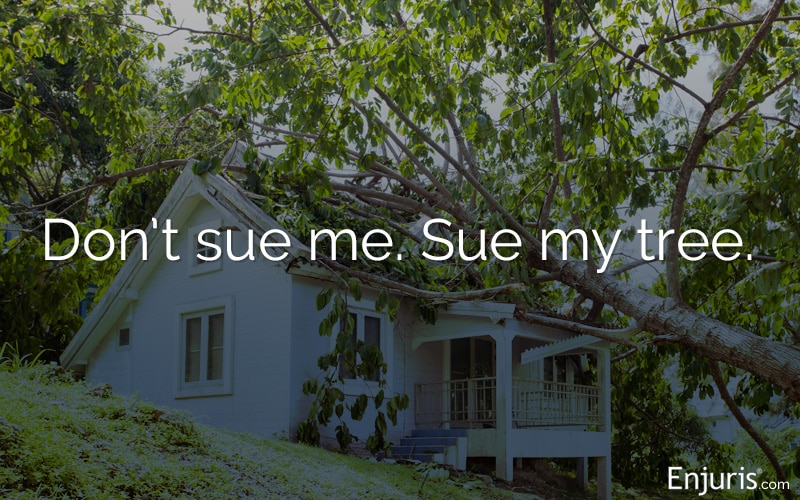
There are 228 billion trees in the United States, according to a study led by Crowther Thomas of Yale University. Although many of these trees have lived for hundreds or even thousands of years, high winds, heavy rains, and disease can force them to fall.

When a tree or a tree branch falls, homeowners are often left wondering who is at fault for any damage that results.

Who owns the tree?

Who’s responsible for the damage caused by a fallen tree largely depends on who owns the tree.

Generally speaking, if the trunk of the tree is on your property, then you own the tree—even if most of the tree’s canopy hangs over your neighbor’s property line.

On the other hand, if the trunk of the tree is on your neighbor’s property, then your neighbor owns the tree—even if most of the canopy hangs over your property line.

Often, trees are planted directly on the line between adjoining properties. These trees, appropriately called “boundary trees,” are typically the common property of both landowners.

Who is responsible for fallen tree damage?

Every state has a statute that governs liability regarding fallen trees.

In most states, the owner of the tree is NOT liable for damage caused by the fallen tree if the tree fell as a result of a so-called “act of God.” For example, if your healthy oak tree fell onto your neighbor’s garage due to a snowstorm or wind storm, you’re not liable for the damages.

On the other hand, if your actions or neglect contributed to the tree falling, then you’re probably responsible for the resulting damage. For example, if your tree fell onto your neighbor’s garage because you were trying to cut it down without professional help, you’re responsible for the damages.

Similarly, you have a duty to eliminate the reasonably foreseeable danger a tree may pose to your adjoining property. So, if your tree falls onto your neighbor’s garage because it was dying, unstable, or diseased, and you knew or should have known it was dying, unstable, or diseased, you’re responsible for the damages.

Courts will typically consider the following factors when trying to determine whether a tree poses a reasonably foreseeable danger to adjoining property:

  • Whether the tree was dead or visibly dying
  • Whether the tree leaned prominently toward the adjacent property
  • Whether limbs of the tree extended far across the property line
  • Whether limbs of the tree extended over where cars were parked or other structures existed

Will an insurance company cover the damage caused by a fallen tree?

When a tree falls onto your neighbor’s property through no fault of your own, your neighbor should submit a claim to their homeowner’s insurance company. Their insurance company will be responsible for taking care of the damages.

If a tree falls onto your neighbor’s property due to your negligence, your homeowner’s insurance company will cover the damages in most cases. As a result, you should file a claim or have your neighbor file a claim with your homeowner’s insurance company. Your insurance company will also defend you if your neighbor sues you as a result of the tree falling.

Remember that you may be personally liable for any damages that exceed your liability limits.

Will an insurance company replace the tree or cover the cost of removing the tree?

If a tree falls down and doesn’t cause any damage, homeowner’s insurance policies typically won’t cover the cost of removing or replacing the tree. There may be an exception if the tree creates an obstacle for drivers (for example, if the tree falls on the road or across a driveway).

The best way to avoid potential liability due to a tree falling is to have a professional arborist look at your trees periodically to see if any special treatment, pruning, or complete removal is necessary.

hurricane damage lawsuits

Can You File a Lawsuit To Recover Costs for Hurricane Damage?

A hurricane or other natural disaster can be life-changing and financially devastating. You can’t sue the weather… but are there legal ways to recover losses?

Learn more

Filed Under: Questions & Answers

Primary Sidebar

Grow your personal injury law firm. Attract & convert more clients.

Tired of expensive marketing
that doesn't deliver?

Partner with Enjuris and reach millions of accident victims actively seeking legal help.
Join Enjuris Partners

Enjuris Partners

  • AL - Nomberg Law Firm
  • CO - Babcock Tucker
  • FL - Lorenzo & Lorenzo
            Palmer | Lopez
  • GA - Gerber & Elkins Law
  • MT - Murphy Law Firm
  • SC - Chappell, Chappell & Newman
  • TX - Brown Trial Firm
            Neal Davis Law Firm

Blog categories

  • News Stories
  • My Accident Story
  • Resources You'll Love
  • Questions & Answers

In your state

AL AZ CA CO FL GA IN MT NC OH SC TN TX

Attorneys, write for Enjuris. Join our Contributor Program.

Start Writing

Footer Form

Need an attorney? Our Enjuris Partners are ready to help FIND OUT IF YOU HAVE A CASE
Start here

© 2026 Enjuris. All rights reserved.

X/Twitter Facebook LinkedIn YouTube Blog feed Instagram TikTok Reddit
Learn about

Car accident attorneys
Defective product attorneys
Personal injury attorneys
Medical malpractice attorneys
Wrongful death attorneys
Workers compensation attorneys
Birth injury attorneys

Personal injury lawyers: Partner with us Lawyer online marketing

System overview
Video
Powered by

SEO Advantage

3690 West Gandy Blvd., Suite 444
Tampa, FL 33611
Attorney SEO services


Enjuris is a platform dedicated to helping people who are dealing with life-altering accidents and injuries. We support students, families, caregivers and communities with resources, personal stories and a national directory of partner attorneys.

Copyright © 2026 Enjuris.com. All rights reserved. The accuracy, completeness, or currency of information on this site is not guaranteed. The information provided is not legal advice, does not constitute a lawyer referral service, and no attorney-client relationship is or will be formed by use of this site. For state-specific information, particularly regarding attorney advertising, refer to the Terms of Use. Your use of this website constitutes acceptance of the Terms of Use and Privacy Policy.

Press Enter to Search