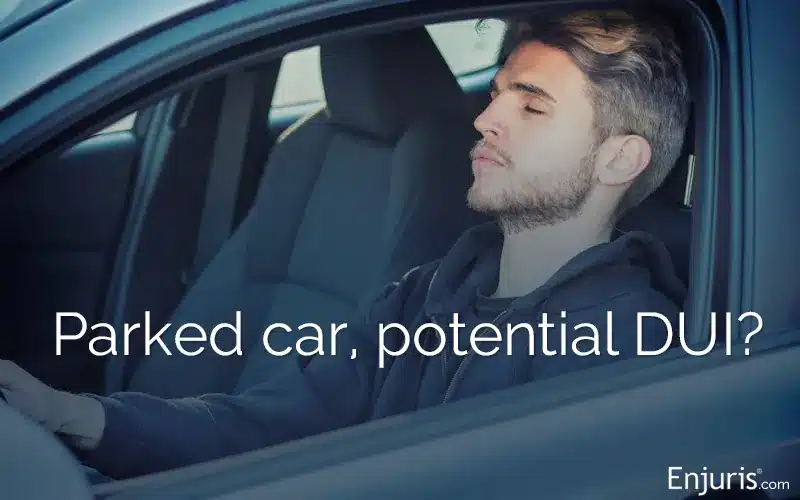
Picture this: You’re at a friend’s birthday bash and you’ve had a couple of drinks. Knowing it’s not safe to drive, you opt to snooze in your parked car until you’re sober.
Suddenly, a tap on your window jolts you awake—it’s a police officer and they want to know if you’ve been drinking.
Could this scenario end with a DUI charge? Let’s clear up the mystery.
What is a DUI?
Driving under the influence (DUI) refers to operating a motor vehicle while affected by alcohol or drugs (including marijuana and prescription medication).
Generally speaking, there are two types of DUIs:
- Per se DUI: You can be charged with a per se DUI if your blood-alcohol content (BAC) is over the legal limit. In most states, this means the following:
- A blood-alcohol content (BAC) of .08% or higher for adults (21 and over)
- A BAC of .04% or higher for commercial vehicle drivers
- A BAC of .02 or higher for minors (under 21)
- A THC concentration of 5 nanograms (ng) or more per milliliter of blood
- Impairment DUI: You can be charged with a DUI if you are “affected” by alcohol or drugs while operating a motor vehicle, even if you consumed less than the legal limit. This is called an impairment DUI. Evidence used to support an impairment DUI might include:
- Erratic driving
- Poor performance on a field sobriety test
- Slurred speech
- Odd behavior
- An admission of being impaired
Did you know that false positives on roadside sobriety tests can happen to 1 in 4 of drivers? Understand your rights during a field sobriety test.
Getting a DUI while sitting in a parked car
You might think, “If I’m not driving, I can’t get a DUI,” but the truth is a bit more complicated.
In most states, the law doesn’t just stop at driving under the influence; it also covers having control over a vehicle while impaired.
Take Arizona, for instance. In the Grand Canyon State state, the DUI statute clearly states that it’s unlawful for a person to drive or be in “actual physical control of a vehicle” while under the influence of drugs or alcohol. In other words, you can be charged with DUI in Arizona even if the car isn’t moving.
Meanwhile, some states, like Washington, have a separate charge for being in physical control of a vehicle while under the influence.
So, how does a police officer determine whether a person is in physical control of a vehicle? Let’s dive deeper.
Factors police consider for DUI in a parked vehicle
In most states, the issue of whether a driver has actual physical control of their vehicle is determined by assessing the “totality of the circumstances.” This means that deciding if a driver really has control over their vehicles involves looking at the whole situation, not just one or two details.
Here are some of the factors that might suggest actual physical control:
- Location of the keys: If the keys are in the ignition, it’s a strong indication that you have control over the vehicle, regardless of whether the engine is running.
- Driver’s seat position: Being in the driver’s seat, especially if you’re buckled up, points toward you having control.
- Vehicle’s condition: If the car is running, with headlines on or the radio playing, it suggests you were either driving or planning to drive.
- Engine temperature: A warm engine can indicate that the vehicle was recently driven or was about to be driven.
Now, let’s take a look at some factors that might indicate a lack of actual physical control:
- Location of the keys: If the keys are nowhere near the ignition—say, they’re in your pocket or on the passenger seat—it implies you weren’t about to start the car or had no intention of driving.
- Location of the driver: If you’re found sleeping in the back seat, it’s less likely that you’ll be considered in control of the vehicle.
- Vehicle’s condition: A car that’s turned off, with no lights on or radio on, especially if it’s parked safely, could indicate you had no intention of driving.
- Physical barriers: Objects or barriers placed between the driver and the driver’s seat, or any form of physical separation that would make it difficult to start driving immediately, can demonstrate a lack of intent or ability to control the vehicle.
According to the Centers for Disease Control and Prevention, about 1 million arrests are made in the United States each year for driving under the influence of alcohol or drugs.
Proactive strategies to avoid a DUI
Avoiding a DUI not only keeps you out of legal trouble, but ensures your safety and the safety of others on the road. While some tips like appointing a designated driver or calling an Uber are well-known, there are other less common yet effective strategies you can employ to prevent a DUI.
Understand your alcohol tolerance: Educate yourself on how your body processes alcohol. Factors like weight, age, gender, metabolism, and food intake can affect your blood alcohol concentration (BAC). Using a personal breathalyzer can provide a rough estimate, as can the chart below.
| The effects of blood alcohol concentration (BAC) | ||
|---|---|---|
| BAC | Typical effects | Predictable effects on driving |
| .02 | Some loss of judgment, relaxation, slight body warmth, altered mood | A decline in visual functions (rapid tracking of a moving target) and a decline in the ability to perform 2 tasks at the same time |
| .05 | Exaggerated movement, some loss of small-muscle control (e.g., focusing your eyes), impaired judgment, lowered alertness, the release of inhibition | Reduced coordination, reduced ability to track moving objects, difficulty steering, reduced response to emergency driving situation |
| .08 | Muscle coordination becomes poor (e.g., balance, speech, vision, reaction time, and hearing), harder to detect danger; judgment, self-control, reasoning, and memory are impaired | Concentration, short-term memory loss, speed control, reduced information processing capability (e.g., signal detection, visual search), impaired perception |
| .10 | Clear deterioration of reaction time and control, slurred speech, poor coordination, and slowed thinking | Reduced ability to maintain lane position and brake appropriately |
| .15 | Far less muscle control than normal, vomiting may occur (unless this level is reached slowly or a person has developed a tolerance for alcohol), major loss of balance | Substantial impairment in vehicle control, attention to driving task, and in necessary visual and auditory information processing |
| Source: National Highway Traffic Safety Administration | ||
Safe parking program: Some areas offer “safe parking” initiatives that allow you to leave your car overnight in a parking lot without the risk of being towed. Research if such programs exist in your area.
Wear a reminder: Some people may find it helpful to wear a specific item (like a bracelet or a watch) when they’re out drinking, which acts as a physical reminder not to drive. It’s a personal cue to stop and think before making the decision to get behind the wheel.
Plan your route and transportation: Before heading out, decide how you’re getting home. Pre-book a taxi or rideshare service.
Beware of “morning after” DUIs: Alcohol can stay in your system for several hours, and sometimes until the next day. If you’ve had a heavy night of drinking, consider alternative travel plans for the next morning.
If you find yourself in a scenario where you’re questioning whether to stay in your parked vehicle after drinking, remember that the best course of action is to avoid any gray areas. If you nevertheless find yourself facing a DUI charge, it’s important to seek legal counsel and support systems to help you navigate the challenge.

Legal Items That Can Complicate a Routine Traffic Stop
Learn five legal—but risky—items that can cause trouble during a traffic stop, and how to avoid unnecessary searches, citations, or arrests.