

Rideshare services are everywhere in Las Vegas—from the airport to the Strip to late nights out—so it is no surprise that Uber and Lyft crashes are common. These accidents may look like ordinary car wrecks, but the insurance behind them works very differently. That difference often determines how much an injured passenger, driver, or pedestrian can recover.
Here is what you need to know if you are injured in a rideshare accident in Nevada.
Nevada is an at-fault state
First and foremost, Nevada follows an at-fault system. This means that the driver who caused the crash is legally responsible for the resulting harm, although the driver’s liability insurer will typically pay covered damages up to the applicable policy limits. In a rideshare crash, the at-fault party might be the Uber or Lyft driver, another motorist, or, in some cases, more than one person.
Accordingly, determining who was at fault is the critical first step in identifying which insurance coverage applies.
The available insurance depends on what the driver was doing
This is the part that surprises many people. A rideshare driver’s available coverage changes depending on what the driver was doing at the time of the crash:
| Rideshare insurance coverage by driver status | |
|---|---|
| App off | The driver is generally treated like any other private motorist, and the driver’s personal auto policy applies. |
| App on and waiting for a ride request | Coverage of at least $50,000 per person and $100,000 per accident for bodily injury, along with $25,000 for property damage, applies. |
| Ride accepted or passenger in the vehicle | Nevada requires at least $1 million in third-party liability coverage. This period begins when the driver accepts a passenger’s request and continues until the last passenger fully exits the vehicle. Uber and Lyft may also provide uninsured or underinsured motorist coverage, depending on the applicable policy and circumstances. |
Nevada regulates transportation network companies under NRS Chapter 706A, while the specific insurance requirements appear in NRS 690B.470. For an injured passenger, the practical takeaway is reassuring: During an accepted ride or active trip, the $1 million liability policy is generally available.
That policy limit is not a guaranteed recovery, however. An injured person must still establish fault, document their injuries and damages, and comply with the policy’s terms.
Determining exactly which period applied—and therefore which policy may be responsible—is often the pivotal issue. This is why injured riders frequently consult a Las Vegas Uber accident lawyer to determine the driver’s app status and obtain relevant trip records.
Comparative fault in Nevada
Nevada uses modified comparative negligence with a 51 percent bar under NRS 41.141. You can still recover compensation if you were partly at fault, provided your share of the fault was not greater than the combined fault of the parties from whom you are seeking recovery. Your compensation is then reduced by your percentage of fault.
Passengers are rarely at fault. In multi-vehicle rideshare crashes, however, insurers often dispute how fault should be divided among the drivers. Carefully documenting the crash can therefore be important.
Example: how modified comparative fault works
Suppose Luis, an Uber driver, changes lanes without checking his blind spot and strikes a car driven by Dana. Dana was speeding at the time, which contributed to the collision. A third driver, Chris, was following Dana too closely and rear-ends her car immediately after the first impact.
Dana is injured and suffers $100,000 in damages. A jury assigns fault as follows:
- Luis: 50 percent at fault for making an unsafe lane change.
- Chris: 30 percent at fault for following too closely.
- Dana: 20 percent at fault for speeding.
Dana can still recover compensation because her 20 percent share of fault is less than the combined 80 percent assigned to Luis and Chris. However, her $100,000 award would be reduced by her 20 percent share of fault, leaving her with $80,000.
The deadline is generally two years
Nevada generally gives injury victims two years to file a lawsuit under NRS 11.190. Rideshare cases can involve several insurers and more paperwork than a standard car-accident claim, so the two-year period can pass faster than expected.
Missing the applicable deadline will usually prevent the injured person from pursuing compensation through a lawsuit.
Why rideshare claims get complicated
Even when coverage exists, rideshare cases have moving parts that ordinary car-accident claims do not:
- Multiple insurers: The rideshare company’s insurer, the driver’s personal insurer, and another driver’s insurer may each attempt to shift responsibility to someone else.
- Disputes over the applicable period: Insurers may argue that the driver had not yet accepted a ride or had already completed the trip, potentially shifting the claim to a policy with lower limits.
- Trip data: The app’s records showing when a ride was accepted, started, and completed can be critical evidence. Those records are generally controlled by the rideshare company.
- Corporate defense: Like other large companies and insurers, rideshare companies have teams focused on investigating claims and limiting payouts.
Practical steps after a rideshare crash
- Report the accident and ask law enforcement to create a crash report.
- Screenshot the trip information in the app, including the driver’s name, trip status, route, and receipt.
- Seek medical care promptly. Insurers may use delays in treatment to question whether an injury was caused by the crash.
- Photograph the scene, the vehicles, and any visible injuries. Obtain contact information from witnesses.
- Report the crash in the app, but be cautious about providing a recorded statement to an insurer before obtaining advice.
- Do not accept a quick settlement before you understand the full extent of your injuries and losses.
A Las Vegas rideshare crash is not simply a fender-bender with an app attached. The coverage that applies depends heavily on what the driver was doing at the moment of impact. Knowing that a $1 million policy may apply after a ride has been accepted, that Nevada generally imposes a two-year filing deadline, and that trip data can be critical evidence puts an injured person in a stronger position to protect their claim.
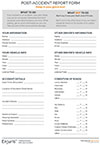 Accident Report Form
Sample post-accident report form to keep in your glove box - fill out at the scene or as soon as you can after a car accident
Download in PDF format