

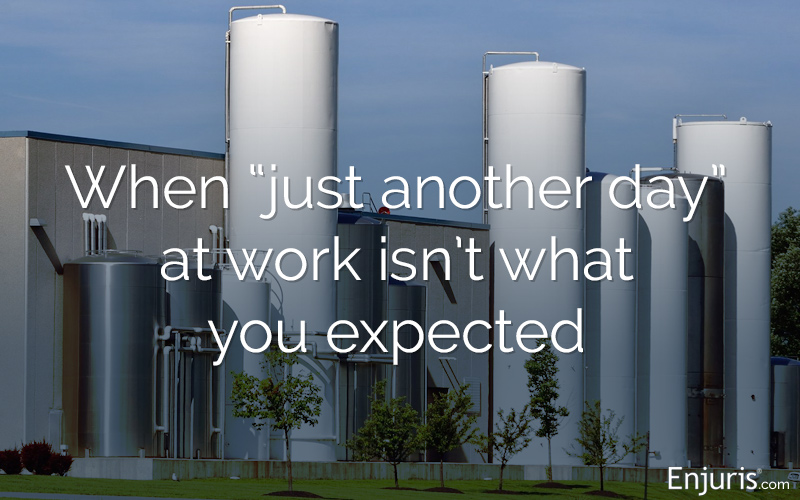
On January 28, 2021, a liquid nitrogen leak occurred at a Gainesville, Georgia poultry plant.
Liquid nitrogen is a hazardous material that can cause serious injuries or death to people who are exposed. In the Gainesville incident, 6 workers were killed and several were taken to hospitals for treatment and subsequently released. The individuals who were killed included maintenance, supervisory, and management-level employees. A 3-year-old child lost both parents in the accident.
What happened?
Often in industrial accidents such as this, there’s an explosion caused by a nitrogen leak but thankfully that didn’t happen this time. Early reports indicate that a nitrogen line ruptured. However, officials are continuing to investigate and it could be some time before we know for sure what caused the leak.
One employee who escaped injury described the “chaos” as the event unfolded. He said that his workspace suddenly became dense with “fog” and made it hard to see their way out. Of the 6 people killed, 5 died on-site at the plant and 1 died later in the hospital. Eleven additional people were injured.
Why is liquid nitrogen dangerous?
What makes liquid nitrogen so dangerous is that it’s colorless, odorless, and extremely cold. It can cause serious injury or death with little to no warning. There are 2 primary ways liquid nitrogen causes injury:
- You can be seriously injured by coming into contact with the gas as it causes severe tissue damage and cold burns.
- Inhalation can result in dizziness, nausea, vomiting, loss of consciousness, or death.
In Gainesville, liquid nitrogen was being used to refrigerate poultry at the Foundation Food Group plant. It’s been reported that the Occupational Safety and Health Administration (OSHA) found several violations at the plant over the past several years.
Workers’ compensation for an industrial accident
In the case of the recent Gainesville plant accident, the injured workers should qualify for workers’ compensation benefits. Likewise, the families of the 6 individuals killed should receive death benefits for the loss of their loved ones. It’s not yet known whether additional legal action may be taken against the employer for gross negligence.
But there’s a major benefit to workers’ compensation:
You don’t have to prove negligence.
This distinction is important because if you were injured in a work-related accident, you can begin to receive your benefits as soon as you can prove that:
- The injury happened while you were doing work-related tasks; and
- The injury required medical treatment.
If you needed to prove negligence (as in the case of a wrongful death or personal injury lawsuit), there would likely be a lengthy period of investigation and you might never be able to prove negligence in some situations, which would mean not receiving any benefits.
Workers’ compensation provides for a quick benefits claims process so you can start to receive your payments right away and avoid debt or paying out-of-pocket for medical treatment, lost wages, and other related expenses.
Georgia 30-day rule
If you suffer a workplace injury, you must report it to your supervisor or manager within 30 days. If you fail to report the injury to your employer in that period, you won’t be able to recover workers’ compensation benefits.
Workers’ compensation death benefits in Georgia
Although the basics of how workers’ compensation works apply nationwide, each state varies with respect to the specific benefits available.
In the tragedy at the poultry plant, the families of the deceased employees could be eligible to receive workers’ compensation death benefits.
In Georgia, a spouse or children of a deceased employee can often receive workers’ compensation death benefits up to two-thirds of the employee’s weekly salary and up to $7,500 for funeral expenses to the family of the deceased.
Georgia workers’ compensation benefits for an injured employee
If you were injured in a workplace accident, you can receive benefits that include:
Medical treatment
Workers’ compensation insurance should cover all of your expenses related to medical treatment, whether that’s surgeries, hospital stays, doctor visits, prescription medications, prosthetic devices, ongoing therapies, or other kinds of treatments.
Mileage reimbursement
If you need to travel for medical care, workers’ compensation benefits should cover the costs of mileage or transportation for that purpose.
Vocational rehabilitation
If your injuries leave you unable to return to your current job or similar job, workers’ compensation typically provides for retraining so that you can seek employment in a position that you’re able to do in your current condition.
When can you file a lawsuit for a workplace injury?
Workers’ compensation was designed to protect workers, and also to protect employers.
The workers are protected because they receive benefits without needing to prove fault. The employer is protected because if an employee collects workers’ compensation benefits, they can’t then sue the employer for the injury. That saves the employer from the time, expense, and bad publicity involved in a lawsuit.
But, there are some things workers’ compensation doesn’t cover.
For instance, you receive a portion of your salary but not an entire replacement. You also can’t claim non-economic damages like pain and suffering or other emotional distress, loss of consortium, or punitive damages.
If your injury was caused by a third party’s negligence, you might be able to file a personal injury lawsuit against that third party. For instance, if your injury is the result of an equipment failure, a hazardous condition on a worksite not controlled by your employer (in other words, if your employer is a contractor on a construction site owned by another company), or due to the negligence of a person who has a different employer, you could have standing for a lawsuit.
Unfortunately, no amount of benefits or compensation can bring back a loved one lost in an accident— nor can it restore your physical condition if you were seriously injured. But it can provide assistance to the family members left behind, and it can give them a measure of financial security.
At the very least, you (and your family) deserve that.
If you’ve been injured in any workplace accident, contact an experienced work injury lawyer near you to figure out how best to make your claim, determine if your settlement is the appropriate amount to cover your costs, and see if there are other options for financial recovery.

If you or a loved one have been seriously injured on the job, or suffered an occupational injury, you should know that you have legal rights under the Georgia workers’ compensation law. At Gerber & Elkins Law, our Atlanta attorneys can tell you what those rights are and we’ll fight aggressively on your behalf to negotiate a fair settlement—and even take your case to the highest court in the land if necessary. We see every client as an individual with a unique story and important concerns. Our law firm has served our clients faithfully in every case. By doing so, we have been able to build a history of success stories by securing large workers’ compensation settlements and payouts. Most importantly, we’ve been able to change the lives of our clients, helping them recover physically, emotionally and financially. View our profile and visit our website today.