
Overtime, by definition, is time you work that’s outside your normal scheduled hours, if those hours bring your weekly total to more than 40 hours of work performed.
Many companies pay hourly employees a higher rate for overtime than their normal wage.
For example, say you make $15 per hour for your regular hours. If your employer’s overtime rate is “time and a half” (1.5), you’d be paid $22.50 per hour for additional hours.
Federal law says that overtime applies after the employee has worked 40 hours in a week. If the employee works 5 days at 8 hours per day, any additional time would trigger overtime pay because they’re over 40 hours.
Arizona follows the Fair Labor Standards Act (FLSA), which means a non-exempt employee must be paid 1.5 times their regular rate for any time worked above 40 hours in a week.
- Exempt: A salaried employee who earns more than $47,476 per year and performs duties based on being highly skilled and formally trained (usually in an office setting).
- Non-exempt: Employee is paid an hourly rate, and duties can be whatever is required by the specific job.
Arizona overtime law basics
Each state has its own laws for how overtime must be paid. Because Arizona follows the FLSA overtime regulations, these are the relevant provisions:
- The overtime pay rate is 5 times the employee’s regular wage.
- An employer is allowed to require overtime work.
- Comp time (that is, hours off in exchange for extra hours worked) is only allowed for government employees.
- An employer isn’t required to pay overtime wages for working nights, weekends, or holidays, as long as the employee is within 40 hours for the week.
- Overtime is calculated weekly, not daily. An employee may work four 10-hour days to reach 40 hours a week, and that doesn’t qualify for overtime. Even though they worked more than 8 hours in a day, they’re still within the 40-hour maximum.
How is workers’ compensation applied to overtime?
Even though overtime is technically outside your normal work hours, many people rely on overtime wages to supplement their income.
That’s where things can get tricky.
When you’re injured at work, workers’ compensation entitles you to benefits for:
- Medical treatment
- Mileage reimbursement (for medical treatment that you can’t get in your local area)
- Income replacement benefits for lost work time
- Temporary partial disability benefits
- Temporary total disability benefits
- Permanent partial disability benefits
Temporary disability benefits (either partial or total) are intended to cover your wages if you need to return to work in a limited role (meaning you can’t perform the tasks associated with the job you did before you were injured) or you’re no longer able to work at all for a specified period of time while you recover.
In both of those situations, your benefits are calculated based on the average weekly wage you earned before the disability, up to a state-mandated maximum. Therefore, your claim must include pay stubs from 12 months of pay periods in order to average how much you actually earned, which includes overtime.
The calculation of your average weekly wage will include:
- Regular wages
- Vacation pay
- Overtime
- Holiday pay
- Bonuses and incentives
Can I obtain income replacement benefits for anticipated overtime?
Wage and overtime disputes can be complicated.
For obvious reasons, your employer’s workers’ compensation insurance company will want to pay you exactly the amount you’d earn for your scheduled hours during the time you take off to recover from an injury, and not a penny more.
But this gets difficult when you regularly take additional shifts or hours. Consider this:
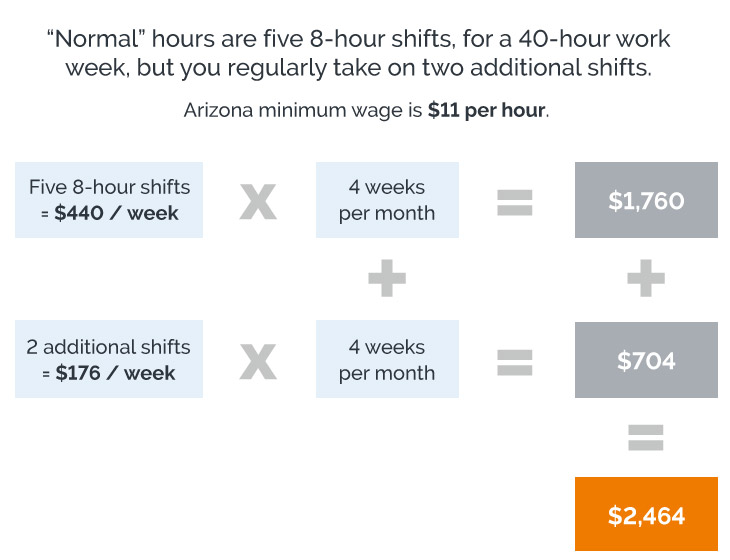
Those two additional shifts you pick up each week can make a big difference in your monthly income — it helps pay for a car payment, bills, kids’ activities, or anything else you need.
So, if you need to take even a few weeks off from work because of an injury, it adds up fast if you’re only receiving replacement income for your normal 40-hour week.
When you file your claim for workers’ compensation benefits, be sure to include any hours that you regularly work over 40 hours per week. If your employer schedules hours ahead of time, you can ask for the records that show what you’re scheduled for upcoming so that the insurance company can determine exactly how much work you’re going to miss.
Workers’ compensation benefits don’t cover the first 7 days of lost wages unless the injury causes you to miss more than 14 days of work.
Temporary partial disability and overtime
Some employers don’t allow overtime for employees who are receiving workers’ compensation or who are recovering from an injury.
That means even if you can be restored to your previous job, but you can’t work more than 40 hours (which you were doing before your injury), you should be entitled to temporary partial disability benefits. That would allow you to receive two-thirds of the wages you’re losing by not performing any overtime.
In other words, if you can be restored to your previous job (from before the injury) at the same rate of pay, but you can’t work overtime, you can apply for workers’ compensation benefits based on temporary partial disability for the amount you’d lose by not working overtime.
What if workers’ compensation doesn’t cover overtime hours?
The workers’ compensation system exists for 2 reasons:
- To ensure that every employee is able to receive compensation to cover medical treatment and living expenses while recovering from a work-related illness or injury.
- To allow every employer the opportunity to settle work-related injury claims in a way that protects them from lawsuits.
There are 3 players in this arrangement: the employee, the employer, and the employer’s insurance company.
Once a claim is filed, you’ll work directly with your employer’s insurance company to settle on an agreeable amount for benefits.
But what if the offer isn’t enough? What if the insurance company doesn’t agree to cover all of your costs… or all of your wages, including overtime?
Contact a workers’ compensation lawyer immediately.
That’s the simple answer.
If you were injured in Arizona, our team can handle the complicated parts. We’ve been handling workers’ compensation claims on behalf of injured employees for more than 40 years. We know the nuances of the law, how to work with insurance companies, and when to get the courts involved.