
Hablamos español.

Your baby’s birth injury could leave them with a lifetime of needs, but if you’re not a medical expert, it will be hard for you to make a case on your own
Being a first-time parent (or a parent of any newborn, even if it’s not your first) comes with joy and often more than a little nervousness. All a parent wants is to give their child the best and healthiest start in life, even before we know who they are or who they’ll grow to become.
That’s why a birth injury can be devastating. It can prevent a parent from ever knowing their child’s full potential because a birth injury can result in permanent, life-long disability or damage.
What if it didn’t have to happen?
That’s going to be every parent’s question as they figure out the next steps and options for their newborn. A condition that’s beyond our control is sometimes easier to accept than considering that a doctor or hospital might have been negligent in causing a baby’s injury.
If the doctor or hospital was negligent — at fault — for your baby’s injury, then you can file a lawsuit for medical malpractice. At the crux of any personal injury lawsuit is the plaintiff (the injured person or their representative) being able to prove that the defendant acted negligently. There are specific standards for medical malpractice, and they might vary depending on where you live and the type of hospital or birthing center.
A birth injury is a preventable condition that results from something that happened during the process of delivering the baby.
This is different from a birth defect, which is a problem that is the result of your child’s DNA. For example, Down’s Syndrome, cleft palates, heart murmurs, a club foot, or other issues can arise because of your child’s genetics. These are not preventable, not the fault of the pregnant person, and not medical malpractice. A doctor might fail to detect certain defects, but the defect is not caused by the doctor’s action or inaction.
What is medical malpractice?
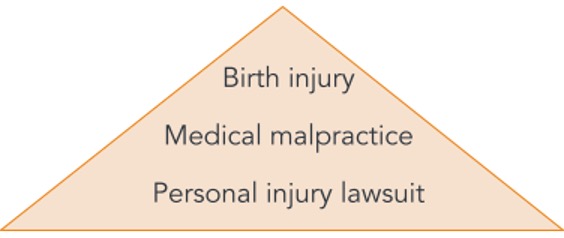
A medical malpractice lawsuit is part of the personal injury area of law. A birth injury is part of medical malpractice.
The plaintiff must prove that the defendant was negligent in order to successfully claim damages in a lawsuit. Damages are the financial costs associated with the injury.
How to prove medical negligence in a birth injury case
These are the elements of negligence:
- The defendant had a duty to either act or not act in a specific way,
- The defendant breached their duty,
- Breach of that duty was the cause of the plaintiff’s injury, and
- The injury resulted in actual damages (cost of medical treatment, lost wages, pain and suffering, etc.).
Elements of medical malpractice:
- Negligent violation of the standard of care. The medical profession has certain standards that are recognized and accepted as reasonable, according to health care professionals under similar circumstances. A physician or medical provider is required to administer care according to the standards that would be reasonable according to their training, specialty, and community. In short, did the physician act as an equally trained doctor would have in a similar circumstance?
- The negligence caused an injury. Violating a standard of care, alone, is not malpractice. In any personal injury claim — medical malpractice included — there must be an actual injury that was caused by the person’s negligence. You need to prove that the negligence was the actual cause of your injury or condition.
There cannot be a claim for medical malpractice if:
- there’s an injury but no negligence, or
- there’s negligence but no injury.
- There are significant damages from the injury. A medical malpractice claim can be extremely expensive because it often requires testimony from medical experts, and there could be an extensive discovery process.
Examples of medical malpractice
In general, these are some common types of medical malpractice errors:
- Failure to diagnose
- Misdiagnosis
- Failure to recognize symptoms
- Failure to order correct testing
- Misreading or ignoring test results
- Disregarding or not taking appropriate patient history
- Unnecessary surgery or other invasive procedure
- Surgical errors
- Incorrect medication or dosage
- Premature discharge
- Poor follow-up care
However, when it comes to birth injuries, these specific examples are common:
- Pulling or twisting the infant during delivery
- Miscalculating the size of the fetus
- Premature or post-mature delivery because of improper dating
- Rh incompatibility
- Failure to provide oxygen to a newborn if needed
- Deliveries using forceps or vacuum extraction
- Failure to perform an emergency cesarean (C) section
- Failure to detect or monitor distress or fetal heartbeat
- Incorrect medication or dosage to the mother during pregnancy or labor
How medical malpractice can cause a birth injury
A baby could experience fetal distress or trauma during the labor and delivery process.
A fetus is in distress when they are not tolerating labor, and this is usually evident by electronic fetal heart monitoring. A baby in fetal distress sometimes needs to be delivered immediately, which means an emergency C-section is better than waiting for labor to take its course.
Fetal distress can be caused by a placenta that’s not functioning normally or when the umbilical cord is wrapped around the baby’s neck, or for other reasons like too frequent or strong contractions. Fetal distress often results in low oxygen to the fetus that, over time, could cause brain damage. Cerebral palsy is a result of brain damage from lack of oxygen.
The human body is miraculous… both babies and pregnant people’s bodies are meant to withstand the natural force of labor. But there are situations when the baby can’t pass through the pelvic bones, often because the newborn is too large for the opening. Contractions that force the head against the hard pelvis could cause significant trauma and brain damage.
Some doctors will use forceps to grasp the baby’s head and attempt to pull the baby out or reposition them in order to make a vaginal delivery possible. However, forceps can cause skull fractures or brain injuries like a hematoma.
A vacuum extractor is also used to facilitate vaginal delivery. It’s a rubber cup that’s inserted onto the baby’s head, tightened, and then used to “suck” out the baby. Similar to forceps, a vacuum extractor can cause a hemorrhage between the skull and scalp or other brain injuries.
In situations like this, the doctor didn’t cause the trauma or distress. The doctor has no control over the mother’s pelvic size, the baby’s size, or other conditions that might occur. But it is the doctor’s job to detect distress or trauma and prevent it before it causes damage.
Proving negligence for a birth injury
As with other medical malpractice claims, you’ll need to prove 3 things in a birth injury lawsuit:
- The medical provider failed to act in accordance with the applicable standard of health care practice,
- The provider didn’t use their best judgment in determining treatment or care,
- The provider’s failure caused injury to the patient (either the pregnant person or the baby).
Gathering evidence to prove a birth injury
A medical malpractice or birth injury case isn’t something you should handle on your own. It’s complex and will require a variety of medical and financial experts. A lawyer who specializes in birth injury can help you navigate the legal complexities and ensure you have the best chance of success.
Your lawyer will begin by obtaining this evidence:
- Medical records. Your medical history will be important. Any documents of your treatment during pregnancy and delivery, along with records of the baby’s birth and subsequent care will be relevant to determining if there was malpractice and to what extent.
- Employment records. Your lawyer will request information on each medical professional named in the lawsuit (doctors, nurses, other hospital staff), including whether there were previous complaints.
- Eyewitness testimony. Any person who assisted in the delivery room could have valuable information that can provide insight into what happened and how.
- Expert testimony. Your lawyer will rely on other obstetricians, nurses, pediatricians, financial experts, actuaries, and others to determine the major issues in the case: (1) whether malpractice took place, and (2) how much compensation you’re owed.
Are there defenses to medical malpractice?
A defendant will often try to demonstrate to the court that the plaintiff was contributorily negligent, or that their own actions played a role in causing their injury.
In a medical malpractice case, the doctor might say that the patient declined to consent to a necessary and recommended medical procedure. For instance, let’s say you are in labor and your baby begins to experience fetal distress. The doctor might say it’s necessary to have an emergency C-section to deliver the baby immediately. If you decline or don’t consent to the surgical procedure after the doctor has said it’s necessary, you likely can’t make a case for malpractice if your child is injured as a result.
Another example is if the patient doesn’t provide the doctor with their complete medical history. For instance, having prior C-sections or a previous termination of pregnancy can affect the strength of a pregnant person’s uterus. It could raise the risk of certain outcomes during labor, like a uterine rupture. Particularly if your delivery is being performed by a doctor who hasn’t followed your entire pregnancy, you need to tell your doctor your full medical history so that they can make the best decisions for your care and treatment.
Why consult with a birth injury lawyer?
A birth injury malpractice case is going to be complex by nature — the process of pregnancy, labor and delivery is unique to each person (and each pregnancy). Often, if you ask multiple doctors what to do in a particular situation, you will get as many answers.
But that doesn’t mean you shouldn’t try.
After all, if your baby has suffered an injury, you want and need to make sure that you have the financial resources to cover the costs of their medical treatment now and in the future — possibly for their lifetime. Birth injury lawsuits often result in high verdicts or settlement amounts because a lifetime of care for a disabled person is extremely expensive.
It’s important to find a birth injury lawyer who is experienced, has access to experts and understands the nuances of medical malpractice laws in your state.
See our guide Choosing a personal injury attorney.