A hit-and-run is a criminal offense in Alaska
A “hit-and-run” is a car accident in which one of the drivers flees the scene of the accident (whether the accident is with a pedestrian, another car, or a fixed object) without stopping to provide their information and assist the other people involved in the crash.
Hit-and-run accidents are particularly frustrating because the innocent party may be left without someone to sue.
Fortunately, victims of hit-and-run crashes in Alaska have some legal options to recover damages, even if the at-fault driver is never found.
Hit-and-run statistics
According to the most recent data from the National Highway Traffic Safety Administration (NHTSA), hit-and-run deaths in the United States have grown steadily over the last 15 years. What’s more, hit-and-run crashes involving bicyclists and pedestrians are on the rise. In 2006, 61.1 percent of hit-and-run deaths were either pedestrians or cyclists. In 2020, that number increased to 69.6 percent.
| Hit-and-run fatalities in the United States | ||
|---|---|---|
| Type of fatality | 2019 | 2020 |
| Pedestrian | 1,241 | 1,582 |
| Bicyclist | 169 | 202 |
| Total | 2,037 | 2,564 |
Hit-and-run statistics in Alaska are only available up to 2016. Nevertheless, you can see from the data that fatal hit-and-run crashes are relatively infrequent in Alaska compared to other states.
| Hit-and-run fatalities in Alaska | ||||||||||
|---|---|---|---|---|---|---|---|---|---|---|
| 2006 | 2007 | 2008 | 2009 | 2010 | 2011 | 2012 | 2013 | 2014 | 2015 | 2016 |
| 4 | 5 | 2 | 1 | 1 | 3 | 0 | 1 | 5 | 3 | 4 |
| Source: AAA Foundation | ||||||||||
Alaska’s hit-and-run laws
Alaska’s hit-and-run statute can be found in Alaska Statutes 28.35.050. To be convicted under the statute, the state must prove beyond a reasonable doubt each of the following elements:
- The defendant was involved in an accident while driving a vehicle;
- The accident resulted in injury, death, or property damage;
- The defendant knew they were involved in an accident; and
- The defendant did not immediately stop at the scene of the accident and (a) provide the other parties with their name and address, the name of the insurance carrier covering the vehicle, the insurance policy number, and the phone number of the insurance carrier, (b) render reasonable assistance to any injured parties.
If you discover only after leaving the scene of the collision that you may have been involved in a collision that resulted in injury or death to another person, you must immediately make a good-faith effort to comply with the 3 steps listed above. What’s more, you must immediately contact 9-1-1 to report the accident.
But what happens if you hit an unoccupied vehicle?
If you collide with an unoccupied vehicle, you must:
- Stop your vehicle at the scene of the accident, and
- Locate the owner of the property or leave a written note providing your name and contact information.
Do I need to take any steps if I hit an animal?
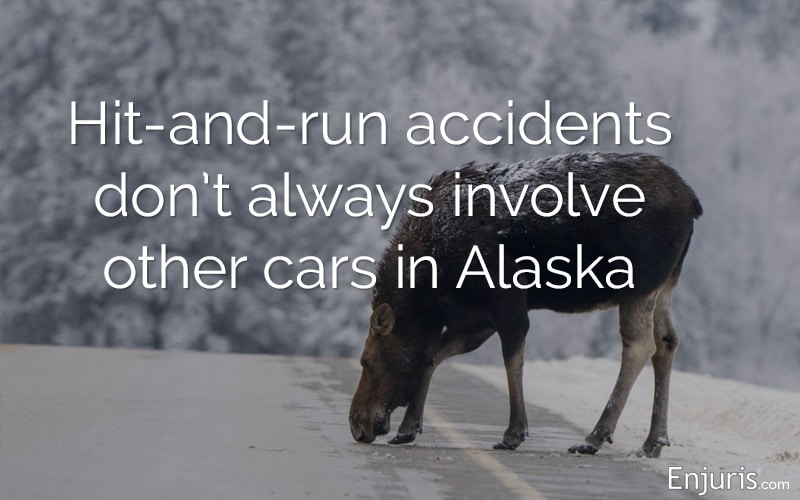
It’s not unusual to encounter an animal when driving in Alaska. Every year, between 600 and 800 moose are killed by drivers in Alaska.
If you hit an animal, you have a legal obligation to contact the nearest police station and report the accident.
The police station will send an officer to secure the area and conduct an investigation. In the meantime, you should turn on your hazards and, if possible, put out a flare or some sort of marker to warn other drivers.
What are the penalties for a hit-and-run?
The penalties for a hit-and-run depend on the nature of the damage caused. At the very least, a hit-and-run driver will have to pay a fine.
| Alaska hit-and-run penalties | ||
|---|---|---|
| Type of accident | Category | Penalty |
| Property damage only | Misdemeanor | A fine of up to $500 and/or up to 1 year in prison |
| Injury or death | Felony | A fine of up to $150,000 and/or up to 10 years in prison |
Anthony Norman Burke was driving his pickup on 98th Avenue in Fort St. John when he collided with Samantha Hunter and Jared Tompkins, who had been crossing the street from their hotel parking lot.
Anthony, who did not see the pedestrians due to the glare of the sun, got out of his vehicle immediately after the crash. Upon realizing that Samantha and Jared were dead, Anthony got back in his truck and drove away.
The accident was captured on dashcam video from a vehicle parked near the scene and broadcast on the news. Anthony turned himself into the police several hours later.
Anthony’s defense lawyer described the circumstances as tragic but pointed out that the accident was deemed unavoidable by accident reconstruction experts.
The prosecutor and defense attorney recommended an intermittent sentence of 90 days in jail and a fine.
How do I recover damages after a hit-and-run?
Most studies estimate that only 10 percent of hit-and-run cases are solved.
If you’re one of the lucky few whose hit-and-run driver is found, you can file an insurance claim with the at-fault driver’s insurance company or file a personal injury lawsuit against the at-fault driver to recover damages.
If the police are unable to locate the driver, your own car insurance may be able to provide you with relief.
In Alaska, the following types of optional coverage typically provide some relief in the event of a hit-and-run accident:
- Collision coverage provides coverage for damage to your vehicle caused by an accident with another vehicle or an object, regardless of who is at fault for the accident.
- Personal injury protection (PIP) provides up to $10,000 coverage regardless of who’s at fault (what’s covered depends on the specific policy)
- MedPay provides coverage for medical expenses incurred by you and your passengers, regardless of who is at fault for the accident.
- Uninsured motorist (UM) coverage provides coverage for bodily injury and property damage sustained by you or the passengers in your vehicle as a result of an accident involving an uninsured driver or an accident involving a hit-and-run driver.
Four steps to take if you’re the victim of a hit-and-run
If you’re involved in a hit-and-run accident, your first reaction may be to chase after the fleeing driver. This is always a bad idea. Chasing a fleeing driver puts you and everyone else on the road in danger.
Instead, follow these steps:
- Move your vehicle. Move your vehicle to a safe spot off the road if possible.
- Call the police. Call the police and report the accident. Be sure to provide them with any information you have about the hit-and-run vehicle (the direction the car was traveling, make, model, color, license plate, distinguishing features, physical description of the driver, etc.).
- Take photographs and talk to witnesses. Be sure to take photographs of the accident scene as well as any damage to your vehicle. Additionally, it’s a good idea to collect the contact information of any witnesses.
- Contact your insurance company. Contact your insurance company to see if your policy covers hit-and-run accidents. Keep in mind that most insurance companies require you to notify them within a certain time period following a crash to receive coverage.
Still have questions about your car accident? Our Guide to Alaska Car Accidents may help.
See our guide Choosing a personal injury attorney.