
Learn the legal options that exist for the family members who lost a loved one in a car accident
One of the first questions people ask when they lose a loved one in a tragic car accident is:
How could this happen?
If the answer to this question is negligence or some other wrongful act by another driver, the concept of wrongful death comes into play.
In this article, we’ll take a look at fatal car accidents and wrongful death claims in Texas.
Fatal car accident statistics
According to the Texas Department of Transportation, the fatality rate on Texas roads in 2017 (the most recent year for which data is available) was 1.36 deaths per 100 million vehicle miles traveled.
While this may not sound like a lot, it amounts to 1 person killed every 2 hours and 21 minutes.
In fact, few states have more fatal crashes than Texas. Here are some other interesting (and alarming) deadly car accident statistics:
- There were no deathless days on Texas roads in 2017
- 40.1% of people killed in car crashes weren’t wearing their seatbelts at the time of the accident
- 28% of people killed in car crashes were involved in accidents where a driver was under the influence of alcohol
- 761 people were killed in car crashes occurring at intersections
- 449 people were killed in crashes involving distracted driving
Causes of fatal car accidents
While the number of car crashes has steadily increased in recent years, the percentage of deadly accidents has actually decreased slightly. This decline is primarily attributed to new and improved car safety technology, including airbag placement, frame construction, crumple zones, and other features.
However, fatal car accidents continue to be a common occurrence, and the downward trend means little to the family of someone who has been killed in a car crash.
The most common causes for fatal car accidents in Texas include:
- Drunk driving
- Reckless driving
- Road defects
- Distracted driving
- Vehicle defects
- Bad weather conditions
What exactly is a wrongful death case?
When a person is injured as a result of another person’s negligence or wrongful act, the injured person has the option of filing a personal injury lawsuit to recover damages.
But what happens when the person is killed as a result of a negligent or wrongful act?
This is where a wrongful death claim comes into play. In Texas, certain family members can essentially step into the shoes of the deceased and sue the responsible party for damages.
What’s the difference between criminal liability and a civil wrongful death lawsuit?
Wrongful death could take many forms. It can be from a car accident, medical malpractice, or any other incident where a person’s negligence caused a victim’s death. A wrongful death claim follows the same legal framework as a personal injury claim, except that rather than being injured, the victim has died.
Sometimes, the deceased person is the victim of a criminal act, like assault or homicide. There are also criminal charges associated with some car accidents, particularly if the defendant was speeding, drunk driving, or otherwise negligent.
But criminal liability for a car accident is different from a civil wrongful death lawsuit, particularly for the victim’s survivors.
If a driver who causes an accident is alleged to have committed a crime, they can be charged by a government agency (i.e. a state or local prosecutor). They are entitled to a trial and are either acquitted or convicted. If the defendant is convicted, they can be sentenced to jail time, fines, license suspension, or other penalties.
The deceased person’s personal representative might be a witness in the criminal trial, but they otherwise do not have a role in that proceeding.
One way of thinking about it is—criminal charges involve a restraint on liberty, whereas civil involves money or property. It is not unusual for there to be parallel proceedings. For example, a defendant is charged with the crime of intoxication manslaughter, and the decedent’s family has also filed a civil suit against that defendant.
A criminal conviction does not compensate the injured person’s family financially.
If the deceased person’s family wishes to pursue financial compensation for their losses, they may file a civil wrongful death lawsuit. The outcome of the criminal and civil proceedings could be different. The civil personal injury lawsuit would require the deceased person’s representative to prove by a preponderance of the evidence that the defendant’s negligence caused the victim’s death. There could be elements of the criminal case that become evidence in a civil trial, but it does not hinge on their criminal conviction. Likewise, a defendant might be found liable in a civil wrongful death lawsuit even after they are acquitted of a crime.
In a criminal case, the burden of proof is much higher. The State must prove the case beyond a reasonable doubt to ALL jurors. If the State fails, the defendant cannot be convicted. That means theoretically a defendant COULD win a criminal case yet still be held liable civilly because of the lower burden of proof.
Who can file a wrongful death claim in Texas?
Under the Texas wrongful death statute, the only people who are legally allowed to file a wrongful death action are the:
- Surviving spouse of the deceased
- Children of the deceased (including legally adopted children)
- Parents of the deceased (including adoptive parents)
Siblings and grandparents of the deceased are not allowed to file a wrongful death claim in Texas. Any eligible family members may file cases individually or jointly.
If none of the individuals entitled to bring a wrongful death action have begun the action within 3 months after the death, the deceased’s executor (the person appointed to carry out the terms of the deceased’s will) may file and prosecute the action unless the people allowed to file a wrongful death action all request that the executor not file a claim.
What must be proven?
When a surviving family member files a wrongful death claim, they essentially step into the shoes of the deceased. As a result, the family member must prove liability the same way the deceased would’ve had to if they had survived the accident.
For example, if the deceased was killed as a result of a person running a red light, the surviving family members would have to prove the elements of negligence (i.e., the defendant owed the deceased a duty, the defendant breached the duty by running a red light, the breach caused damage to the deceased).
What damages can be recovered under a wrongful death claim?
While no amount of money will ever replace the loss experienced in the wake of a fatal car accident, filing a wrongful death claim can ensure that you and your family are financially cared for so that you can focus on grieving and healing.
In Texas, wrongful death damages aim to compensate the victim’s family for costs arising due to the person’s death and for the loss of financial support they would have had if their loved one were still alive.
If negligence is proven, grieving individuals and families may seek compensation for the following damages in a fatal car accident case:
- Funeral/burial expenses
- Medical costs for past treatment
- Loss of future projected income and earnings
- Loss of companionship/consortium (spouse)
- Loss of love and care (children/dependent)
- Pain and suffering
In some Texas wrongful death claims, exemplary damages (i.e., punitive damages) are available. Exemplary damages may only be recovered when a wrongful death is caused by a willful act or omission, or by gross negligence. The purpose of exemplary damages is not to compensate the family, but to punish the wrongdoer.
Importantly, damages recovered in a wrongful death action aren’t subject to the debts of the deceased. In other words, if the deceased died with debts, the money you recover in a wrongful death action can’t be collected by the debtors.
How are damages divided among family members in a wrongful death lawsuit?
When damages are awarded in a Texas wrongful death case, they’re divided among the surviving family members in proportion to the injury they suffered as a result of the untimely death. These proportions are typically determined by the judge or jury after extensive testimony from the surviving family members and other witnesses.
Statute of limitations in Texas wrongful death cases
Texas requires that all wrongful death lawsuits are filed within 2 years of the deceased’s death, unless a rare exception applies to the situation. It’s best not to rely on rare exceptions though, and instead seek out an experienced wrongful death lawyer as soon as possible to determine if and when you need to file your claim.
Is a survival claim the same as a wrongful death claim?
A survival claim is different than a wrongful death claim. A survival claim is based on a claim that existed while the deceased was still alive.
For example, a survival action may be appropriate (in addition to a wrongful death claim) if the deceased didn’t die right away. In such a situation, the deceased’s estate would be entitled to pain and suffering damages due to the suffering that the deceased experienced before their death.
If your loved one has been killed in a car accident, don’t waste any time finding and meeting with an experienced Texas attorney to discuss your options.
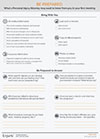 Your First Meeting with an Attorney
A worksheet to prepare for your first meeting with a personal injury attorney – what to bring, what they'll ask
Download in PDF format

Introducing Bentley’s Law
in Texas
A monumental move against intoxication manslaughter. This legislation ensures that drivers guilty of this crime are financially responsible for the minor children of parents they’ve tragically taken. Discover Texas’s proactive stance on DUI accident responsibility.
See our guide Choosing a personal injury attorney.