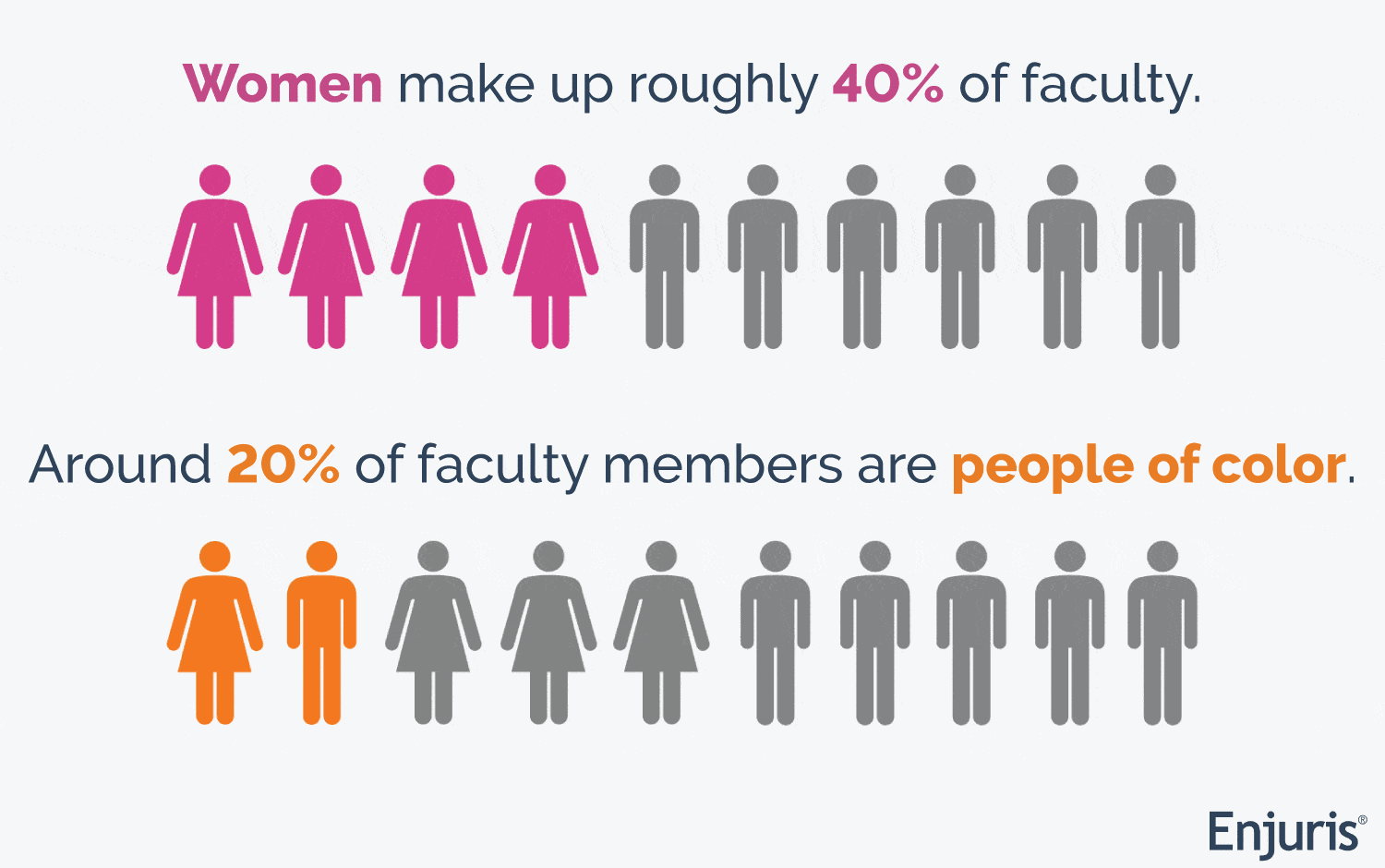
Faculty diversity is improving, but still lags behind student demographics
For the last decade, Enjuris has examined gender and ethnoracial diversity in U.S. law schools because we believe diversity is important in the legal field.
But focusing only on student demographics overlooks an equally important part of the picture. This report marks our fourth analysis of faculty demographics at ABA-approved law schools nationwide, shifting attention to those who shape legal education from the front of the classroom.
Gender diversity among law school professors
In 2025, 54.20 percent of law school faculty identified as male, while 43.28 percent identified as female.
A small share of professors—0.10 percent—identified as another gender, and 0.79 percent chose not to report their gender.

View full size Get the code Use this graphic on your site
We encourage people to use our infographics, with proper attribution. Just copy and paste the code below to use this infographic on your site. If you need help, let us know!
<a href="https://www.enjuris.com/students/law-school-faculty-demographics/" target="blank"><img src="https://www.enjuris.com/wp-content/uploads/2026/01/canva-infographic-total-law-school-faculty-2025.jpg" alt="Total law school faculty (2025)" title="" style="width: 100%; max-width: 750px; display: block; margin: 15px auto;" /></a>
Female faculty, who comprised just 20 percent of law school faculty in the 1980s, have seen substantial gains over the decades, though 2025 saw a slight year-over-year decline.
Trends in female faculty representation at law schools (2018–2025)
| 2018 | 2019 | 2020 | 2021 | 2022 | 2023 | 2024 | 2025 |
|---|---|---|---|---|---|---|---|
| 10,084 | 10,353 | 10,283 | 10,426 | 11,217 | 11,820 | 12,171 | 12,004 |
| 38.71% | 39.86% | 40.24% | 41.91% | 42.42% | 42.80% | 43.53% | 43.28% |
Some law schools have had considerably more success hiring and retaining female faculty than others.

View full size Get the code Use this graphic on your site
We encourage people to use our infographics, with proper attribution. Just copy and paste the code below to use this infographic on your site. If you need help, let us know!
<a href="https://www.enjuris.com/students/law-school-faculty-demographics/" target="blank"><img src="https://www.enjuris.com/wp-content/uploads/2026/01/canva-infographic-top-10-law-schools-female-faculty-2025.jpg" alt="Top 10 law schools by percentage of female faculty in 2025" title="" style="width: 100%; max-width: 750px; display: block; margin: 15px auto;" /></a>

View full size Get the code Use this graphic on your site
We encourage people to use our infographics, with proper attribution. Just copy and paste the code below to use this infographic on your site. If you need help, let us know!
<a href="https://www.enjuris.com/students/law-school-faculty-demographics/" target="blank"><img src="https://www.enjuris.com/wp-content/uploads/2026/01/canva-infographic-bottom-10-law-schools-female-faculty-2025.jpg" alt="Bottom 10 law schools by percentage of female faculty in 2025" title="" style="width: 100%; max-width: 750px; display: block; margin: 15px auto;" /></a>
Racial and ethnic diversity among law school professors
The ABA requires every accredited law school to report enrollment data annually by completing a Standard 509 Disclosure. The Standard 509 Disclosure allows law schools to report the race and ethnicity of their students using seven distinct categories defined by the ABA.
However, when it comes to law school faculty, schools are only required to report whether a faculty member is a “person of color.”
With this in mind, people of color made up 21.35 percent of law school faculty in 2025 (down from 21.42 percent in 2024).

View full size Get the code Use this graphic on your site
We encourage people to use our infographics, with proper attribution. Just copy and paste the code below to use this infographic on your site. If you need help, let us know!
<a href="https://www.enjuris.com/students/law-school-faculty-demographics/" target="blank"><img src="https://www.enjuris.com/wp-content/uploads/2026/01/canva-infographic-total-law-school-faculty-race-2025.jpg" alt="Total law school faculty (2025)" title="" style="width: 100%; max-width: 750px; display: block; margin: 15px auto;" /></a>
Though these numbers may be alarming, particularly in light of the fact that 36.43 percent of law students were minorities in 2025, it’s important to keep in mind that the number of minority law professors has increased over the years.
Trends in faculty of color representation at law schools (2018–2025)
| 2018 | 2019 | 2020 | 2021 | 2022 | 2023 | 2024 | 2025 |
|---|---|---|---|---|---|---|---|
| 4,110 | 4,327 | 4,399 | 4,746 | 5,169 | 5,815 | 5,989 | 5,923 |
| 15.78% | 16.66% | 17.21% | 19.08% | 19.55% | 21.05% | 21.42% | 21.35% |
Of course, some law schools have had more success hiring and retaining persons of color than others.

View full size Get the code Use this graphic on your site
We encourage people to use our infographics, with proper attribution. Just copy and paste the code below to use this infographic on your site. If you need help, let us know!
<a href="https://www.enjuris.com/students/law-school-faculty-demographics/" target="blank"><img src="https://www.enjuris.com/wp-content/uploads/2026/01/canva-infographic-top-10-law-schools-female-faculty-minority-2025.jpg" alt="Top 10 law schools by percentage of minority faculty in 2025" title="" style="width: 100%; max-width: 750px; display: block; margin: 15px auto;" /></a>
**Excludes schools located in Puerto Rico

View full size Get the code Use this graphic on your site
We encourage people to use our infographics, with proper attribution. Just copy and paste the code below to use this infographic on your site. If you need help, let us know!
<a href="https://www.enjuris.com/students/law-school-faculty-demographics/" target="blank"><img src="https://www.enjuris.com/wp-content/uploads/2026/01/canva-infographic-bottom-10-law-schools-female-faculty-minority-2025.jpg" alt="Bottom 10 law schools by percentage of minority faculty in 2025" title="" style="width: 100%; max-width: 750px; display: block; margin: 15px auto;" /></a>
Importance of diversity among law school faculty
Although law school faculties have become more diverse over time, faculty demographics continue to trail the gender and ethnoracial diversity seen among law students. This gap matters, not only from an institutional standpoint, but also for student experience and outcomes.
Accreditation standards reflect that concern. The American Bar Association requires accredited law schools to demonstrate an active commitment to diversity. Under Standard 206(b), law schools must show “by concrete action” that their faculty and staff are diverse with respect to gender, race, and ethnicity.
The ABA has repeatedly emphasized that this requirement is not aspirational. Over the years, it has issued notices of noncompliance to schools that failed to adequately document progress under Standard 206(b), requiring written explanations of the steps taken to address faculty diversity. In serious cases, ongoing noncompliance can place a school’s accreditation at risk.
The standard’s official interpretation explains why faculty diversity is essential, noting that a diverse classroom environment “promotes cross-cultural understanding, helps break down racial, ethnic, and gender stereotypes, and enables students to better understand persons of different backgrounds.” In other words, diversity among faculty is directly tied to the educational mission of law schools.
Empirical research supports this position. Studies have found measurable academic consequences when students and instructors are demographically mismatched. Research published by the IZA Institute of Labor Economics concludes that student–instructor demographic mismatch has statistically significant negative effects on course grades. The impact of having an instructor of a different race is roughly twice as large as the effect of having an instructor of a different sex, with nonwhite students experiencing the strongest effects. The study also found cumulative consequences, including reduced persistence in law school and lower graduation rates following repeated exposure to mismatched instructors during the first year.
At Enjuris, we will continue to monitor and report on the gender, racial, and ethnic composition of faculty at ABA-approved law schools, with the goal of providing a clearer picture of where progress is occurring—and where meaningful gaps remain.
More Enjuris research you might like
- Law School Rankings by Female Enrollment (2025)
- Law School Enrollment by Race & Ethnicity (2025)
- Is there a gender wage gap in the legal profession?
- When you want a female personal injury lawyer, will one be available?
- How your race and gender could impact your injury settlement
- Enjuris resources for students
About Enjuris®
Enjuris.com is a collection of independent legal resources designed to help people with their biggest questions following an accident or injury. Through instructive articles written by experienced attorneys, printable forms, and a free legal directory, Enjuris provides injury victims with the information and tools they need to take the next step. In keeping with its mission, Enjuris.com also provides promising college and law school students with scholarships and other resources to help them one day become effective lawyers.
Data source: American Bar Association, ABA Required Disclosures (Standard 509 Reports). Any mistakes in data reported to the ABA are the responsibility of the reporting school. Enjuris assumes no responsibility for inaccuracies or for changes in such information that may occur after publication. The figures here are as reported on December 18, 2025. Schools may update their data at any time. Please see the ABA website for up-to-date figures.