Understanding what to do after a pedestrian accident can keep you safer in the Garden State
Everyone is a pedestrian.
Even if you don’t normally take walks for exercise, recreation, or to get somewhere, you’re a pedestrian each time you set foot in a space that’s also shared with cars. That means when you’re crossing the street to catch a bus, heading for your own car in a parking lot, or stepping across the road to chat with a neighbor, you need to be mindful of how to stay safe around motor vehicles.
In New Jersey, the number of fatalities each year for pedestrian-related accidents has stayed fairly constant since 2014.
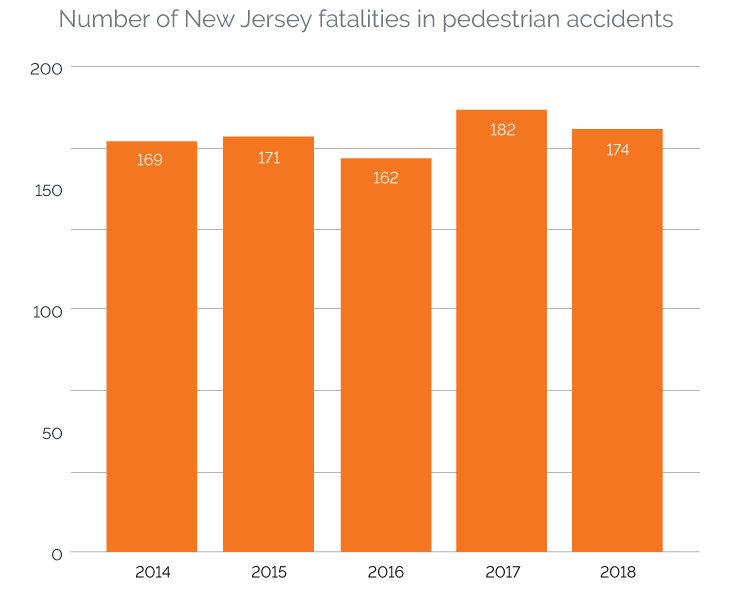
Source: National Highway Traffic Safety Administration
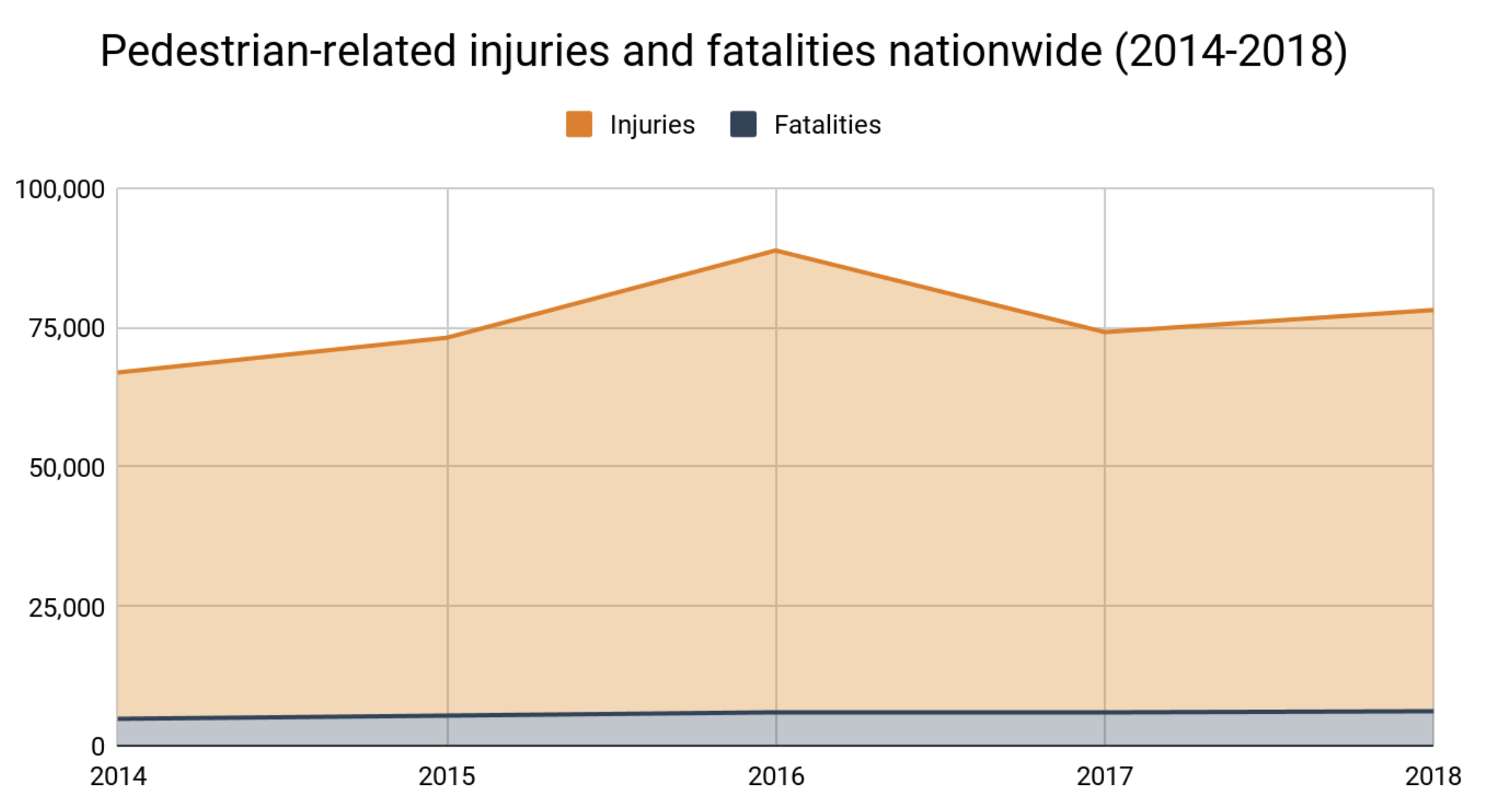
Fortunately, pedestrian fatalities are rare. Non-fatal injuries, on the other hand, are all too common. Here’s how the numbers look on a national scale:
Who’s liable in a New Jersey pedestrian accident?
In any personal injury accident, whether it’s a slip-and-fall, car accident, or another situation that caused harm, the injured person’s ability to receive damages depends on who was at fault — or liable — for the accident.
The main concept of personal injury law is that everyone owes a duty in certain situations, and that failure to meet your duty is negligence. This duty can change even minute to minute, and here’s why:
You can have a duty to someone you don’t even know.
For example, a driver has a duty to every other road user. A property owner has a duty to anyone who lawfully uses the property. Everyone has a duty to avoid causing harm to another person by action or inaction.
If a person is injured by someone else’s negligence, they’re entitled to recover damages, which are the costs associated with the injury. Damages can be for both actual costs (i.e. the amount of money spent on your recovery such as medical bills and lost wages) and compensation for pain and suffering, other emotional distress, loss of consortium, and potentially punitive damages.
Damages usually cover:
- Medical treatment (current and future)
- Rehabilitation and other therapies
- Pain and suffering and mental anguish
- Scarring, disfigurement, and loss of function of a body part or organ
- Loss of consortium
- Lost wages, present and future (including loss of earning capacity)
In order to claim damages, it’s necessary to determine who was at fault for the accident. Often, it’s the driver — but not always.
New Jersey follows the 51% Rule for comparative negligence. If a plaintiff (the injured person) is more than 51% at fault, they cannot receive any damages for an injury. In any personal injury case, the judge or jury will evaluate the evidence to determine how much fault is attributed to each party.
If the plaintiff’s contribution to the accident is less than 51%, their damage award will be reduced according to their percentage of fault. If it’s more than 51%, then they won’t receive any damages.
New Jersey requires Personal Injury Protection (PIP) insurance. Normally, it covers your medical expenses if you’re in an accident, but it can also extend to a pedestrian or bicyclist whom you’ve injured in a collision. If it doesn’t cover the full extent of their injuries, your bodily injury policy is available to cover their damages, too.
Pedestrians injured in a hit-and-run collision
A hit-and-run accident is when the driver leaves the scene of the crash and fails to provide contact and other necessary information to the victim or police. A hit-and-run driver can sometimes be located. If the injured person is able to get a license plate number or if there are witnesses, the police might be able to find them easily. There are also other ways that police can use evidence at the scene to identify a hit-and-run driver.
But what if you can’t identify the person who hit you?
If you have New Jersey auto insurance, you might be able to make a claim through your own uninsured or underinsured motorist policy. If you don’t have UM/UIM insurance, you might not be able to recover damages.
Pedestrian injuries from road conditions
Some pedestrians suffer injuries without ever being hit by a car. If you were injured because of a pothole, poorly designed traffic patterns, poorly placed turn signals or traffic signs, faulty and non-functioning traffic signals, traffic signals hidden by trees or other obstructions, or poor street lighting, you might have a premises liability claim.
If you were injured on private property, you would make a claim against the property owner. If you were injured on a public street or property, it might be more complicated because a claim against a government entity is different from a claim against a private person or company. If that’s the situation, you should contact a New Jersey personal injury lawyer as soon as possible for help suing a public entity.
Pedestrian right-of-way laws in New Jersey
Since your damages can be reduced according to your amount of fault in New Jersey, it’s even more reason why you should know state laws for pedestrians.
There are 2 sections of New Jersey law (NJ Rev. Stat. § 39:4-36) that are especially important for New Jersey pedestrians:
- When a driver must yield to pedestrians: The driver must yield the right-of-way to a pedestrian crossing in any unmarked crosswalk at an intersection, except at a crosswalk when traffic is controlled by signals and where there is a pedestrian tunnel or overhead crossing.
- Pedestrians must obey traffic signals: A pedestrian is required to yield the right-of-way if there isn’t a marked or unmarked crosswalk.
Penalties for violating New Jersey pedestrian right-of-way laws
A driver who fails to yield to a pedestrian in a marked crosswalk might receive these penalties:
- 2 points on their driver’s license
- $200 fine
- 15 days of community service
- Insurance surcharges
A pedestrian who fails to obey pedestrian signals or use correct crosswalks at an intersection with a signal could be charged a $54 fine.
10 safety tips for pedestrians
- Always cross at a corner or intersection and use a marked crosswalk where available.
- Yield the right-of-way to a vehicle if crossing where there’s not a marked crosswalk.
- Before crossing, look left, then right, then left again to check for cars.
- Walk facing traffic.
- Obey traffic signals and walk signs.
- Be alert — don’t text or be occupied on your phone while walking.
- If you’re wearing a listening device, either keep one ear “free” or the volume low enough that you can still hear outside noise like traffic.
- Wear reflective clothing when walking at night and carry a flashlight.
- Avoid walking while intoxicated; impairment can increase your risk of being hit by a car.
- Walk on the sidewalk or designated walking area where one is available. If there isn’t a sidewalk, stay as far to the left as possible.
What to do if you’re injured in a pedestrian accident in NJ
- Attend to your physical condition. Call 911 for medical help. If you’re unable to do so, ask a driver or bystander to call for you.It’s important to get a medical examination as soon as possible, even if you think your injuries are so minor that you don’t require treatment. Visit your doctor, an urgent care center or a hospital. Symptoms of some injuries might not appear for days or weeks after the accident, so documenting your condition immediately after the accident is crucial for an insurance settlement or legal claim.
- Call the police. A police report is essential and should contain the driver’s information, the facts of the accident, a description of the scene, and other information that will be important to your claim.
It doesn’t necessarily mean the person will face any charges, especially if they weren’t violating any traffic laws. But don’t let them convince you that a police report isn’t necessary. It’s your right (and for your protection) to get one.
- Obtain witness contact information. Witnesses can be the most valuable tool in a legal claim. Take each witness’s name, phone number, and email address.
- Document the scene. If you’re able to do so, take photos of the road conditions, traffic signals, any damage to the vehicle, and other factors that might have affected the accident.
- Contact a personal injury lawyer. A lawyer has access to reconstruction experts, financial professionals, medical experts, and other experts who can bolster your claim for relief.
The Enjuris personal injury directory can guide you to a New Jersey lawyer near you who’s skilled, ready, and willing to handle your claim. It’s important to speak with a lawyer before you discuss the accident with an insurance company (other than to report the accident). You never want to admit fault to the police or an insurance adjuster; let your lawyer do the negotiating in order to get the best results.
See our guide Choosing a personal injury attorney.