
Fraud rings deliberately cause crashes so innocent drivers take the blame. Here’s how to recognize the setups, protect yourself with a dashcam and good habits, and fight back if you’re targeted.
Wait. What just happened??
Maybe that was your first thought after an accident—particularly if the accident seemingly doesn’t make sense.
Picture this: You stopped at a red light. The car in front of you abruptly reverses and hits your front bumper. The driver and passenger get out of the car, they’re massaging their necks, and they’re saying you rear-ended them. And you’re standing there, scratching your head, and wondering how that’s possible. You were stopped at the light. Minding your own business, at a full stop, waiting for the light to change. How could you possibly have rear-ended them?
Well, you didn’t. It’s generally assumed that the following car is at fault in a rear-end collision. Many states, including New York and others, start from that presumption. And a person who’s trying to commit fraud is counting on it.
This isn’t a far-fetched or hypothetical scenario. A viral video from 2024 showed a Honda that deliberately reversed into an Acura SUV. Prosecutors later said the collision was one of three staged crashes that involved the same group of people. Staged accidents are organized crimes that put innocent drivers at legal and financial risk.
What’s a staged crash?
Investigators for the National Insurance Crime Bureau (NICB) classify fraudulent crashes in three ways, but they have one key difference. That distinction is whether a real collision has actually happened at all, and whether it involved an innocent person.
- Orchestrated (staged) accidents
An orchestrated accident involves everyone—drivers, passengers, and “witnesses” who come forward are all involved in the fraud. There might not even be a real accident; the group gathers vehicles that are already damaged and arranges them so it appears that a crash took place. They might even create new damage (by intentionally hitting some other stationary object) to claim it was caused by the accident.
This type of crime ring can include a “jump-in,” which is a person who wasn’t even inside the vehicle, but climbs in before police arrive, or are listed as injured passengers, to boost the number of injury claims that can be filed. Each “injured” person seeks medical treatment at a clinic that’s also involved in the scheme.
Obviously, these schemes are sophisticated and involve a lot of people. But they don’t involve innocent drivers or bystanders. The target is the insurance company—though it’s not a victimless crime. Each policyholder pays more through higher premiums when insurance companies make higher and more payouts because of fraud. - Paper accidents
A paper accident is, simply, one that didn’t happen. It exists on a police report and in an insurance claim file. Typically, these are accidents that allegedly happened on private property, and police often aren’t called, or they might be reported as hit-and-run collisions. This often involves an organized group that will call police to request paperwork that would support the claim. A police report might be filed by phone or as a walk-in report, so there’s never an officer present at the scene.
Commonly, one of the perpetrators will “admit” fault, and the claims are filed against their own insurance policy. There’s no dispute by the at-fault party, so the insurance company doesn’t investigate as thoroughly as it would otherwise.
Typically, this type of claim falls on the insurer, not an innocent victim. But, just as mentioned above, costs of fraudulent claims do ultimately trickle down to all of a company’s policyholders. There’s also a possibility in a paper accident that an uninvolved person could become a victim if a real person’s vehicle is falsely identified in a hit-and-run claim. - Caused accidents
If you’re a driver, this is the category that would be most concerning. A caused accident is when there’s an intentional collision between a scammer and an unsuspecting person. The scammer chooses a target vehicle that’s likely to be well-insured, like a commercial or luxury vehicle, and sets up the crash.
According to the NICB, the criminal will deliberately put the victim in a position where the crash is unavoidable, and then the victim must pay medical bills or insurance claims. These crashes are designed to make the victim appear to be at fault to the responding officer. There might even be a fake witness—someone who appears seemingly out of nowhere to back up the other driver’s story. Witness testimony is compelling—people tend to believe an account that’s corroborated by others, and they don’t know that this witness is in cahoots with the fraudster.
The other types of fraudulent accidents hurt insurers, and consumers or policyholders are only affected tangentially. But a caused accident directly affects the victim driver; it can lead to a liability claim against your policy, higher premiums, a possible lawsuit, and potential physical injury.
How does a perpetrator stage a crash?
Here are a couple of common setups that could happen, where you could be a victim:
- “Swoop and squat.” The “swoop” vehicle cuts in front of a “squat” vehicle, forcing the target (i.e. innocent driver) vehicle behind it to brake hard and rear-end the swoop car. At that point, the swoop vehicle will typically speed away and disappear, leaving the victim responsible for the vehicle damages and any injuries claimed by the passengers of the squat car.
- Drive down, or “wave.” A driver waves another motorist into a merging lane, then speeds up and hits the car they just waved in.
- Panic stop. The crash is caused by a sudden, unnecessary stop or lane change, and the insured driver often reports that the claimant’s brake lights never activated.
- T-bone. A criminal speeds into a vehicle at an intersection, while a “bystander” accomplice claims the innocent driver ran the stop light or failed to stop at a stop sign.
The payoff is usually related to injury claims, not car repairs. There are criminal networks that include chiropractic or physical therapy clinics. These facilities have “runners” that steer accident victims to these particular clinics and form claims based on soft-tissue sprains and pain.
How often do these fake accidents happen?
There is no single agency that collects this data, so there’s no exact national count of staged accidents. However, insurers flag questionable claims (QCs) and refer them to the National Insurance Crime Bureau (NICB).
The NICB has emphasized that a referral, alone, doesn’t mean a claim is fraudulent, and many questionable claims turn out to be legitimate. However, NICB has said that staged accidents are underrepresented in its data because not all member insurers choose to submit their questionable claims. The real figure is likely higher.
But here’s what we know:
Staged accident QCs increased 46% from 2007 to 2009. Total referrals have more than doubled, with questionable claims totaling more than 116,000 in 2012. By 2025, the NICB reported nearly 209,000 claims.
There was also a 41% increase in questionable claims involving fake or exaggerated harms on auto policies from 2022 to 2024.
California has the dubious distinction of having the most staged-auto claims in 2023, followed by New York and Florida. But they might not hold that lead for long—New York saw a 14% increase, and New Jersey had a 58% increase in staged-accident claims from 2022 to 2023.
New York, specifically, had an 80% increase in five years of suspected motor vehicle insurance fraud reported to the state’s Department of Financial Services. Most referrals involved suspected no-fault fraud.

Again this is not a victimless crime.
The FBI estimates about $20 billion per year in losses related to staged accidents; this adds $400 to $700 per year to the average American family’s insurance premiums. The Coalition Against Insurance Fraud says insurance fraud losses are at about $308.6 billion.
Does a dashcam help protect you from being a victim of a staged accident?
The purpose of a staged crash is so that liability rests on your word against several (staged) “witnesses.” But a dashcam changes the story in your favor. The camera can record vehicle speeds, signal timing, road signs, the location and activity of pedestrians, and other details—which are exactly the context a fraud claim relies on.
Ashpia Natasha was driving her Acura SUV on the Belt Parkway in Queens, New York, in 2024. A Honda Civic driven by Victor Murillo cut her off, forcing her to brake hard. The Honda deliberately reversed into Natasha’s vehicle, and the driver left the car and sped off in a getaway car. The passengers in the Honda made a claim against Natasha for $79,000. Natasha’s dashcam caught the Honda deliberately reversing into her car, and the driver leaving the scene in a waiting vehicle.
Natasha’s video went viral.
The viral video sparked a two-year investigation into a staged-crashes scheme on several New York highways, in which the criminals would file fraudulent insurance claims.
Prosecutors said Murillo and a partner staged three crashes between August and October 2024. They would recruit passengers and use borrowed cars. There were different passengers involved in each crash, but Murillo was always the driver. His partner pleaded guilty to insurance fraud and conspiracy, and was sentenced to one to three years in prison. Murillo pleaded guilty to staging a motor vehicle accident, insurance fraud, and conspiracy. He received a two-year prison sentence. The prosecutors specifically credited Natasha’s dashcam footage with helping to obtain convictions.
Truly organized crime rings know where traffic cameras are located. They often choose intersections with stop signs because they’re unlikely to be monitored. But having your own dashcam eliminates that problem.
Read more: Dash Cam Laws by State: What To Know Before You Go
How to protect yourself from a staged accident
- Leave room in front of you. Fleet safety experts advise drivers never to tailgate, and to leave enough space between your vehicle and the one ahead that you can always make a panic stop without hitting the forward card. If you’re at a traffic light, stop where you can still see the rear tires of the car in front. That way, you have room to react if it begins to move in reverse.
- Be wary of a courtesy wave. If someone waves you into traffic, still check again before you begin to move.
- Watch for warning signs. Be alert to a car full of passengers who keep looking around. Investigators note that occupants tend to look back at the victim just before impact—this is a red flag. It’s also a red flag if several occupants of a vehicle all claim to have the same injury.
- Keep your camera on and maintained. If you have a loop-recording dashcam with GPS, make sure it’s running consistently. Ideally, add a rear camera since many staged crashes involve the car behind you or a car backing into you.

What to do if you think you’ve been set up
Warning signs that suggest a caused accident
First, know the red flags that could indicate that you’re a victim of a caused accident. The NICB offers this guidance:
- A sudden lane change and immediate braking. A car swerves in front of you and brakes hard for no apparent reason.
- Passengers are watching you. Occupants of the car ahead keep looking back, waiting for you to be distracted, and then tell their driver to brake.
- An “unknown vehicle” involved. The other driver claims they had to stop because an unknown car cut them off. That mystery car is often part of the scheme.
- Everyone claims the same injury. Biomechanics research shows it’s very unlikely that all occupants would suffer identical injuries.
- The “victim” car is uninsured. A crime ring will often skip insuring the vehicle they plan to use as the not-at-fault car.
- Many occupants in one car. In many schemes, the car that strikes another car carries only the driver, while the car that gets struck is full of passengers.
Steps to take if you’re a victim of a setup
- Call the police and insist on a report. Don’t admit fault, and don’t negotiate a cash deal at the scene.
- Document everything. Take photos of each occupant, license plates of involved vehicles, damage and surroundings, and count the passengers.
- Preserve evidence immediately. Save your dashcam footage before it records over itself. Ask any nearby businesses or residences for their surveillance video right away, since many systems will overwrite footage within just a few days.
- Tell your insurer you suspect staging. Ask that the claim is sent to its Special Investigations Unit, and share your footage right away. Footage provided weeks into an investigation carries less weight than footage shared at first contact.
- Report the fraud. Check the chart below to find the fraud hotline in your state.
- Consult a personal injury lawyer.

The bottom line is that scams are everywhere, and—while we know not to click on sketchy links in emails or texts, give personal information over the phone, and to take other precautions that seem like second nature at this point—sometimes you can’t fully protect yourself.
If you find that you’re the victim of a staged crash fraud accident, contact a car accident attorney as soon as possible. If you think you were targeted, early action makes the difference.
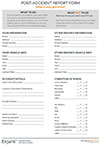 Accident Report Form
Sample post-accident report form to keep in your glove box - fill out at the scene or as soon as you can after a car accident
Download in PDF format
See our guide Choosing a personal injury attorney.