Who can be held liable if a loved one is abused in a nursing home?
Almost 26 percent of residents in Aiken, South Carolina, are 65 years of age or older, according to the most recent census data.
Fortunately, there are 4 nursing homes in Aiken and several more located just outside the city:
- Anchor Rehabilitation and Healthcare Center of Aiken
- Azalea Woods Nursing Home
- Pepper Hill Center for Rehabilitation and Healing
- PruittHealth-Aiken
Sending a loved one to live in a nursing home is one of the hardest decisions you’ll ever make. You may know your loved one needs professional care, but you understandably have concerns about the quality of care they’ll receive.
Let’s take a close look at nursing home abuse in Aiken, South Carolina, including how to recognize potential signs of abuse and what legal rights residents have while living in a nursing home.
What is nursing home abuse?
The term “nursing home abuse” refers to an act or a failure to act that causes harm to a person in a long-term care facility.
The Centers for Disease Control and Prevention (CDC) recognizes 6 common types of nursing home abuse:
- Physical abuse. Physical abuse occurs when a resident experiences illness, pain or injury as a result of the intentional use of physical force. Examples include hitting, kicking, pushing, slapping and burning.
- Sexual abuse. This type of abuse involves forced or unwanted sexual interaction of any kind with a resident. This may include unwanted sexual contact, penetration or noncontact acts such as sexual harassment.
- Emotional or psychological abuse. This type of abuse refers to verbal or nonverbal behaviors that inflict anguish, mental pain, fear or distress on a resident. Examples include name-calling, humiliating, destroying property or not letting the resident see friends and family.
- Neglect. The failure to meet a resident’s basic needs constitutes neglect. These basic needs include food, water, shelter, clothing, hygiene and essential medical care.
- Financial abuse. This type of abuse involves illegally or improperly using a resident’s money, benefits, belongings, property or assets for the benefit of someone other than the resident. Examples include taking money from a resident’s account without proper authority, unauthorized credit card use, and changing a will without permission.
Aiken nursing home abuse statistics
According to the World Health Organization (WHO), roughly 66 percent of nursing home staff around the world report that they’ve committed at least 1 act of nursing home abuse within the past year.
There are roughly 1,100 incidents of abuse and 350 incidents of neglect in South Carolina nursing homes every year, according to the most recent data from the South Carolina Department of Aging.
The most common nursing home complaints in South Carolina are as follows:
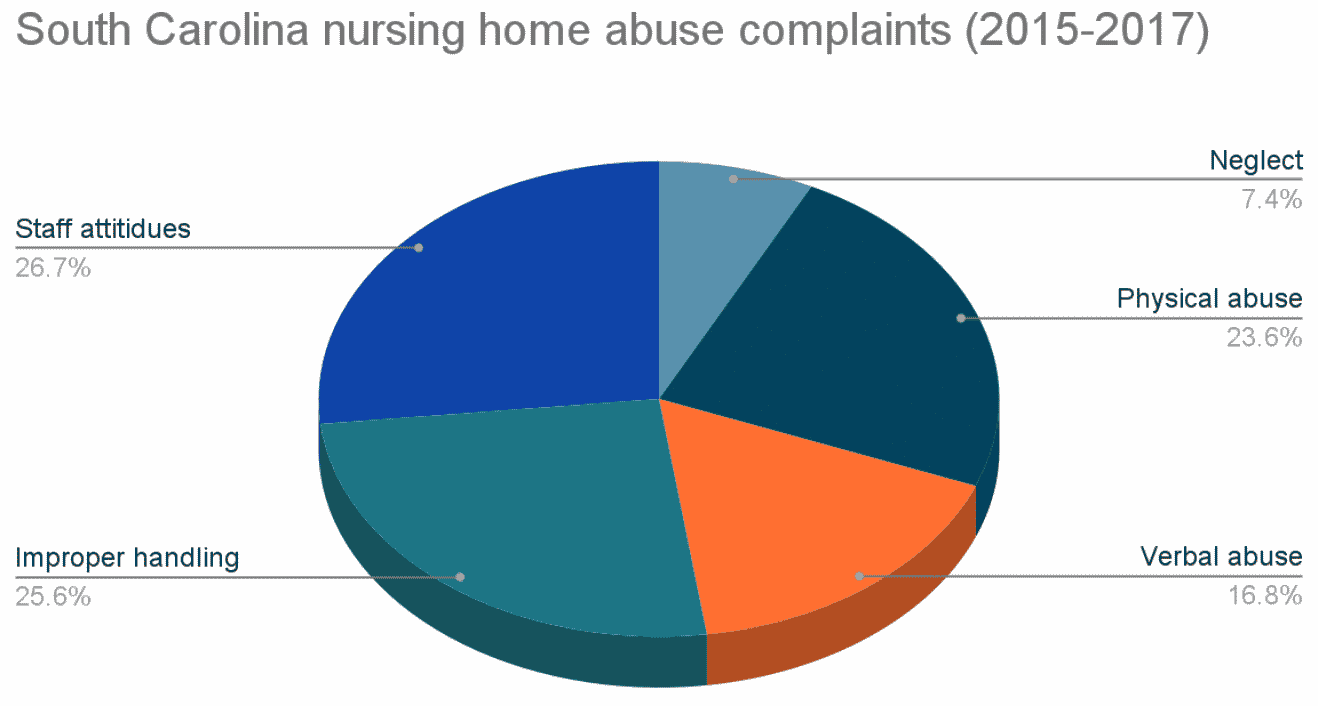
Although data for nursing home abuse in Aiken is not available, a recent federal Special Focus Facility (SFF) report identified a number of nursing homes across the country that have a “persistent record of poor care.” None of the nursing homes identified were located in Aiken, but several were located in South Carolina:
- Blue Ridge of Sumter – Sumter, South Carolina
- Commander Nursing Center – Florence, South Carolina
- Compass Post Acute Rehabilitation – Conway, South Carolina
- Life Care Center of Hilton Head – Hilton Head, South Carolina
- PruittHealth-Blythewood – Columbia, South Carolina
- Riverside Health and Rehab – Charleston, South Carolina
What are the signs of nursing home abuse?
The sad reality is that nursing home residents are often incapable, embarrassed or afraid to tell anyone that they’re being abused. As a consequence, the abuse continues, and the resident’s final days are filled with terror and shame.
As a friend or family member of someone in a nursing home, the responsibility often lands on you to identify signs of abuse. Here are some things to keep an eye out for:
- Your loved one stops taking part in activities they enjoy.
- Your loved one has trouble sleeping.
- Your loved one loses weight for no reason.
- Your loved one becomes withdrawn or acts agitated or violent.
- Your loved one displays signs of trauma (for example, rocking back and forth or appearing fearful).
- Your loved one has unexplained bruises, burns, cuts or scars.
- Your loved one develops bed sores or other preventable conditions.
- Your loved one lacks medical aids (glasses, walker, dentures, hearing aid, medications).
- Your resident smells of feces or urine.
- Your loved one begins making unusual purchases.
Although anyone in a nursing home can suffer abuse, there are certain risk factors that make being the victim of nursing home abuse more likely:
- Being female
- Being a veteran
- Identifying as LGBTQ+
- Having a mental illness
- Low income
- Social isolation
What legal rights do nursing home residents have in Aiken?
South Carolina has a set of laws (called the “Bill of Rights for Residents of Long-Term Care Facilities”) intended to protect older adults and adults with disabilities who are in long-term care facilities. These laws can be found in Title 44, Chapter 81 of the South Carolina Code of Laws.
Let’s look at some of the highlights:
Medical treatment
As a resident of a long-term care facility in South Carolina, you have the right to:
- Choose your own personal physician
- Receive from your physician a complete and current description of your medical condition in terms you understand
- Participate in planning the care and treatment you receive
- Refuse to participate in any type of experimental tests or research
- Have privacy during treatment
- Have your medical records treated with confidentiality
- Approve or refuse the release of your medical records to anyone outside your nursing home, unless you’re transferred to another health care facility or it’s otherwise required by law
- Be offered treatment without discrimination as to sex, race, color, religion, national origin or source of payment
Communication
As a resident of a long-term care facility in South Carolina, you have the right to:
- Have your legal guardian, family members, and other relatives see you when they visit
- Refuse to see your legal guardian, family members, and other relatives
- Send and receive mail with freedom and privacy
- Associate and communicate privately with persons of your choice
- Meet with your legal guardian, family members, or other resident’s family members to discuss your nursing home, so long as the meeting doesn’t disrupt resident care or safety
- Meet with and participate in social, religious, and community group activities, unless a written medical order prohibits such activity
Personal treatment
As a resident of a long-term care facility in South Carolina, you have the right to:
- Be treated with respect and dignity
- Be free from mental or physical abuse
- Be free from restraints unless your doctor has ordered them
- Be free from working or performing services for your nursing home unless they’re are for therapeutic purposes
- Be discharged or transferred to another facility against your wishes—only for: your welfare, the welfare of the other residents, medical reasons, or for nonpayment
- Be notified in writing at least 30 days prior to discharge or transfer
Personal possessions
As a resident of a long-term care facility in South Carolina, you have the right to:
- Have security in storing your personal possessions
- Approve or refuse the release of your personal records to anyone outside the facility, except as provided by law
- Keep and use personal clothing and possessions as long as they do not affect other residents’ rights
- Manage your personal finances
Personal privacy
As a resident of a long-term care facility in South Carolina, you have the right to:
- Have privacy when receiving personal care
- Have privacy when visiting with your spouse
- Share a room with your spouse, unless your doctor forbids this in your medical record
- Have your personal records treated confidentially
- Employ a sitter from outside the facility to come and provide you with sitter services, unless you have already agreed in writing with the facility not to hire a private sitter
Additionally, there are a number of federal laws that protect nursing home residents, including the Nursing Home Reform Act (NHRA).
Can you sue a nursing home in Aiken for abuse or neglect?
You can sue a nursing home in Aiken for abuse or neglect. Nursing homes have an obligation to exercise due care to avoid harming residents. If the nursing home breaches this duty of care, the nursing home may be held liable.
Examples of situations where a nursing home can be held liable include:
- Negligent training of staff
- Negligent hiring of staff (for example, failure to perform background checks)
- Failure to provide adequate security
- Charging for unnecessary treatment
- Failure to implement procedures to protect against viruses and other diseases
- The imposition of unreasonable or dangerous physical restraints
Keep in mind that a nursing home can be held liable for the negligent actions of their employees under the doctrine of respondeat superior so long as the employee was acting within the scope of their employment at the time of the negligent action.
5 steps to take if you suspect a loved one is being abused in an Aiken nursing home
If you suspect that your loved one is being abused in a nursing home in Aiken, there are 5 steps you should strongly consider taking:
- Report the abuse. If your loved one is in danger, call 9-1-1 to ensure that your loved one is protected.
- Gather information. If it’s safe to do so, gather any evidence you can to support the claim of abuse. This might include taking photographs of the injuries or conditions, requesting medical records, and obtaining witness contact information.
- Remove your loved one. If your loved one is not being treated properly in their nursing home, it’s time to start looking for other nursing homes or safer living options.
- Contact the South Carolina Long Term Care Ombudsman Program. The South Carolina Office on Aging has a Long Term Care Ombudsman Program. The program is free and designed to receive and resolve complaints from residents in nursing homes. You can find more information about the South Carolina Long Term Care Ombudsman Program here.
- Contact an attorney. If the ombudsman is unable to resolve your issue or you want to file a lawsuit against the nursing home, reach out to an experienced South Carolina nursing home attorney.