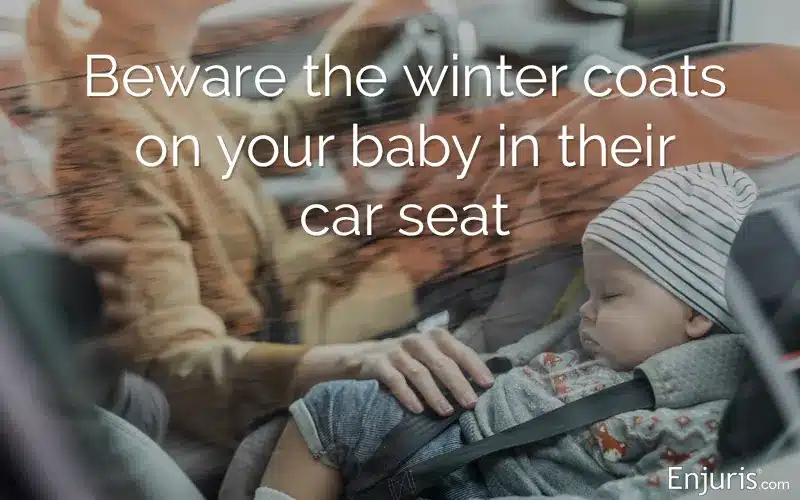
A bulky coat could compress in a crash, which means your child’s harness is too loose to keep their body protected.
Yes, taking a baby’s coat or snowsuit on and off can be a hassle. But it’s necessary to keep your baby safe in the car.
Whether you love the cold and snow or hate it, we can all agree that winter can present some challenges that we don’t face during the milder months. For parents of babies and toddlers, there are even more challenges, particularly when it comes to taking your baby out in the cold.
But one thing that’s been discussed for many years on the mommy blogs and Facebook circles is now being widely discouraged in the mainstream media—and that’s putting your young child in a car seat while they’re wearing a bulky winter coat.
An auto safety manager at the Consumer Reports Auto Test Center says that a baby or young child should not wear a thick, puffy coat or too many layers under the safety harness in a car seat. The reason is that the bulk compresses in an accident and would leave the straps too loose and, therefore, ineffective. The additional slack created when the straps compress the coat would be too much space for the harness system, and the child is no longer properly protected.
But I don’t want my baby to be cold!
Of course you don’t. But you might have to do some “car seat gymnastics” to figure out a system for getting your child secured in the seat properly, while staying warm in winter. The following tips are for babies and older children who use any car seat with a five-point harness.
Even adults should avoid bulky coats under seat belts in the car. It adds space between your body and the seat belt, which could make you less safe in a crash. The belt should always be as close to your body as possible.
The “pinch test”
If you want to know if your baby is properly secured, you can do the “pinch test.” Once the child is in their safety harness, tighten the straps as much as possible with no gaps. Then, unhook the clip and remove your child without loosening the straps. Take off their coat and put them back in the seat with the harness straps at the same adjustment as with the coat on. Re-buckle the clips. Try to pinch the strap with two fingers at the shoulders. If you can pinch the strap, then there’s too much slack and it’s unsafe.
The other way to check whether the straps are tight enough is to place a finger between the harness strap and your baby’s torso. You should not be able to put more than one finger between the strap and the baby’s body. If you can, it’s not tight enough.
How to keep your baby safe AND warm in the car
- Remove the puffer coat before getting in the car. You can place a blanket or coat over their harness straps to keep them warm.
- If your baby is still in a carrier car seat, place them in the seat and secure the straps inside your house or wherever you are; place a blanket or coat over them to walk to the car. That way, you don’t have to get them out and remove their coat in a cold car.
- Layer your baby. Dress them in thin underlayers like tights or long-sleeved onesies. Then layer with warmer clothes and perhaps a thinner fleece over the top; this way, they are not unsafe in a bulky puffer coat but still have plenty to stay warm.
- If you are layering your baby’s clothes or using a blanket over their car seat harness, be mindful of keeping the car too warm. Babies can overheat, so be sure that if they are bundled up, the car isn’t getting too hot inside.
- Be careful about using after-market car seat covers! A car seat poncho or blanket should never be between the seat and the baby. Your baby should always be directly touching the back of their car seat (with only their clothes in between). There are car seat bundling items on the market that are not safe, so unless it’s specifically recommended for use by the manufacturer of your seat, it’s probably not a safe choice. If the item was not sold with the car seat by its own manufacturer, then it was not crash-tested for that seat and cannot be considered safe.
Here’s a final tip: If you have a toddler, leave your destination with their coat on backward (i.e. zipper in the back). When they get to the car, pull one arm out at a time to secure them in their seat, then leave the coat on backward (but open) over the harness for the duration of the ride.
For more on child passenger safety, see our coverage of the 2026 LATCH recall affecting certain car seat systems.