The Seat Belt Defense is available in some states, but not all
If you’ve been involved in a car accident, you might have unwittingly received a crash course (no pun intended) on negligence and your state’s fault system.
You might know that the basis for a personal injury lawsuit is that if a person’s negligence causes an injury to someone else (the plaintiff), the plaintiff is entitled to recover damages (money) in order to make them whole. That means the plaintiff is restored to the financial condition they would be in if the accident hadn’t happened.
There are 2 concepts in the law that affect what’s commonly known as the Seat Belt Defense:
- Negligence. In order to recover damages, the plaintiff must prove that the defendant was negligent. Negligence is the failure to exercise the appropriate level of care for a situation.What is the appropriate level of care? That depends. Essentially, it’s taking reasonable care to avoid causing harm to another person. Failure to take reasonable care could include a driver who runs a red light, texts while driving, or is speeding. A driver has a duty to every other road user, which includes other drivers, pedestrians, and bicyclists.
- Fault systems. Each state has its own system for allocating damages based on whether a plaintiff shares fault for the injury.Following an accident, the court will look at whether the plaintiff shared liability and to what extent. Even if you didn’t cause the accident, the court might find that you could have prevented it if your action had been different. If that happens, the court will then determine each party’s percentage of fault.
In this type of situation, the court would determine what percentage of fault is attributed to each driver. Hypothetically, it might find that Driver A was 80% at fault and Driver B was 20% at fault.
At that point, it becomes important what state court is handling the case because different states will have different outcomes.
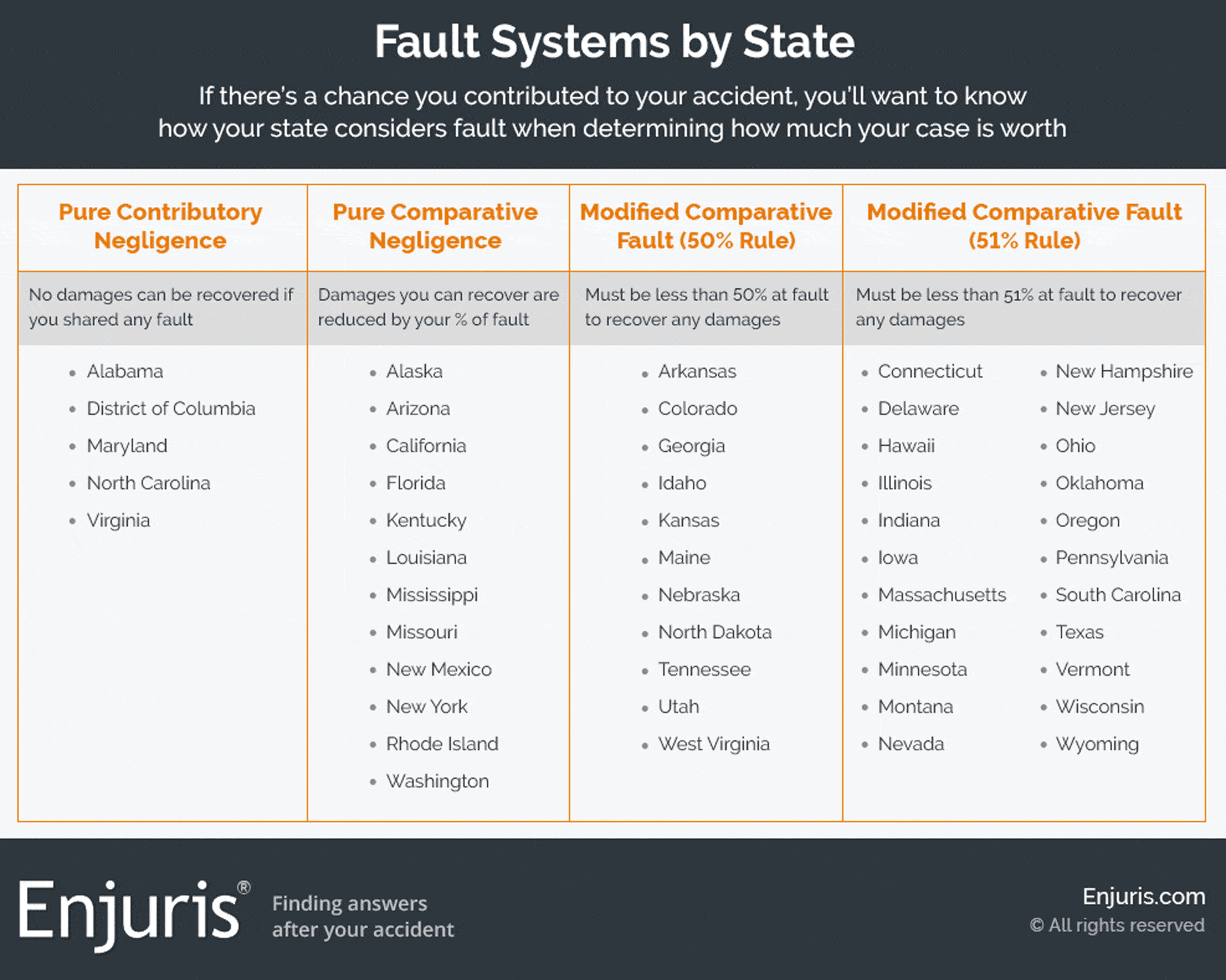
Fault Systems by State
View Full Size Get the Code Use this graphic on your site
Use this infographic on your site
We encourage people to use our infographics, with proper attribution. Just copy and paste the code below to use this infographic on your site. If you need help, let us know!
<a href="https://www.enjuris.com/personal-injury-law/shared-fault-rules/" target="blank"><img src="https://www.enjuris.com/wp-content/uploads/2022/10/fault-systems-by-state-2022.gif" alt="Fault Systems by State" title="Fault Systems by State" style="width: 100%; max-width: 987px; display: block; margin: 15px auto;" /></a>
What is the Seat Belt Defense?
Why are negligence and fault important to understanding the Seat Belt Defense?
Because…
How different states use the seat belt defense
Not all states allow the seat belt defense. Some states with laws that require seat belts still prohibit the seat belt defense.
The seat belt defense is only possible if the accident happened in one of the states in the first column.
| Seat belt defense is permitted | Seat belt defense is not permitted | Neutral (neither for nor against the seat belt defense) | Limit potential reduction in damages because of the seat belt defense |
|---|---|---|---|
| Alaska Arizona California Colorado Florida Georgia Iowa Michigan Missouri New Jersey New York Ohio Oregon West Virginia Wisconsin |
Alabama Arkansas Connecticut Delaware Idaho Illinois Kansas Louisiana Maine Maryland Massachusetts Minnesota Montana Nebraska New Hampshire New Mexico North Carolina Oklahoma Pennsylvania Rhode Island South Carolina Tennessee Texas Utah Vermont Virginia Washington Washington, D.C. Wyoming |
Hawaii North Dakota Indiana Mississippi Nevada |
Iowa Michigan Missouri Oregon Wisconsin |
How the seat belt defense works
Consider this hypothetical scenario:
A defendant caused an accident that resulted in injury to the plaintiff. The plaintiff was seriously injured and has sued the defendant for $100,000 to cover the costs of their injuries.
As part of the defense, the defendant’s lawyer provides medical and accident reconstruction experts who can testify that IF the plaintiff was wearing their seat belt, their injuries would have been less severe (or nonexistent).
Therefore, the defendant would be effectively paying damages for the plaintiff’s poor decision not to wear a seat belt.
The plaintiff’s failure to wear a seat belt can be considered a failure to mitigate damages, which means the plaintiff did not take reasonable action to limit the extent of their injury. Usually, “mitigation” is an action taken after something has happened — as a reaction, not prevention — but some states interpret failure to wear a seatbelt as a failure to mitigate damage before the accident happened.
Is the seat belt defense fair to the plaintiff?
Well, it’s controversial.
That’s why some states limit the percentage of fault that can be attributed to a plaintiff who is otherwise without shared liability for the accident.
In these states, there’s a statutory limit on the amount of fault that can be placed on the plaintiff for failing to wear a seat belt:
- Missouri: 1%
- Iowa, Michigan, Oregon: 5%
- Wisconsin: 15%
What are the arguments against the seat belt defense?
If you’re a victim who was injured and you are concerned that the defendant might try to use the seat belt defense to minimize your damage claim, your lawyer could argue that:
- The lack of a seat belt was not the cause of the accident. Although failing to wear a seat belt might have made injuries worse, it didn’t cause the accident or injury.
- Wearing a seat belt does not affect the mitigation of damages. Usually, a plaintiff has a legal duty to mitigate damages after an accident happens. In other words, if there’s a way to repair what has been broken, they should do so. But fastening a seat belt after an accident is not a logical or reasonable way to mitigate injuries.
- The seat belt defense contradicts the “eggshell plaintiff” doctrine. This rule of law says that the defendant takes a plaintiff as they found them. In other words, if a plaintiff has a particular condition that makes them especially vulnerable to injury, that’s not the defendant’s fault or responsibility. If the factor that makes a plaintiff more vulnerable to injury is that they weren’t wearing a seat belt, that couldn’t have been controlled or changed by the defendant.
- The defendant is not responsible for anticipating another person’s negligence.
- It can be difficult to determine what the plaintiff’s injury would have been if they were wearing a seat belt. Even medical experts can sometimes have trouble comparing scenarios because every accident is different. Asking a jury to determine what amount a plaintiff would be owed if they had been injured less while wearing a seatbelt as opposed to injured more without a seatbelt is a very difficult calculation to make.
If you’ve been in an accident where someone was injured and hadn’t been wearing a seat belt, this might or might not become an issue… largely depending on what state you’re in. And, whether you’re the at-fault driver considering whether this defense might be available to you or you’re an injured plaintiff who wants to recover your full compensation, there are going to be complex legal and evidentiary questions.
Connect to top-rated lawyers in seconds using our comprehensive national directory
See our guide Choosing a personal injury attorney.