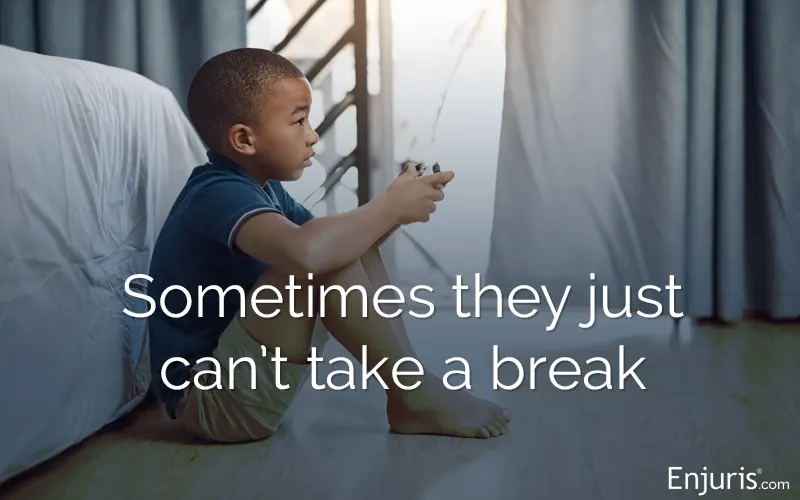
Were gaming companies to blame for a child’s video game addiction? One mom says yes, and she’s suing for damages.
Video game addiction is a real, legitimate mental health condition. If your child has been diagnosed with a video game addiction, is the child to blame? The parent? Or the gaming company?
If you’re a parent, is there one thing that’s a constant source of strife between you and your kids?
Maybe it’s too much junk food. Maybe it’s too much time on their phone or iPad. Maybe it’s struggles with homework. Maybe it’s fighting with their siblings.
Or, maybe it’s the amount of time they spend on video games.
If it’s the latter, you’d be among millions of parents today who face the same issues. But one parent is taking it further—an Arkansas mom filed a lawsuit against Microsoft, Activision Blizzard, Electronic Arts (EA) and EA DICE, Activision, Ubisoft, and Epic Games, along with some of their studios for negligence for failure to warn users of the games’ addictive qualities. The complaint also includes deceit and fraudulent misrepresentation, fraudulent inducements, and violation of the Deceptive Trade Practices Act.
While some parents consider their children’s gaming to be an annoyance or a distraction, for others it’s a mental health disorder.
What is video game addiction?
Common Sense Media released a study in 2022 that found that teens spent an average of an hour and 46 minutes each day on gaming in 2021. The average for boys was two hours and 19 minutes per day. They play video games on computers, mobile devices or gaming consoles.
Teen boys, teen girls, younger children and adults can suffer from video game addictions, which have an official diagnosis of “internet gaming disorder.” Boys are twice as likely to experience this as girls.
Process addictions, or behavioral addictions, involve actions that have the same effect on the brain as alcohol or drugs. These types of behavioral addictions include shopping, exercising, or gaming. Engaging in a particular activity activates the brain’s “feel-good” chemical, dopamine. The dopamine rush creates a craving response, leading to a compulsion to continue the behavior. A child or teen who is addicted to gaming craves playing uncontrollably.
In a study published in 2020, the researcher followed nearly 400 teens for more than six years. Of those, 10% of gamers exhibited pathological gaming behavior that increased during that time period. These teens also showed higher levels of depression, anxiety, aggression, and problematic cell phone use. Most of these individuals were male.
The World Health Organization set forth three criteria for diagnosing a gaming disorder:
- The person is unable to control their urge to play video games;
- The person feels that gaming is more important than any other activity; and
- The person continues to play video games despite negative consequences like relationship issues or poor performance at work or school.
How to know if your child has a video game addiction
The American Psychological Association has a set of warning signs that indicate a video game addiction. If a teen experiences five or more of the following criteria during a 12-month period, the parent might wish to seek help for this diagnosable condition.
- Preoccupation with gaming
- Withdrawal symptoms like irritability and anxiety when deprived of video games
- Increased tolerance—the ability and need to spend more and more time gaming
- Loss of interest in other activities
- Deceiving parents about the amount of time they spend gaming
- Loss of educational opportunities
- Using gaming to escape or relieve anxiety, guilt, or other negative emotions
- Inability to control the frequency and length of their playing
- Not limiting video game time even though it’s creating psychological problems
If a teen becomes generally more irritable, anxious, or depressed; if they are not managing personal hygiene and grooming; if they eat poorly because of constant gaming or stay up too late, then these can also be signs of a video game addiction—but could indicate other problems, as well.
Game addiction lawsuit
The Arkansas mom filed a lawsuit on behalf of her child, identified as “G.D.” in the lawsuit because he is a minor.
G.D. is 13 years old. His mother claims he plays video games for 12 to 14 hours a day. He’s playing Fortnite, Rainbow Six: Siege, Battlefield, and Call of Duty; he spends about $350 per month on gaming. G.D.’s mother estimates that he has spent $3,000 on in-game transactions and downloadable content, which does not include the costs of consoles, games and an Xbox Game Pass Ultimate subscription.
The plaintiff (G.D.’s mom) says her son has suffered physical harm that includes pain in his hands, elbow and shoulders. The lawsuit seeks damages for the parents’ economic losses, statutory and punitive damages, and legal fees in undetermined amounts.
The legal complaint also claims the gaming companies devised schemes to encourage players to spend money, including through microtransactions, as part of the addiction. The complaint discusses loot boxes; pay-to-win transactions; and “rubber banding”, which is when the difficulty of a game is tied to the player’s willingness to continue making purchases.
Isn’t it the parent’s responsibility to limit a child’s gaming time?
Attorney Tina Bullock says this:
There’s no warnings on that about video games that they can be addictive. Therefore parents are just trying to get their kids to just come eat, come do their homework, do these things. And like a normal household you would expect to see come down and eat with your family or come do your homework and all of a sudden you have a child that is blowing up. Punching holes in the wall, throwing objects. They’re getting upset and they don’t realize this is a gaming addiction. Most parents, their go-to thought is ‘Hey I’ve got a behavior issue.’… They’re at their wit’s end. Parents aren’t trained on the symptoms of addiction so a lot of them didn’t realize this is what was going on.
According to the lawsuit, these gaming companies have caused increased mental health, behavioral, physical, and educational issues for children. Further, the lawsuit claims that the defendants “manufactured, published, marketed, and sold video games, including those played by G.D., that Defendants had specifically developed and designed to cause the addiction experienced by G.D. and other users.”
Will the lawsuit be successful for the plaintiff?
The plaintiff will need to prove that the defendant was negligent or intentional in causing harm to her son. Her attorney alleges that the games are designed to analyze the player’s behavior using AI and then purposely keeping them engaged in the game in a way that creates an addiction.
How do the games do this?
The games use AI to look at the types of characters the user chooses, how they respond when they win or lose, style of play, how long they keep playing, and other factors. They begin to track the user to the point that they know when to offer another pack or skin to entice the player to level up and continue playing—all of which sets the scene for addictive behavior.
Can you prevent your child from developing a video game addiction?
Some parents think the obvious approach is to limit your child’s time in front of a screen, but experts say this can backfire. Instead, focus on addressing the issues that might make a child vulnerable to this addiction. For instance, guide your child to build positive coping mechanisms by emphasizing physical activity and creative expression. Communicate with your child so they feel safe and comfortable communicating with you as well. If you sense that your child or teen is struggling, don’t hesitate to seek professional help. If you’re unsure how to do this, your child’s pediatrician or a school counselor can guide you to additional resources.
At the time of this writing, it remains to be seen how this lawsuit will play out in the courts.
Sources:
The Latest Research on Teenage Video Game Addiction
Microsoft, EA, Activision, Ubisoft and Epic face game addiction lawsuit
Arkansas parent files lawsuit against leading video game companies