As social media has proliferated across the globe—Facebook alone has 2.9 billion active monthly users—the questions and concerns about the possible negative impacts associated with social media use have grown.
Studies show that social media usage is associated with anxiety, loneliness, depression, and social isolation, among other problems.
Moreover, Meta is now facing a class action lawsuit and regulatory scrutiny over its AI-powered smart glasses, after reports revealed that sensitive footage captured by users was reviewed by third parties.
When a product causes harm to its users, the users are typically able to file a product liability lawsuit against the manufacturer of the product. Social media companies have thus far avoided many of these types of lawsuits, but the 28 lawsuits recently filed against Meta in different U.S. District Courts across the country may open the floodgates.
What is social media?
Social media refers to “the websites and online platforms that facilitate interactions between users by providing them opportunities to share information, opinions, and interests.”
People use social media and gaming platforms like Roblox for all kinds of reasons, including entertainment, communicating with friends and others, searching for information, and purchasing products.
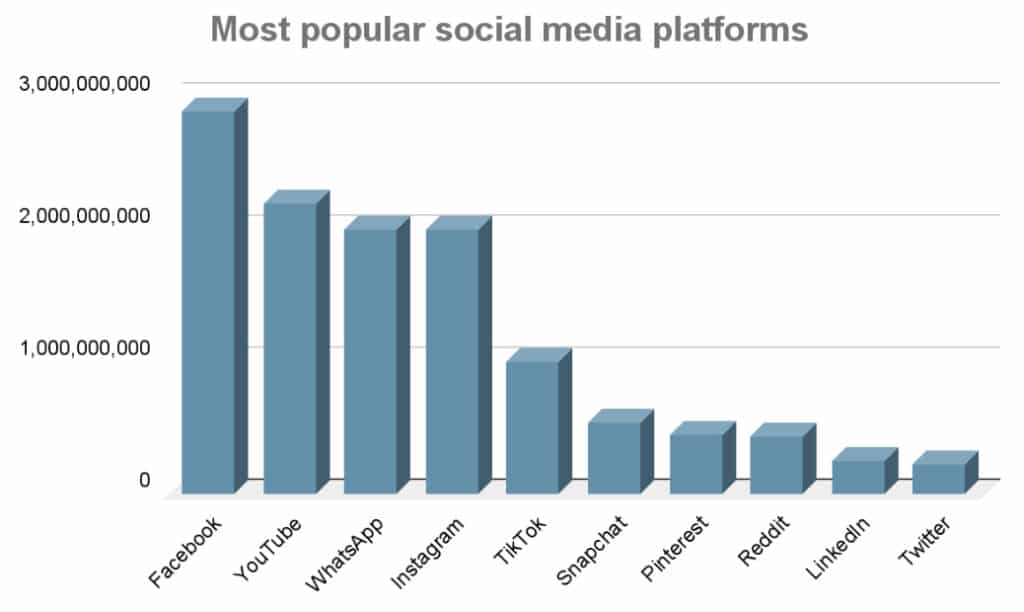
Source: Search Engine Journal
The average person spends 147 minutes on social media every day. To understand how popular social media has become, consider the fact that the average amount of time spent on social media in 2012 was just 90 minutes.
How does social media affect your brain?
A growing body of research has found that social media platforms like Facebook and Instagram can have a detrimental affect on users’ mental health. This is particularly true for young people whose brains are still developing.
According to research published in the International Journal of Information Management and other places, social media usage dramatically increases anxiety, loneliness, social isolation, and depression in users, while decreasing attention span and memory.
Additionally, social media limits the likelihood that users will have beneficial in-person relationships and social interactions. Even when a user is having an in-person interaction, social media platforms cause “phubbing,” which describes a situation in which an individual uses, or is distracted by, their smartphone during a face-to-face communication.
Making matters worse, social media use is highly addictive, making it hard to quit even when you know it’s hurting you.
Psychologists estimate that as many as 10 percent of Americans meet the criteria for social media addiction.
Social media is addictive because it triggers the brain’s reward system to release dopamine, just like heroin, meth, or alcohol. When a user receives a like, retweet, or other notification, the brain receives a flood of dopamine and sends it along reward pathways, which causes the user to feel pleasure.
This pleasurable feeling is, however, short lived, causing users to seek additional rewards by checking or posting on social media. Making matters worse, the brain is rewired to adapt to the unnaturally high levels of dopamine social media releases, which is why you often feel down after you stop using social media.
At its extreme, users engage with social media to provide the continuous rewards they’re not receiving in real life until they’re engaging with social media more than they’re engaging with real life.
Another factor of social media addiction is the fact that the reward centers of the brain are most active when people are talking about themselves. Offline, it’s estimated that people talk about themselves 35 percent of the time. Online, however, people talk about themselves 80 percent of the time.
“There are only two industries that call their customers “users,” explains Edward Tufte, a professor emeritus of statistics and computer science at Yale University, “illegal drugs and software.”
Almost 30 lawsuits filed against Facebook and Instagram
Meta Platforms Inc. (“Meta”), the technology company formally named Facebook, is currently facing 28 lawsuits filed in different U.S. District Courts by plaintiffs who claim the company was aware its platforms (Facebook and Instagram) harm users by causing anxiety, depression, and other mental health issues.
One of the plaintiffs, Brianna Murden, filed a motion asking that the 28 different lawsuits be consolidated in the U.S. District Court of the Northern District of Illinois.
Multidistrict litigation cases (MDL’s) are similar to class action lawsuits in that a group of people who have been injured by the same party under similar facts are consolidated under one federal judge who handles all of the discovery issues. Unlike class action lawsuits, the trials remain separate. An example of a recent MDL case involves 3M defective earplugs.
Brianna’s case is representative of the other 27 lawsuits. Brianna, a 21-year-old female, began compulsively using Facebook and Instagram at the age of ten. Her lawsuit alleges that, as a result of the addictive design of Meta’s products and the constant stream of 24-hour notifications, Brianna began to struggle psychologically and subsequently developed an eating disorder, depression, body dysmorphic disorder, suicidal ideation, severe anxiety, self-harm tendencies, and a reduced ability to sleep.
“Meta’s Facebook and Instagram products are unreasonably dangerous to users,” according to the lawsuit. “Further, Defendants failed to warn minors and their parents about risks posed by the products.”
What about TikTok?
Meta isn’t the only social media company being sued for allegedly harming its users.
Arkansas filed a lawsuit against TikTok and its parent company ByteDance alleging that its products harm users. More specifically, the lawsuit alleges that the company violated Arkansas’ Deceptive Trade Practices Act—a state law designed to ensure that businesses operate in a fair, honest, and transparent manner—when it labeled its app as suitable for teens despite the abundance of content containing profanity, substance use, and nudity.
The lawsuit seeks billions of dollars in fines.
“TikTok is a wolf in sheep’s clothing,” one of the lawsuits stated. “As long as TikTok is permitted to deceive and mislead Arkansas consumers… those consumers are easy prey.”
Just prior to the lawsuit filed by Arkansas, a federal judge dismissed a wrongful death lawsuit against TikTok and ByteDance over the death of a 10-year-old girl who participated in the so-called “Blackout Challenge.”
The lawsuit was one of several related to the Blackout Challenge, a dangerous game that encourages participants to choke themselves until they pass out, which had appeared on the child’s TikTok “For You” page.
The judge ruled that TikTok did not create the challenge but simply made it available on their site; hence the platform was not liable for the content.
Needless to say, TikTok and its parent company ByteDance are likely to become very familiar with the route to the courthouse over the next few years.
These cases highlight the mounting legal pressure on platforms to address the real-world consequences of viral content—especially when it involves dangerous social media stunts or challenges that put users at risk.
Can I file a lawsuit against Meta?
Even if the court chooses to grant the MDL motion, you’ll still be able to file a lawsuit against Meta (or any other social media company for that matter). In fact, the MDL may help you to decide whether filing a lawsuit is worthwhile.
It’s expected that the federal court will schedule a series of “bellwether” trials. A bellwether trial is a single trial that’s representative of a large group of trials. The trial is used as a test case in order to see how future litigation may turn out.
If the plaintiffs succeed in the bellwether trials, you can expect to see a flood of new lawsuits filed. On the other hand, if the plaintiffs do not succeed, you can expect that future social media users will be more reluctant to file suit.

Were You Harmed by a Social Media User… or By the Media, Itself?
Here’s when you can sue Instagram or another platform—and when your lawsuit should target an individual social media user instead.