

Retaliation.
We all know what it means, but in the context of workers’ compensation, it’s a little more nuanced than you might expect. Workers’ compensation retaliation is illegal in every state—but Georgia law handles it a little differently.
Workers’ compensation retaliation is when an employer takes adverse action against an employee for filing, or intending to file, a workers’ compensation claim. This type of action could include wrongful termination, demotion, a pay cut, or hostile changes in their working conditions as a result of the worker’s having pursued benefits for a work-related injury.
Retaliation could be blatant or subtle, but it’s always aimed at punishing the employee or discouraging others from filing claims. This could include:
- Termination, or firing the employee shortly after a claim was filed;
- Demotion or pay cut, which is reducing wages, hours, or job responsibilities;
- Harassment or intimidation in the form of threats, increased scrutiny, or fostering a hostile work environment;
- Negative performance reviews, or issuing unwarranted poor evaluations; or
- Failure to accommodate, by refusing to accept doctor-ordered restrictions or denying medical leave.
However, Georgia is one of a small number of states with no anti-retaliation statute or common-law exception that protects workers’ compensation claimants from termination. The Court of Appeals in Evans v. Bibb County (1986) declined to create a public policy exception to protect workers. And, while it’s technically not legal to fire someone for filing a claim, this isn’t accurate under Georgia state statute, alone. However, there are meaningful protections through federal law—and through the critical fact that workers’ comp benefits survive termination.
Let’s take a look at what the law actually says.
Workers’ comp retaliation and Georgia law
Employer retaliation remains one of the most common concerns among Georgia workers. Unlike most states, Georgia has never enacted a statute specifically prohibiting an employer from firing an employee for filing a workers’ compensation claim. This gap in the law creates real confusion—sometimes, even among attorneys—about what an injured worker’s protections actually entail. However, there are specific steps a Georgia employee may take to safeguard both their benefits and their job.
The Georgia at-will doctrine
Georgia is an at-will employment state. That means an employment contract for an indefinite period may be terminated at the will of either party, and the employer is not obligated to provide a reason (O.C.G.A. § 34-7-1). In simple terms, a Georgia employer may fire an employee at any time, for any reason, or for no reason at all.
But this is not absolute.
Federal law prohibits an employer from firing someone because of their race, sex, religion, national origin, age, or disability. Likewise, terminations that violate the Family and Medical Leave Act (FMLA) or the Occupational Safety and Health Act (OSHA) are likewise unlawful. Most states have adopted either a statute or a common-law public policy exception that prohibits employers from terminating employees in retaliation for filing a workers’ compensation claim. Georgia has done neither.
The Georgia Workers’ Compensation Act, O.C.G.A. § 34-9-1 et seq., does not include an anti-retaliation provision. There is no section of the Act that prohibits an employer from firing, demoting, or disciplining a worker for seeking benefits. This question was settled in the Evans case, mentioned above.
Plaintiff Jerry Evans argued that he was wrongfully fired for pursuing his rights under the Workers’ Compensation Act, and he urged the court to adopt a public policy exception. The court declined. It held that an at-will employee may be terminated “with or without cause and regardless of [the employer’s] motives.” This remains the law today.
The consequence of this ruling is that under current Georgia law, an employer may legally fire an at-will employee for filing a workers’ compensation claim, and the employee has no standalone state-law cause of action for retaliation. This is why the situation is nuanced; some injured workers believe there’s more protection than is the reality… it’s not entirely true that it’s “illegal” to fire someone for filing a claim.
However, while Georgia law doesn’t provide a direct remedy for workers’ compensation retaliation, an injured worker isn’t without options.
What are the protections against retaliation for Georgia workers?
- Workers’ compensation benefits survive termination.
This is the single most important point for an injured worker to understand. Being fired doesn’t end your right to workers’ compensation benefits. Georgia workers’ compensation is a no-fault insurance program administered by the State Board of Workers’ Compensation. Benefits are tied to the injury, not to your continued employment.
If your claim is valid, you’re entitled to medical benefits, temporary total disability payments (currently capped at $800 per week), and any other disability benefits to which you’re otherwise entitled, regardless of whether you’ve been terminated.
Sometimes, a termination actually increases a claim’s value because the employer can’t reduce their benefit exposure by offering a light-duty role, instead of your usual job. - The Americans with Disabilities Act might apply.
The ADA defines a disability as a physical or mental impairment that substantially limits one or more major life activities. If a workplace injury results in a condition that qualifies as a disability under the ADA, then it could trigger federal anti-retaliation protections. An employer that has 15 or more employees may not fire a worker because of a qualifying disability or retaliate against an employee for requesting a reasonable accommodation. An ADA claim is filed through the Equal Employment Opportunity Commission (EEOC) and can lead to reinstatement, back pay, compensatory damages, and attorney’s fees. - The Family and Medical Leave Act might apply.
The FMLA provides up to 12 weeks unpaid, job-protected leave for a serious health condition. If an injured worker is employed by a covered employer (50 or more employees within a 75-mile radius) and has worked at least 1,250 hours in the preceding 12 months, then termination during or in retaliation for taking FMLA leave is a federal violation. A workplace injury can qualify as a serious health condition under the Act. - OSHA whistleblower protections might apply.
If a worker is terminated for reporting unsafe working conditions, which often accompany a workers’ compensation claim, the anti-retaliation provisions of OSHA might provide a separate cause of action. - You might have employment contracts or collective bargaining agreements.
Some workers aren’t at-will—including those who have a written contract that specifies termination only for cause, or if they are covered by a union agreement. If one of those scenarios applies, you might have a breach of contract claim if you’ve been fired in connection with a workers’ compensation filing.
How to prove retaliation through a federal claim
If you have a viable federal claim under the ADA, FMLA, or another statute, there’s a set framework for how to proceed.
First, the employee must establish a prima facie case. Prima facie is Latin for “on its face.” In the law, it signifies that the evidence is sufficient to prove a fact or support a claim, unless it is disproved. It establishes that the case may proceed and that the claim has sufficient initial evidence to move toward trial.
In this instance, it would mean:
- The employee can show that they engaged in a protected activity;
- The employer took an adverse employment action; and
- There is a causal connection between the firing and the injury claim.
If the employee meets this burden, the employer must provide a legitimate, non-discriminatory reason for the termination. The employee may then demonstrate that the true motivation was retaliatory. This is a court’s burden-shifting analysis, which can be applied when a plaintiff lacks direct evidence of discrimination.
In practice, the most powerful evidence is the timing of the termination. If the worker is terminated in the days or weeks after a claim is filed, this would raise a strong inference of retaliation. There could be other circumstantial evidence, like sudden changes in performance evaluations, inconsistent explanations for the termination, deviation from standard company procedures, and disparate treatment as compared to similarly situated employees who did not file claims.
What to do if you’re injured on the job in Georgia
Regardless of whether you’ve been fired after a workplace injury in Georgia, there are steps to take to protect both your benefits and your legal position.
- Report your injury in writing. Georgia law requires notice to the employer within 30 days of the injury. A written report (email, letter, or text message) creates a documented record that becomes critical if a retaliation dispute arises later.
- Document everything. Maintain copies of performance reviews, emails, text messages, and any communications with your employer about your injury or your claim. If your employer’s attitude toward you seems to change after you file a claim, keep a written record of what happened and when.
- Being fired doesn’t end your benefits. Do not let fear of termination prevent you from filing a claim. If you were terminated, file a Form WC-14 with the State Board of Workers’ Compensation if you’ve not done so already, and ensure your claim is active.
- Consult an attorney immediately. There’s a lot of complexity in the interplay between workers’ compensation, at-will employment, the ADA, the FMLA, and other federal protections—there is no cookie-cutter solution. An experienced GA workers’ compensation attorney can evaluate whether your termination gives rise to a federal claim, if your benefits are being properly paid, and whether your settlement posture has changed as a result of your firing.
Ultimately, the fact that Georgia doesn’t have an anti-retaliation statute for workers’ compensation claimants is a significant gap in the law. It can leave Georgia injured workers more vulnerable than those in most other states, but it doesn’t mean they’re powerless. Benefits survive termination, federal statutes provide an alternative cause of action in many instances, and the practical reality is that employers who fire injured workers often increase the ultimate cost of the claim.
If you were injured at work and are concerned about retaliation—or if you were already terminated—act quickly, document thoroughly, and get experienced legal counsel involved before making a decision that could affect your rights. A qualified Georgia workers’ compensation attorney can evaluate your rights and ensure your interests are protected every step of the way.
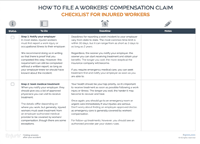 Workers’ Compensation Checklist
Download this checklist for injured workers to learn how to file a workers’ comp claim and track your progress.
Download in PDF format