

We’ve come a long way from the early, uncertain days of the Covid-19 pandemic. At that time, many companies were forced to pivot on a dime and switch their workforce to remote positions. While most aspects of our lives have reverted to pre-pandemic lifestyles, remote work continues.
It’s estimated that in 2025, 22% of Americans work remotely, or about 32.6 million people. This is lower than the peak of remote work during the pandemic, but it’s higher than pre-pandemic levels. There are also companies that have adopted hybrid work models, where employees are working in a combination of in-office and remote roles. In fact, remote job postings now account for about 15% of all job postings.
Many people prefer working remotely. Often, it provides more flexibility in work hours, particularly for people who care for children or elderly parents. Even people who aren’t caregivers sometimes prefer working remotely. It can save money on a commute; improve work-life balance; save on food, clothes, parking, and other expenses; and offer broader job opportunities because you’re not limited to jobs within commuting distance.
However, this culture shift toward remote work raises new questions and challenges regarding workers’ compensation law. The shift to remote and hybrid work blurs the lines between personal and professional environments. In Georgia, as in many other states, this change has prompted new legal questions about workers’ compensation eligibility when an injury occurs outside a traditional job site. Can you still file a claim if you’re injured while working from home? What types of injuries qualify?
Advantages for companies that offer remote or hybrid work environments
A company only offers remote work arrangements if they benefit the bottom line. Let’s take a look at some reasons why companies find remote work beneficial:
- Fewer overhead costs. Companies with a remote workforce can save on office space, utilities, cleaning services, and office supplies. Some businesses have either downsized or eliminated physical offices altogether.
- Access to a wider talent pool. Employers are no longer limited by geography and can hire top talent regardless of location. They can also build a team with more diversity than is available in some local areas.
- Increased productivity. Many remote workers report being more productive without the distractions of an office. As well, remote workers report that better work-life balance that comes from flexible scheduling can improve their focus and performance.
- Improved employee retention. Employees with flexible arrangements are often more loyal and satisfied.
- Reduced absenteeism. Remote workers are less likely to take full sick days for minor illnesses or personal obligations, and they might be more willing to work through mild illnesses at home. It could also curb the spread of contagious illnesses so they don’t affect as many employees.
- Business continuity. A remote environment enables a company to maintain operations if there’s an emergency, natural disaster, or other work disruption that would prevent people from coming to a physical office. In addition, a decentralized workforce is less vulnerable to a local disruption like a weather-related issue or similar.
- Environmental impact. As businesses strive to be more sustainable, less commuting means fewer emissions and a reduced carbon footprint. For companies with sustainability benchmarks and goals, remote workers can help reduce energy use.
- Scalability. It’s easier and more cost-effective to scale a team up or down quickly based on need if there are no logistical constraints of a physical space.
Georgia workers’ compensation basics and remote employment
Workers’ compensation benefits are contingent upon an injury having happened at work, or in the course of employment. As the shift to remote and hybrid work continues to create fuzzy separation between the personal and professional environments, Georgia raises new questions about the eligibility for workers’ comp for injuries that happen outside the traditional job site and the types of injuries that qualify.
Georgia workers’ compensation law requires most employers with three or more employees to carry workers’ compensation insurance. This coverage is designed to provide medical treatment and wage benefits for injured workers.
To qualify for Georgia workers’ compensation benefits, the injury must arise:
- Out of employment, meaning the job must create the risk of injury; or
- In the course of employment, which means the injury must happen while the employee is engaged in job-related tasks or activities.
How do these qualifiers for workers’ compensation apply to remote workers?
Remote workers in Georgia can qualify for workers’ compensation benefits, but a claim might be more closely scrutinized.
The insurer will investigate whether or not the injury was related to the job. For example, if the employee trips over a power cord when they are getting up to answer a work call, this would likely be covered. If the employee takes a break to walk their dog, slipping on ice outside would not be covered since that was their personal time and unrelated to work.
Sedgwick CMS v. Valcourt-Williams
A 2020 Florida case has influenced how courts nationwide—including in Georgia—evaluate remote work claims.
A workers’ compensation claimant, Tammitha Valcourt-Williams, tripped over her dog while reaching for her cup of coffee in her kitchen. She sought workers’ compensation benefits, claiming that since the accident was during working hours, she should be eligible.
The workers’ compensation judge determined that a remote work arrangement meant the employer “imported the work environment into the claimant’s home and the claimant’s home into the work environment.” However, the appeals court said the question isn’t whether the home environment becomes the work environment—it’s whether the employment has exposed the claimant to a condition that increases their risk of injury.
The appeals court reversed the initial decision because it determined that the risk existed whether she was at home working or at home not working. In other words, the risk of tripping over her dog existed before she took the job and will continue to exist after her job ends. Therefore, the risk did not arise out of her employment.
Common remote work injury scenarios
Some common examples of injuries suffered by remote workers include:
- Repetitive strain injuries or back and neck injuries from poor ergonomics. Injuries like carpal tunnel syndrome, neck/back strain, or tendonitis can develop over time and are often linked to typing, sitting for long hours, or inadequate seating.
- Falls in home offices. This could include tripping over power cords, slipping on a spilled drink while going to a work-designated area, or falling down stairs en route to a home office. These injuries might qualify for workers’ compensation if the activity was work-related.
- Tech-related accidents. For example, injuries from lifting equipment like printers or office chairs, or electrical injuries from faulty work equipment could be eligible for workers’ compensation benefits.
- Work-related stress injuries. A psychological injury like anxiety or depression could qualify for benefits if it meets Georgia’s strict criteria for job-related pressure.
- Injuries during work breaks. If an employee is injured during a break that’s incidental to employment and the injury occurred in the person’s home office area (i.e. workspace), Georgia courts might consider an injury during a lunch or bathroom break as covered under workers’ compensation laws.
Light-duty work accommodations
A Georgia employer must offer light-duty work when available. In other words, if the injured employee is still recovering but can complete some type of work that’s not necessarily the tasks in their original job, they should be assigned a role that is conducive to their recovery. Sometimes, an employer will offer remote work as a form of light duty. This can raise disputes if the employee feels they’re being asked to return too soon or perform tasks beyond their medical restrictions.
What to do if you’ve been injured as a Georgia remote worker
- Notify your employer. Georgia law requires an injured employee to notify their employer within 30 days of the injury. Make a written report and include the time, date, activity, and location of the accident.
- Seek medical treatment. Your employer should provide a list of approved physicians; choose a provider from the list or someone who is authorized by your employer or its workers’ compensation insurer.
- File a workers’ compensation claim if necessary. If your claim is denied or delayed, you may file Form WC-14 with the Georgia State Board of Workers’ Compensation. Typically, you have one year from the date of the injury in which to file a claim.
- Track documentation. Keep records of your injury, diagnosis, treatments, bills, correspondence with your employer, and proof that the injury occurred while working
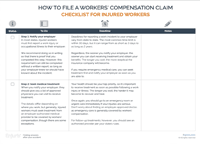 Workers’ Compensation Checklist
Download this checklist for injured workers to learn how to file a workers’ comp claim and track your progress.
Download in PDF format
How can I prove my injury was work-related?
It can be more challenging to prove that your injury was work-related if you’re remote. Here are a few tips to strengthen your claim:
- Clearly define your work hours and location, for example, a home office.
- Be sure your employer has acknowledged your remote setup in writing.
- Document the incident immediately, including photos or messages that show you were working.
Tips for employers and employees
Employer: Provide ergonomic guidelines and consider virtual inspections of home offices.
Employee: Maintain a clear separation between work and personal spaces, and keep detailed logs of work-related activities.
If you’re involved in a workers’ compensation claim or dispute as a remote employee, you can contact a Georgia workers’ compensation lawyer any time for advice and assistance with your claim.

Why You Need a Georgia Workers’ Comp Attorney
Georgia workers’ compensation claims can be complex and time-consuming. Discover the common obstacles and why legal representation is vital for a successful outcome.