• Skip to main content
  • Skip to primary sidebar

New Hdr Right

Enjuris
Finding answers after your accident
Contributor loginSearch
Get help Call Now

Nav Menu

  • Find a Lawyer
  • Accident Resources
        • Personal Injury Law
          • You've been hurt. Now what?
          • Do I have a claim?
          • Finding the best attorney to represent you
          • Dealing with insurance
          • Laws by state
          • View all
        • Accident Types
          • Car accident
          • Truck accident
          • Workplace injury
          • Wrongful death
          • View all
        • Workers' Comp
          • Common work injuries
          • Finding the best workers’ comp lawyers
          • How workers’ comp benefits work
          • Personal injury vs. workers’ compensation
          • View all
        • Injury Guides
          • Spinal cord / column
          • Brain Injury
          • Occupational injuries
          • Whiplash
          • View all
        • More
          • Blog
          • Questions & answers
          • Tell your story
          • Forms and worksheets
          • Videos
          • For students
          • Our Safety Allies
          • About us
          • Legal dictionary
  • Attorney Marketing
    • VOICES program
    • Contributor plan
    • Partner plan
    • Social media marketing
    • All plans
    • Enjuris badges
Accident Help (Home) » Injury Blog » Felony Charges Filed in Fatal California Crash Involving Tesla’s Autopilot

Felony Charges Filed in Fatal California Crash Involving Tesla’s Autopilot

How can I contribute?

About Enjuris Attorney Editor

Contributor: Enjuris Attorney Editor

Add as preferred source on Google
Felony Charges Filed in Fatal California Crash Involving Tesla’s Autopilot

Tesla is making history, but this time for the wrong reasons.

Los Angeles County prosecutors recently filed 2 counts of vehicular manslaughter against the driver of a Tesla Model S. The driver is the 1st person to be charged with a felony in the United States for a fatal crash involving an automated driving system. 

Although the historic criminal charges are getting most of the headlines, a couple of related civil lawsuits filed against the driver could have far-reaching implications.

The accident

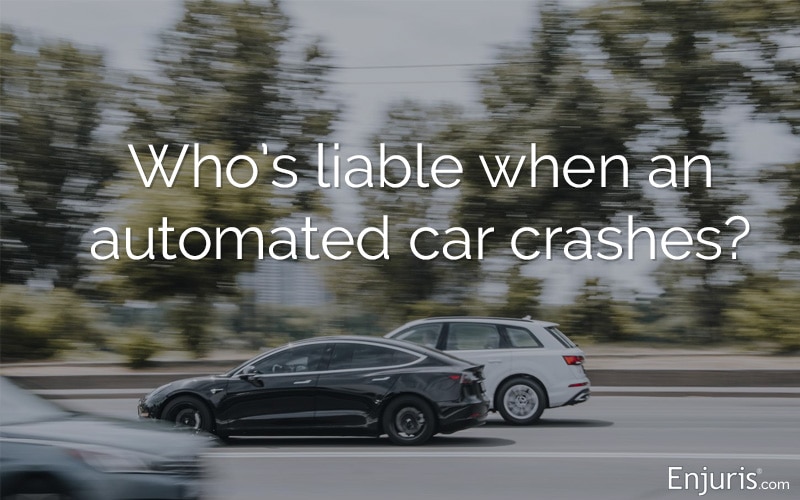
On December 29, 2019, Kevin George Aziz Riad was driving his black Tesla Model S at a high speed when it ran a red light in the Los Angeles suburb of Gardena and slammed into the driver’s side of a Honda Civic heading west on Artesia Boulevard.

Both occupants of the Honda Civic, Gilberto Alcazar Lopez, age 40, and Maria Guadalupe Nieves-López, age 39, died at the scene.

Investigators from the National Highway Traffic Safety Administration (NHTSA) confirmed that the Tesla’s Autopilot features were in use at the time of the crash.

Tesla’s Autopilot system, which comes standard on every new Tesla, is an advanced driver-assistance system that, among other things, enables the vehicle to steer, accelerate, and brake on its own.

Although Tesla’s Autopilot system is intended to “enhance safety and convenience behind the wheel,” the NHTSA has spent a significant amount of time reviewing the widespread misuse of Autopilot by drivers whose overconfidence and inattention (termed “automation complacency”) has been blamed for multiple crashes.

Criminal charges filed against the driver

Los Angeles County prosecutors filed 2 counts of vehicular manslaughter against Kevin George Aziz Riad following the accident. Vehicular manslaughter carries a penalty of up to 6 years in California State Prison and fines up to $10,000.

Riad pleaded not guilty and is free on bail while the case is pending.

The charges are historic, as they mark the 1st U.S. case in which serious criminal charges were filed in a fatal crash involving an automated driving system.

Facing facts:An estimated 765,000 Tesla vehicles are currently equipped with automated driving systems in the U.S.

Civil charges filed against the driver and Tesla

The families of the victims have filed wrongful death lawsuits against Kevin George Aziz Riad and Tesla.

The lawsuits filed against Riad allege that he was negligent for being inattentive and failing to stop at a red light. The lawsuits filed against Tesla claim that Tesla sold a defective vehicle that “suddenly and unintentionally accelerated to an excessive, unsafe, and uncontrollable speed” and lacked an effective automatic emergency braking system.

A joint trial is scheduled for 2023.

Auto accident liability for self-driving cars

The question of who should be held civilly liable—the driver or the manufacturer—when an automated car causes an accident has been the topic of much debate.

Practically speaking, if you’re injured in a self-driving car accident, your lawyer is likely to sue both the manufacturer and the driver of the vehicle.

The wrongful death lawsuits filed against Riad and Tesla could set a powerful precedent for holding the driver, manufacturer, or both liable following a crash.

Criminal vs. civil cases

When a person is arrested and charged with a crime, they are brought to a criminal court where the government, on behalf of the people of the U.S., prosecutes the case. The goal of a criminal court is to punish criminals through fines or jail time.

When a person (called a “plaintiff”) sues another person (called a “defendant”) for damages, they do so in a civil court. The goal of a civil court is to compensate the plaintiff for any injuries they suffered as a result of the defendant’s actions or inactions.

A car accident case can be tried in a civil court even if no criminal charges are filed against the defendant. What’s more, because civil suits use a “preponderance of the evidence” standard, which is less stringent than the criminal “beyond a reasonable doubt” standard, victims of a car accident can recover civil damages even if the criminal court declares the defendant innocent of the crime.

Enjuris tip:Learn more about the differences between civil and criminal law.
AEB regulation

USDOT’s New Regulation: AEB Systems Required in Cars by 2029

New mandate for Automatic Emergency Braking (AEB) systems in cars by 2029 aims to reduce accidents and enhance driver protection through advanced technology.

Learn more

Filed Under: California

Primary Sidebar

Grow your personal injury law firm. Attract & convert more clients.

Tired of expensive marketing
that doesn't deliver?

Partner with Enjuris and reach millions of accident victims actively seeking legal help.
Join Enjuris Partners

Enjuris Partners

  • AL - Nomberg Law Firm
  • CO - Babcock Tucker
  • FL - Lorenzo & Lorenzo
            Palmer | Lopez
  • GA - Gerber & Elkins Law
  • MT - Murphy Law Firm
  • SC - Chappell, Chappell & Newman
  • TX - Brown Trial Firm
            Neal Davis Law Firm

Blog categories

  • News Stories
  • My Accident Story
  • Resources You'll Love
  • Questions & Answers

In your state

AL AZ CA CO FL GA IN MT NC OH SC TN TX

Attorneys, write for Enjuris. Join our Contributor Program.

Start Writing

Footer Form

Need an attorney? Our Enjuris Partners are ready to help FIND OUT IF YOU HAVE A CASE
Start here

© 2026 Enjuris. All rights reserved.

Reader survey

X/Twitter Facebook LinkedIn YouTube Blog feed Instagram TikTok Reddit
Learn about

Car accident attorneys
Defective product attorneys
Personal injury attorneys
Medical malpractice attorneys
Wrongful death attorneys
Workers compensation attorneys
Birth injury attorneys

Personal injury lawyers: Partner with us Lawyer online marketing

System overview
Video
Powered by

SEO Advantage

3690 West Gandy Blvd., Suite 444
Tampa, FL 33611
Attorney SEO services


Enjuris is a platform dedicated to helping people who are dealing with life-altering accidents and injuries. We support students, families, caregivers and communities with resources, personal stories and a national directory of partner attorneys.

Copyright © 2026 Enjuris.com. All rights reserved. The accuracy, completeness, or currency of information on this site is not guaranteed. The information provided is not legal advice, does not constitute a lawyer referral service, and no attorney-client relationship is or will be formed by use of this site. For state-specific information, particularly regarding attorney advertising, refer to the Terms of Use. Your use of this website constitutes acceptance of the Terms of Use and Privacy Policy.

Press Enter to Search