It’s important to know road rules and laws for your moped or scooter before you hit the pavement.
Electric scooters and mopeds have increased in popularity in recent years. It seems we should thank urban millennials for this development—it seems the term “micro mobility” was named for their preferences. This term is generally used (though not strictly defined) to refer to small, lightweight vehicles that are usually electric that are used for transportation in urban centers.
Just like the COVID-19 pandemic changed where many people work, recent years have changed how we get to work.
If you live in or visited a city recently, mopeds and electric scooters are ubiquitous. But before you hop on this trend, it’s important to understand their comparisons to motorcycles and the risks of associated injuries.
Why are mopeds and scooters so popular?
1. A moped or a scooter is a vehicle.
Commuters, particularly younger adults, see their mopeds and scooters as transportation, not recreation. It can save time they would otherwise spend sitting in traffic or hunting for a parking spot, and they are less expensive than owning a car. Aside from the cost of a moped or scooter being less than a car, they don’t cost money in gas or parking.
2. They are convenient to own and store.
People who live in cities might not have access to a garage or parking area, but an electric scooter can be so portable that it can be folded and stowed inside an apartment. It can be transported in elevators and stored in offices. That means, unlike a traditional bicycle, you don’t have to worry about theft or damage from the weather being left outside.
3. There are few physical restrictions to riding a micro-mobility vehicle.
Some people don’t like bicycles because they require a certain amount of physical fitness and stamina. But a moped or scooter requires little of the user; nearly any person with normal mobility and at any age could ride one. And, there’s little reason to sweat — which is a big advantage if your office doesn’t have a shower!
Just how popular ARE e-scooters?
- There were 5 million e-scooters sold in 2018.
- The e-scooter market is expected to reach nearly $42 billion by 2030.
- There are anticipated to be 129 million e-scooters and motorcycles on the road by 2028.
- A report by the National Association of City Transportation Officials said that there were 136 million rides in 2019 by Americans on dockless scooters, bikes and traditional bikeshare systems. That was an increase from 84 million in 2018.
Source: Appinventiv
What’s the difference between a moped, motor scooter, and a motorcycle?
A moped looks similar to a motorcycle, and some people confuse the two, notwithstanding the fact that a moped has a sleeker, smaller profile.
| Motorcycle | Moped | Motor scooter |
|---|---|---|
| Two-wheeled vehicle powered by a motor, no pedals. Designed for higher speeds, fast acceleration, and high-speed handling features. Offer wind protection and have some cargo storage. 250cc or larger engine that is mounted in the middle of the frame rather than on the rear suspension. Ride sits atop the engine with the gas tank in front of them. The rider cannot step through the chassis, and must swing a leg over the chassis to mount. Wheels are usually more than 16” in diameter. Most motorcycles have a manual clutch and rider must shift gears manually (usually with the right leg) and use the right foot to actuate rear brakes. |
Similar to a traditional bicycle, with pedals and a low-powered engine. Two or three wheels. Usually has step-through frame and engine smaller than 50cc with a maximum speed of 28 miles per hour. Should not be ridden on the highway, as it cannot keep pace with faster traffic. Intended for riding on urban streets. Engine “assists” pedaling and provides a portion of the power. Most can be ridden using pedals only. Two-brake horsepower motor and automatic power drive system. |
Two- or three-wheeled vehicle with step-through chassis and footrest platform. No seat or saddle; rider stands. Small engine that ranges from 50cc to 250cc. 10” wheels operated by electrical charge that powers lights, ignition, and battery. There are both automatic and manual transmission scooters, but most newer models have automatic with twist-and-go throttle. A scooter rider must have a motorcycle endorsement, insurance, and proper riding gear as required for motorcyclists. They must follow the same laws as motorcyclists. |
Risk of injuries associated with mopeds and scooters
According to the JAMA Network, electric scooter injuries increased from 4,500 to nearly 15,000 in the years between 2014 and 2018. The individuals most likely to suffer injuries live in cities and are between the ages of 18-34.
Although scooter rental companies like Lime, Bird, Uber and Lyft require riders to wear helmets, many riders don’t abide by the rule. The scooter does not offer protection like a car would, and rides are traveling alongside motor vehicles on busy roads. Some scooter riders use sidewalks, and that can result in injuries to pedestrians, too.
Common types of injuries for e-scooter riders
25% of scooter injuries are broken bones, 33% involve head injuries, 27% are fractures, 23% are contusions and abrasions, and 14% are lacerations.
Legal considerations distinguishing mopeds, scooters, and motorcycles
If you’re involved in a moped accident, scooter accident, or motorcycle accident, it could be important to know how your vehicle is classified under the law. This could factor into your liability and compensation if you need to make an insurance claim or file a personal injury lawsuit.
A motorbike with an engine smaller than 50cc is considered a moped. Larger would be a motorcycle. Any vehicle, including a scooter, with an engine over 250cc is defined as a motorcycle. Any bike with wheels that are more than 16 inches is considered a motorcycle. A moped or scooter’s wheels will be 10 to 16 inches.
Laws will vary depending on the state, so if you’re going to ride a motorcycle, scooter, or moped, it’s important to know the road rules where you are. That includes obtaining a motorcycle license for legal driving. In some states, moped and motorcycle riders aren’t required to wear a helmet over a certain age.
Regardless of whether you’re riding a motorcycle, moped, or scooter, you need to follow state traffic laws and regulations. If you cause an accident, you could be liable for someone else’s injuries. If you’re the victim of another driver’s negligence, you could be entitled to compensation. Again, state laws will govern whether and how this happens.
If you have questions about liability, compensation, or other legal issues, you can contact a personal injury lawyer near you for guidance.
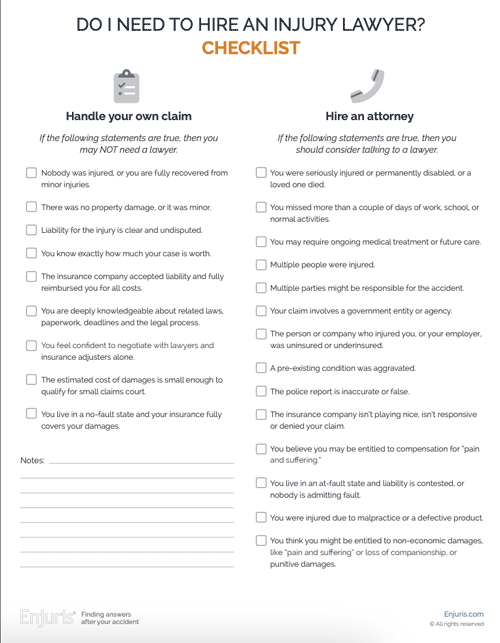 When To Hire a Lawyer Checklist
Can you handle your own claim, or should you hire an attorney? Use this worksheet to determine when you should consider hiring a personal injury or workers' comp lawyer.
Download in PDF format
See our guide Choosing a personal injury attorney.