

Deadlines, forms, and everything you need to know to claim workers’ compensation benefits
You were injured at work… Now what?
You want to be sure that you file a claim correctly and on time in order to receive the compensation you need to cover costs. The Montana Department of Labor & Industry (DLI) governs workers’ compensation in the state and can help you through the process.
Getting a diagnosis after a work injury
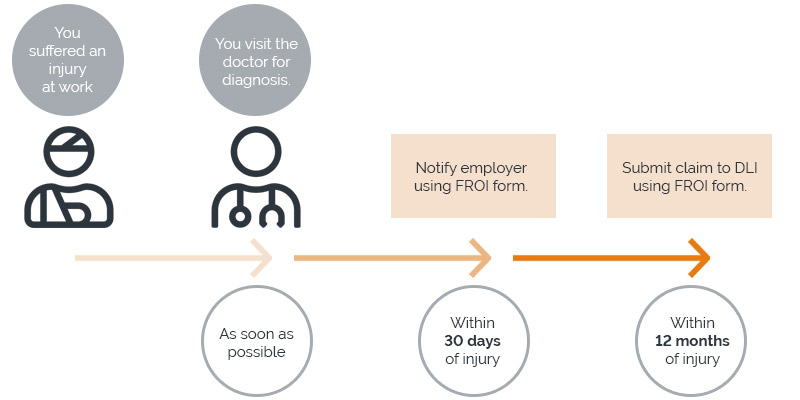
If you’ve suffered an injury at work, the first step is to get a diagnosis. In order to get initial treatment, you can go to your regular primary care provider or any physician of your choice. However, once the claim process begins, the insurer might designate a doctor or it will need to approve the one you chose.
It’s important to tell the medical provider right away that the injury is work-related. The physician must diagnose and treat your injury based on the Montana Utilization and Treatment Guidelines.
A diagnosis might be complicated, and it could require several office visits or tests like an X-ray, ultrasound, CT scan, MRI or blood tests.
Occupational illness or disease
Workers’ compensation is a no-fault insurance system. If you suffer any injury while on the job—whether it’s a slip and fall that results in a broken bone or a severe injury like an amputation—your employer’s workers’ compensation insurance is required to pay for those expenses, regardless of whether it was a pure accident or it was someone’s fault.
That “someone” could be a hazard in the workspace like a slippery floor, negligence of another employee or a supervisor, or even your own negligence. No-fault insurance means exactly that:
Workers’ compensation insurance covers that kind of injury simply because it happened at work.
An occupational illness or disease is a condition that develops as a result of conditions in the workplace, but isn’t from a specific incident or accident.
Examples include:
- Carpal tunnel syndrome or other repetitive motion injuries
- Asbestos-related cancer or lung conditions (for example, mesothelioma)
- Industrial asthma
- Industrial dermatitis
- Neurological disorders
- Back or neck strain and pain
While it’s clear that workers’ compensation insurance covers these conditions, it can be hard to prove that they developed as a result of workplace conditions or exposure. Especially if your condition is related to exposure to toxins or radiation, it could develop months or years after the exposure happened.
Filing a First Report of Injury form
The Montana DLI website includes the First Report of Injury (FROI) form. As an injured worker, you have two reporting requirements:
- You must notify your employer within 30 days of the injury or when you became aware that your condition was related to your employment.
- The signed form must be submitted to the employer’s insurer or the DLI within 12 months of the injury.
If you fail to submit this form on time, you can lose your right to receive benefits.
You’ll notice that there are sections on the form for the worker, employer, and insurer to complete. Once you’ve completed your portion (worker), your employer is required to complete their section and forward it to the insurer within 6 days. The insurer is then required to forward it to the DLI immediately.
How the workers’ compensation insurer handles a claim
The adjuster might require you to submit to an independent medical evaluation (IME). You would visit a doctor selected by the insurance company in order for them to verify your doctor’s diagnosis or get a second opinion. The adjuster is required to take your convenience, physical condition, and ability to attend into consideration when scheduling the time and place for this evaluation.
Once the adjuster has evaluated your claim, they’ll inform you within 30 days about what benefits the insurance company intends to provide. If you’re satisfied by the offer and you believe that it fairly compensates you for your losses, you can enter into a settlement agreement with the insurance company.
Once the claim is accepted, wage loss benefits begin to be paid within 14 days.
Should I consult a personal injury lawyer before agreeing to a workers’ compensation settlement?
It’s a good idea to consult a personal injury lawyer before agreeing to a workers’ compensation settlement. In Montana, a workers’ compensation settlement is a full and final release of liability. In other words, signing a settlement agreement means that you can’t change your mind later if you decide that you need additional benefits. Your claim is closed and you can’t make any more requests or claims related to that injury.
Workers’ compensation is an exclusive remedy for an injury at work, which means you can’t sue your employer for negligence because your workers’ compensation claim takes the place of a lawsuit. BUT in some circumstances, there might be a personal injury claim if there are other factors involved.
For example, if you fell off a scaffold because your safety harness broke, you might be able to sue the manufacturer of the harness in a lawsuit separate from your workers’ compensation claim.
Another example of a third party being negligent for your injury is if your job takes you to a worksite owned by someone else and you’re injured because of negligence in maintaining the building or land. In that case, it’s possible that you could have personal injury lawsuit against the property owner.
It’s important that you’re aware of all of your options before you accept a settlement. Even if there’s no possibility of a lawsuit against a third party, you also want to be certain that the compensation you’re getting is exactly what you deserve. Especially if your injury was severe and you might be out of work for a while, or if you won’t be able to return to the same job or one at the same pay rate, it’s important that the benefits are enough to cover your past and future lost wages.
A workers’ compensation lawyer is experienced at handling claims and representing the interests of the injured worker. They’ll advise you about whether your settlement is fair and if it’s going to be enough to cover your future expenses.
What to do if your claim is denied
If your claim is denied, or if the amount offered isn’t enough to cover your expenses, there’s an appeals process.
DLI offers a Petition for Settlement Disputed Initial Compensability. That’s a lot of words to describe a form to request more benefits than the insurance company offered. You need to submit the original denial letter to the DLI, along with the form, to challenge the insurance company’s decision.
You can take these steps after initiating an appeal:
- Send a letter to the insurance company. Explain why you disagree with the decision and what you think you should receive in benefits. The insurance company has 15 days to respond. If it denies your appeal or doesn’t respond, you move to the next step.
- Request a mediation conference. It’s mandatory to file a mediation petition to dispute a Montana workers’ compensation benefit award. The mediation conference is a three-way phone call between you, the insurance company, and the mediator. The mediator’s role is to facilitate a settlement agreement. The mediator doesn’t issue a decision, but they can make a recommendation for a fair settlement. You don’t need to accept the settlement, but if you do, you’re bound to it. You can’t change your mind later. It’s a good idea to have your workers’ compensation attorney on the call, too. They can handle negotiations and make sure you’re getting a fair settlement before you agree to anything.
- Petition for a workers’ compensation hearing. If you don’t reach agreement through mediation, you can request a hearing with the Montana Workers’ Compensation Court. This can be a lengthy process; it can take up to 2 years after denial of a claim for a hearing to happen. Before the hearing, you’ll attend a pretrial conference. The judge reviews your case, looks at the issues, and considers both parties’ evidence. At the hearing, each side presents witnesses, documents, and arguments. The judge will issue a written decision.
- Appeal to the Montana Supreme Court. If you still believe that you’re not getting appropriate resolution, you can appeal to the Montana Supreme Court. The court will review the judge’s order and decide whether to uphold or overturn it.
How to find a Montana workers’ compensation lawyer
As you can see, workers’ compensation can be a complicated process. Settlement negotiations often include provisions having to do with disability benefits, social security, and your pension. That’s why it’s important to have someone on your side who speaks the legal language.
The Enjuris Personal Injury Law Firm Directory includes Montana personal injury lawyers who are ready to help with your workers’ compensation claim. They’re experienced in handling insurance companies and know the ins and outs of the process so that you can get the benefits you deserve.

How SSD and Workers’ Comp Interact in Montana
Learn how Montana workers can coordinate SSD and workers’ comp benefits, avoid offsets, and protect income through smart timing and settlement planning.
See our guide Choosing a personal injury attorney.