

What to do if your Montana insurance provider leaves you high and dry
If you’re injured in an accident, there’s a good chance you’ll end up corresponding with an insurance company sooner or later. Whether it’s your own insurance company or the insurance company for the at-fault party, most people find this process about as enjoyable as being stuck in rush-hour traffic or getting a root canal.
Part of the reason dealing with an insurance company is so frustrating is that it often feels like they are in the driver’s seat and there’s nothing you can do to help resolve your claim. But, in fact, there is something you can do if the insurance company fails to act reasonably.
An insurance “bad faith claim” is a legal term used to describe a claim that a person may have against an insurance company for its “bad acts.”
This article looks at bad faith law in Montana, including the obligations an insurance company has and the damages that can be recovered when those obligations aren’t met.
First-party vs. third-party insurance claims
Before we dive into when you can sue an insurance company, it’s important to recognize that a bad faith lawsuit can stem from a first-party claim or a third-party claim.
- A first-party claim occurs when you file a claim with your own insurance company after an accident or injury. For example, let’s say you scratch the side of your vehicle while backing out of your garage. If you decide to file a claim, you’ll do so with your own insurance company.
- A third-party claim occurs when you file a claim against another person’s insurance policy. For example, if you’re rear-ended by another driver, you’ll obtain the other driver’s insurance information after the accident and file a claim with their insurance company.
Overview of Montana bad faith laws
In Montana, you can file a lawsuit against your own insurance company under any of the following 3 causes of action:
- Breach of contract
- Fraud
- Violation of Montana’s Unfair Claim Settlement Practices Act
With respect to third-party claims, you can file a lawsuit under the latter 2 causes of action. However, because you don’t have a contract with the at-fault party’s insurance company, you can’t sue their insurance company for breach of contract.
Let’s take a look at all 3 causes of action:
Breach of contract
Although you might not think of it as such, an insurance policy is a contract between the policyholder (the insured) and their insurance provider (the insurer). Like any other type of contract, an insurance policy spells out the obligations of both parties. If the insurance company fails to meet (in other words, breaches) any of these obligations, the insured can sue for breach of contract.
In order to establish a breach of contract claim against your insurance company, you must prove the following three elements:
- The existence of a contract,
- A breach of 1 or more of the contract’s terms by the insurer, and
- Damages suffered as a result of the breach.
The most common example of a breach of contract claim in the insurance context is when the insurance company refuses to provide coverage for an event that is clearly covered by the policy.
Fraud
Montana permits an action against an insurance company for actual or constructive fraud. The Montana Supreme Court has identified the following elements that must be proven to establish a claim of actual insurance fraud:
- A representation
- Its falsity
- Its materiality
- The speaker’s knowledge of its falsity or ignorance of its truth
- The speaker’s intent that it should be acted upon by the person and in the manner reasonably contemplated
- The hearer’s ignorance of its falsity
- The hearer’s reliance upon its truth
- The right of the hearer to rely upon it
- The hearer’s consequent and proximate injury or damage
That’s a lot of legalese, but essentially an insurance company commits actual fraud if it knowingly makes a false statement about your policy and you rely on that false statement to your detriment.
Constructive insurance fraud, on the other hand, is defined by statute as:
Again, that’s a lot of legalese. To put it more simply, actual fraud requires knowledge and intent to commit fraud on the part of the insurance company, whereas constructive fraud only requires knowledge.
Montana’s Unfair Claim Settlement Practices Act
Montana’s Unfair Claim Settlement Practices Act (MUCSPA) is the meat and potatoes of most bad faith claims.
Under MUCSPA, an insured person or a third-party claimant can bring an action for actual damages caused by any of the following acts or omissions by the insurance company:
- Misrepresentation of important facts or insurance policy provisions relating to coverages at issue
- Refusal to pay claims without conducting a reasonable investigation based upon all available information
- Failure to affirm or deny coverage of claims within a reasonable time after proof of loss statements have been completed
- Failure to attempt to reach a prompt, fair, and equitable settlement of claims in good faith, in which liability has become reasonably clear
- An attempt to settle claims on the basis of an application that was altered without notice to or knowledge or consent of the insured
- Failure to promptly settle claims when liability has become reasonably clear in order to influence settlements under other portions of the insurance policy coverage
Statute of limitations in bad faith cases
For a bad faith claim under MUCSPA, the lawsuit must be filed within 2 years from the date of the violation (for an insured) or 1 year from the date of the settlement or entry of the judgment on the underlying claim (for a third-party claim).
What damages can be recovered in a bad faith claim?
In a Montana bad faith claim, the plaintiff can recover the following types of damages:
- The amount due under the insurance policy (up to the policy limits). For example, if your insurance company improperly denies your claim for $400,000, you can recover the full $400,000 (assuming the amount is under your policy limits).
- Consequential damages. This includes any other damages that occurred because of the insurance company’s bad act.
- Emotional distress. You can recover damages for any anxiety, emotional distress, or embarrassment suffered as a result of the insurance company’s bad faith.
- Punitive damages. Punitive damages are rare and only available if the insurance company acted with actual malice or actual fraud. Punitive damages are limited to $10 million.
If you think you may have a bad faith claim against an insurance company, be sure to document everything (especially any written or oral correspondence with the insurance company) and reach out to a Montana personal injury attorney.
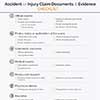 Documents & Evidence Checklist
Checklist of 30 items to help you prepare for making a personal injury or accident claim
Download in PDF format
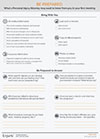 Your First Meeting with an Attorney
A worksheet to prepare for your first meeting with a personal injury attorney – what to bring, what they'll ask
Download in PDF format
See our guide Choosing a personal injury attorney.