
What to do after a hit-and-run accident
What’s more frustrating than a car accident?
A hit-and-run accident.
A hit and run occurs when a driver hits another vehicle, person, or piece of property and flees the scene without stopping to provide their personal information.
All states have laws imposing penalties for committing a hit and run. In Illinois, the penalties range from small fines to lengthy prison sentences depending on the circumstances of the crash.
Here’s what you need to know if you’re the victim or the perpetrator of a hit-and-run accident in the Prairie State.
Chicago is the largest city in Illinois. With a population of over 2.5 million, hit and run in the Windy City is among the highest in the state.
What makes an accident a hit-and-run in Chicago?
In Chicago, and throughout Illinois, a driver is required by law to remain at the scene of a car accident until all involved parties have exchanged information and the accident is reported to the police. If you fail to do this, you can be charged with either a misdemeanor or a felony.
Failure to stop and provide information results in a Class A misdemeanor if the accident resulted in only property damage. Penalties increase with the severity of the accident up to a Class 4 felony if the crash results in a fatality. This would mean 1-3 years in prison, a fine up to $25,000, and license revocation. Failure to report the accident to the police is a Class 1 felony punishable by imprisonment of 4-15 years, along with a fine up to $25,000 and license revocation.
Hit-and-run statistics
According to research conducted by the AAA Motor Club, a hit-and-run crash occurs every minute in the United States.
Though not all hit-and-run accidents end in tragedy, fatal hit-and-run crashes have been on the rise in the U.S. In 2016, there were more than 1,900 fatal hit-and-run crashes nationwide — 69 of those in Illinois. The majority of victims were bicyclists and pedestrians.
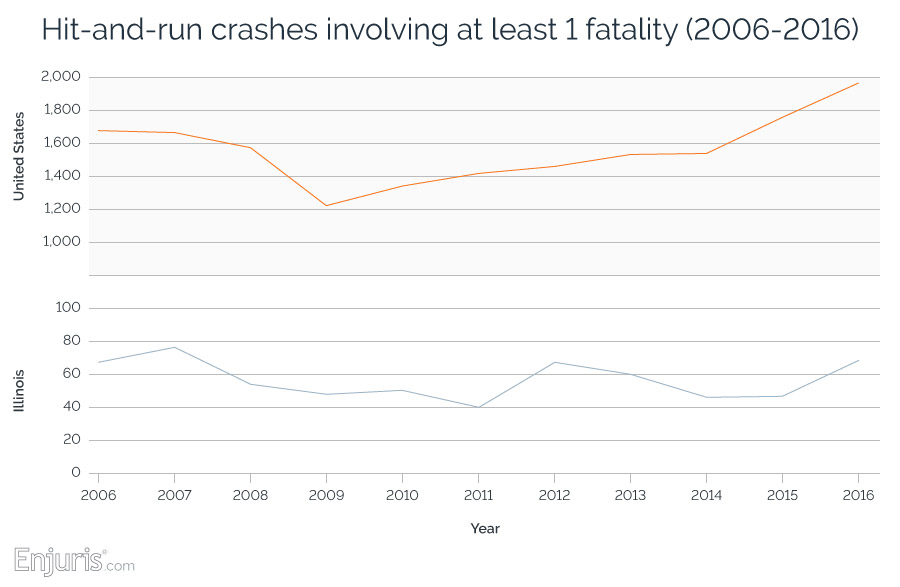
Source: AAA Foundation for Traffic Safety
Illinois hit-and-run laws
The Illinois laws concerning hit-and-run accidents can be found in the Illinois Vehicle Code. Here’s what you need to know:
In Illinois, the driver of any vehicle involved in a motor vehicle accident that results in injury or property damage is required by law to:
- Stop their vehicle at the scene or as close as possible
- Provide their name, address, registration number, and driver’s license to others involved in the accident
- Assist any injured persons
Illinois law requires you to file a written report if the accident you were involved in resulted in:
- Death or injury, or
- Property damage of more than $1,500
The report form is generally provided at the scene by the responding officer. However, the form can also be obtained at any police station or sheriff’s office. The form should be filed online or by mail as indicated on the form within 10 days of the accident. Failure to file an accident report within 10 days of the accident could result in the suspension of your license.
Penalties for a hit and run in Illinois
The penalties for a hit and run depend on the circumstances surrounding the accident, including the nature of the damages caused.
- Accidents with an unattended vehicle. If you failed to stop and leave your information after crashing into an unattended vehicle such as in a parking lot, you’re guilty of a Class A misdemeanor. The penalties include possible imprisonment of less than 1 year and a possible fine of no more than $2,500.
- Accidents that cause only property damage. If you fail to stop for an accident that caused only property damage, you’re guilty of a Class A misdemeanor. The penalties include possible imprisonment of less than 1 year and a possible fine of no more than $2,500. If the damage you caused is more than $1,000, your driver’s license will be suspended.
- Accidents that cause injury. If you fail to stop for an accident that resulted in injury, you’re guilty of a Class 4 felony. The penalties include imprisonment of 1-3 years, a maximum fine of $25,000, and the revocation of your license. In addition, if you fail to report the accident to the police, you’re guilty of a Class 2 felony. The penalties include imprisonment of 3-7 years, a maximum fine of $25,000, and revocation of your license.
- Accidents that cause death. If you fail to stop for an accident that results in death, you’re guilty of a Class 4 felony. The penalties include imprisonment of 1-3 years, a maximum fine of $25,000, and the revocation of your license. In addition, if you fail to report the accident to the police, you’re guilty of a Class 1 felony. The penalties include imprisonment of 4-15 years, a maximum fine of $25,000, and the revocation of your driver’s license.
| Illinois Penalties for a Hit-and-Run | ||||
|---|---|---|---|---|
| Accidents with an unattended vehicle | Accidents that cause only property damage | Accidents that cause injury | Accidents that cause death | |
| Failure to stop and provide the required information | Maximum imprisonment of 1 year
Maximum fine of $2,500 |
Maximum imprisonment of 1 year
Maximum fine of $2,500 License suspension (if more than $1,000 damages) |
Imprisonment of 1-3 years
Maximum fine of $25,000 Revocation of license |
Imprisonment of 1-3 years
Maximum fine of $25,000 Revocation of license |
| Failure to report accident to police | None | None | Imprisonment of 3-7 years
Maximum fine of $25,000 Revocation of license |
Imprisonment of 4-15 years
Maximum fine of $25,000 Revocation of license |
Why wouldn’t a driver stop?
There are many reasons why a driver might flee the scene of an accident. Some of the more common reasons include:
- The driver is intoxicated or driving under the influence of drugs
- The driver is driving with a suspended license
- The driver doesn’t have car insurance
- There is an outstanding warrant for the driver’s arrest
- The car is stolen
In addition, a driver might flee the scene because they didn’t realize they were involved in an accident (or that someone was injured).
The defendant was driving a commercial truck when he drifted out of his lane and struck a pickup that was stopped on the shoulder. Jose Ibarra was standing next to the driver’s side of the pickup truck and struck by the defendant’s vehicle. He died almost immediately.
The defendant didn’t stop.
A witness who saw the accident contacted the police and provided the defendant’s license plate number. When apprehended by the police, the defendant admitted to falling asleep and drifting out of his lane, but stated that he thought he hit a road sign or mile marker. He denied knowing that he hit a pickup truck.
The defendant was arrested and charged with a felony for failing to stop after an accident involving death. The sole issue on appeal was whether the charge required the State to prove that the defendant knew that he was in an accident with another person.
Ultimately, the Court of Appeals held that the State must establish that the defendant knew that a person was involved in the accident. The court ordered a new trial in which the State could attempt to prove this element.
What should you do if you’re the victim of a hit and run?
If you’re injured in a car accident, the first emotion you probably feel is fear — fear that you or someone else is injured. If you’re the victim of a hit and run, this fear is quickly joined by feelings of frustration.
How could someone run from this?
Try to remain calm and take the following 3 steps:
- Contact emergency services. If you’re injured, you’ll want to call an ambulance right away. You’ll also want to contact the police and explain that you were involved in a hit and run.
- Collect information. Gather as much information about the driver, car, and accident as possible, including the license plate number, a description of the vehicle, the direction the vehicle was headed, and photos of the accident scene and any damages.
- Locate witnesses. Did anybody see the accident? What about people in nearby vehicles or those waiting for the bus nearby? How about individuals working in the surrounding buildings? Identify any witnesses and collect their contact information. When the police arrive, be sure to tell the police about the witnesses.
Just as there are some things you should do following a hit and run, there are also some things you absolutely should not do:
- DON’T chase after a fleeing driver. Not only is chasing after a fleeing driver extremely dangerous, but you may miss key witnesses if you leave the scene.
- DON’T leave the scene before calling the police. If it’s safe to do so, stay at the scene and wait for the police to arrive. Going home or even to the hospital before contacting the police may cause the police to doubt your story.
How do I recover damages after a hit and run?
Hopefully, the police (or your lawyer) will be able to track down the fleeing driver. If the driver is found, you can file a claim with their insurance provider or file a personal injury lawsuit against them.
Examples of optional coverage that might cover hit-and-run damages include:
- Uninsured motorist (UM) coverage. UM coverage provides coverage for bodily injury and property damage sustained by you or the passengers in your vehicle as a result of an accident involving an uninsured driver or a driver who can’t be located. In Illinois, UM coverage is required.
- Personal injury protection (PIP) coverage. PIP coverage provides up to $10,000 in coverage regardless of who’s at fault. What is covered depends on your specific policy.
- MedPay coverage. MedPay coverage provides coverage for medical expenses incurred by you and your passengers regardless of who is at fault.
An attorney can help investigate a hit-and-run accident and make sure you receive the damages you deserve. Use our free online directory to find an experienced personal injury attorney in your area.
See our guide Choosing a personal injury attorney.