A work injury can affect every aspect of your life. That’s why workers’ compensation benefits are designed to compensate you for a variety of costs.
No matter what type of job you have, anyone—anyone!—could be injured at work.
Workers’ compensation exists to provide no-fault insurance benefits to a person who becomes injured while at their workplace or while performing work-related tasks.
The Delaware Department of Labor reports that there were 427,527 people employed in the state in 2020. Of those, 7,900 suffered non-fatal work-related injuries or illnesses and there were seven fatalities. The number of illnesses and injuries was the lowest that year since 2006. (source)
Here’s a look at Delaware injuries and illnesses by industry:
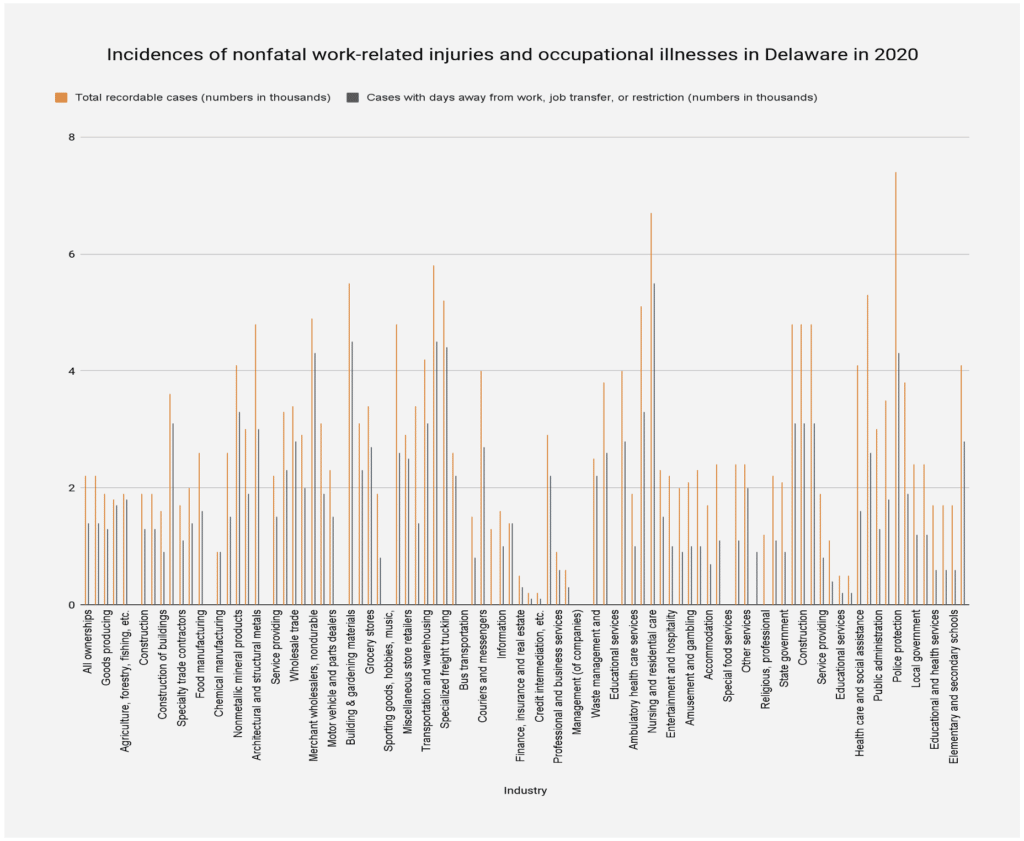
Source: U.S. Bureau of Labor Statistics
When are you eligible for Delaware workers’ compensation benefits?
Workers’ compensation is provided by an employer to benefit an employee who is injured at work. A Delaware employer with one or more employees is required to carry workers’ compensation insurance. Farm workers are exempt but employers may elect coverage.
An injury is covered if:
- It happened in the workplace. If you’re on your work site, it doesn’t matter if you were performing tasks directly related to your job or not. In other words, if you trip in the company break room while you’re grabbing your lunch from the refrigerator, your injuries would be covered.
- It happened off-site but while engaged in activities for your work. In other words, if your job takes you to clients’ homes or offices, offices to work with other professionals, construction sites or anywhere you need to be for your job, you can receive workers’ compensation for injuries that happen in those locations.
Occupational illnesses and diseases
Some work-related issues arise without a specific accident or incident that causes them. You could experience an injury or illness that develops gradually over time. These are also covered under Delaware workers’ compensation insurance.
Strain or repetitive motion injuries
Injuries like musculoskeletal strain from lifting, turning, reaching or repetitive motion can leave you with pain or discomfort that happens after doing these activities for an extended period of time, but they’re not isolated to a specific incident. You don’t have to be performing hard labor in order to suffer strain—these types of injuries can happen to people who work at a “desk job” using computers or phones, who spend a lot of time driving or even those who are simply on their feet often.
Occupational illnesses
There are also illnesses that develop as a result of a condition or the environment of your workplace. People who are exposed to excessive noise on a regular basis can develop hearing problems or related issues, for example. You also could develop an illness if you’re exposed to chemicals or toxins at work.
These are covered illnesses under Delaware workers’ compensation insurance.
Delaware workers’ compensation benefits
Medical treatment
Delaware workers’ compensation offers benefits that cover the cost of your medical treatment related to the injury. This includes doctor or hospital visits, prescription medications, diagnostics like CT scans or MRI, ongoing physical or rehabilitative therapies and more.
Temporary total disability
If your injury leaves you unable to work for more than three days, you can receive temporary total disability benefits beginning on the fourth day. However, if the disability extends beyond seven days, then you can be compensated for the full time out of work with no waiting period.
You can receive 66⅔% of your gross weekly wages from immediately prior to the injury, up to a state-mandated maximum.
Temporary partial disability
If you’re able to return to work but at a lower rate of pay than prior to the injury, you can receive temporary partial disability benefits until you’re able to resume the duties of your previous role.
You can receive ⅔ of the difference between your pre-injury wage and your current wage. You can receive this benefit for up to 300 weeks.
Permanent impairment
If you suffer a permanent partial disability, your benefits are based on a percentage of your losses. A “scheduled” loss under Delaware workers’ comp law is a loss that involves the arms, hands, fingers, legs, feet, toes, eyes or ears. An “unscheduled loss” involves the back, heart, lungs and other systems.
Disfigurement
If a worker suffers a scar, burn or amputation injury, they may file a petition for disfigurement one year after the accident or surgery. This benefit is paid for up to 150 weeks, depending on the severity of the injury.
Death benefits
If a person dies in a work-related injury or from a work-related illness, their dependent survivors may claim benefits.
The secretary of labor designates a maximum rate, and dependents may be paid up to 80% of the maximum rate. The employer or the workers’ comp insurer must pay up to $3,500 in funeral or burial expenses.
How to make a claim for Delaware workers’ compensation benefits
If you’re a worker who was injured, there are three steps you can take right away:
- You must immediately notify your employer of the injury. If you fail to provide notice of the injury or refuse to accept medical treatment, it could jeopardize your right to receive benefits.
- Provide a notice of claim to your employer if the period of disability extends beyond three days.
- If you cannot reach agreement with your employer or the insurer, you can apply for a hearing before the Industrial Accident Board.
What if your workers’ compensation claim is denied?
If your employer denies coverage for your injury, you have two years from the date of the accident or discovery of the illness in which to file a petition with the Delaware Office of Workers’ Compensation.
Note that if you have a hearing, your employer is required to be represented by an attorney. The employee is not. The employee is not provided an attorney but will have an assigned specialist who can help you navigate the process and can answer your questions.
If you have a hearing, it would benefit you to have a Delaware workers’ compensation attorney. A lawyer isn’t as costly as you might think. Rather, your lawyer’s compensation is a percentage of your benefits. You don’t need to pay out of pocket up front.
When should you seek the guidance of a workers’ comp lawyer?
If your injury is not severe and you are able to receive one-time treatment or short-term treatment and reach full recovery, you might not need a lawyer.
However, if you are severely injured, require ongoing treatment or if the insurance company is not immediately offering to cover the full value of your claim, you should contact a workers’ compensation lawyer right away.
Your lawyer will negotiate your claim with the insurer and ensure that the amount of compensation is correct for the length of time you’ll be out of work and any future medical treatment and other covered expenses.
Did you know that workers' compensation law varies by state?












Need a lawyer?

The basis for personal injury law is fairly straightforward:
If you’re injured because of someone’s negligence, then you’re entitled to recover for your financial losses related to the injury.
The premise for the workers’ compensation system is similar:
Your employer is required to have specific insurance that provides benefits if you’re injured at work.