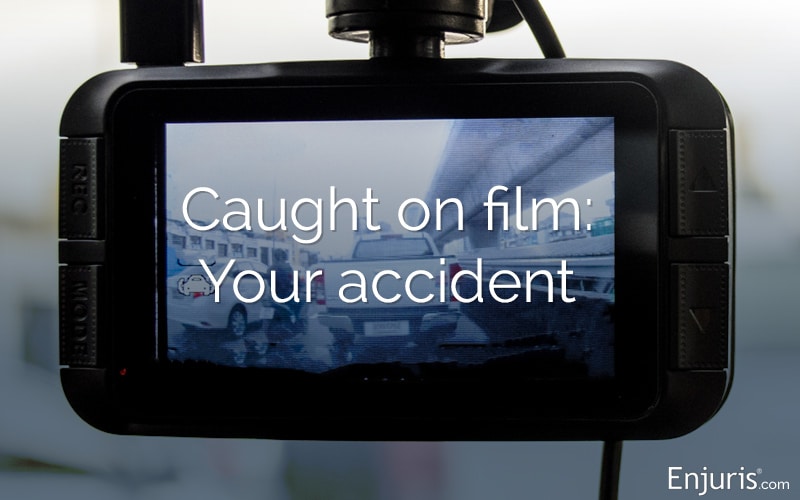
Dashcams are legal in all 50 states, but there are regulations that might affect how you use them
A dashboard-mounted camera, or “dashcam,” might be able to act as your “witness” if it captures the events leading up to—or during—a car accident.
A dashcam is a video camera that’s attached to the inside of a vehicle that continuously records what’s happening either outside or inside the vehicle.
This might work in your favor after an accident, or it might not.
Dashcams are legal
In all 50 states, it is legal to install a dashcam in your vehicle.
However, it’s important to note that some states vary with how you can use the recorded information because it’s a form of surveillance.
Some states have wiretapping and other privacy laws that could prevent dashcam footage from being used in a legal matter. Most people use dashcams to record what’s happening outside the car, but there are some dashcams that also record audio of what happens inside the car, and that could include conversations between the driver and passengers.
In other states, everyone being recorded needs to consent. The all-party consent states are:
California
Connecticut
Delaware
Florida
Illinois
Maryland
Massachusetts
Michigan
Montana
Nevada
New Hampshire
Oregon
Pennsylvania
Vermont
Washington
If the dashcam is recording what’s being said inside the car, it could provide evidence of the driver and passengers’ observations and mindset immediately preceding, during, and immediately following a crash.
If a judge or jury needs to determine fault for a car accident, this could be significant.
Let’s look at a couple of examples:
A vehicle ahead is swerving dangerously. The passenger is recorded 5 minutes before the accident speaking to the driver saying, “Watch out for that blue sedan! He’s all over the place, so you should keep your distance.”
This does show that there was a dangerous driver ahead who was likely to cause an accident, but it also shows that the driver of the vehicle that was recorded was aware of the situation and could have taken steps to avoid an accident. In a state where a plaintiff’s liability can affect the amount of damages, this can result in the plaintiff’s being unable to claim damages.
The driver and passenger are talking. The driver says to the passenger, “I just heard my phone buzz. Can you hand it to me so I can see who texted?” Moments later, an accident happens.
This exchange could demonstrate that the driver was texting while driving, and that can be important for determining the cause of the accident.
The question of whether the car’s occupants consented to be recorded could be important with respect to whether the recording is admissible as evidence in court.
The issue of privacy for passengers being recorded is particularly important for Uber, Lyft, and other ride-sharing services. Uber and Lyft defer to relevant state laws with respect to passenger recordings.
Know your state law for mounting a dashcam
Dashcams are legal in every state, but there are regulations about how you can mount one.
In Nevada, Kentucky, Maryland and New York, you may use a suction cup to mount a dashcam on your windshield. There are 12 states (Idaho, California, Arizona, Alaska, Hawaii, Colorado, Arkansas, Illinois, Alabama, Georgia, Florida, Delaware, and Connecticut) that have specific mounting rules — like that the dashcam may not occupy more than a 7-square-inch area on the passenger side or a 5-inch area on the driver’s side.
The remaining states do not permit a dashcam to be mounted on the windshield.
Dashcam footage as evidence in a personal injury lawsuit
When you’re in a car accident, you can receive damages based on who was at fault. The specific rules related to fault vary by state; some states have a system of no-fault insurance where you can collect an insurance payment regardless of who caused the accident.
There are instances when insurance doesn’t cover the full extent of your damages and you need to file a personal injury lawsuit in order to recover damages (costs) associated with the accident.
Sometimes, it’s clear who caused the accident. In other instances, it could be less obvious. If that happens, the insurance companies and lawyers are going to need to determine exactly how the accident happened.
Here are some of the advantages and disadvantages to using dashcam footage as evidence:
| Advantage to a dashcam | Disadvantages to a dashcam |
|---|---|
| A dashcam can provide proof that the accident happened. If the accident was the other driver’s fault, the video footage might show that and can be valuable evidence. | You might not be able to use dashcam footage recorded on private property or restricted areas. On a public road, that shouldn’t be an issue.
It’s also possible that your dashcam footage could show that you caused or contributed to the accident and it can hurt your case. |
Remember this:
For instance, the dashcam might show that another driver made an illegal left turn when they hit you. But it might also have captured audio recording that your child was crying in the backseat. The defendant’s attorney might try to argue that you were distracted by your child and therefore didn’t react quickly or correctly to avoid the collision.
Dashcam footage will be treated like any other photo or video evidence.
It needs to be reliable, meaning it was unedited or altered in any way. It is also subjective. There could be differences of opinion, even among experts, about what the video demonstrates.
Similarly, if your camera records someone committing a crime, neither the police nor anyone else may require you to delete the footage. You should consult a lawyer in this instance to find out your legal rights and responsibilities.
Should you get a dashcam?
The decision is yours.
But if you’re in an accident, you should know that there might be parts of the recording that can work against you, even if you think it is mostly in your favor.
All in all, a dashcam can be used as valuable evidence following an accident. It’s similar to when a store has surveillance video that captures a customer’s slip and fall, for instance.
After any accident when liability is in question, or if you’re not being offered the settlement you think you deserve, you should contact a personal injury lawyer. Your lawyer will review the evidence and maximize your damage amount by minimizing your liability. It’s also best not to share dashcam footage with any insurance company, law enforcement, or the other parties until it’s been reviewed by your own lawyer.

Dash Cam Laws by State: What To Know Before You Go
Dash cam laws vary by state. Learn where dash cams are legal, restrictions on audio recording, and how to stay compliant with local regulations.
See our guide Choosing a personal injury attorney.