
The internet loves a good “can-you-believe-it” law. The problem is that many of these lists recycle claims that were never actually laws—or that were repealed years ago.
At Enjuris, we aim to be an accurate source of legal information, even when the topic is a little silly. So we went back to the primary sources—state statutes, administrative rules, and municipal codes—to build a list of genuinely odd rules that are still on the books.
Below, you’ll find the weirdest verified law from each U.S. state, complete with a citation to the official source. But before you scroll down to see where your state lands, a quick word about how these strange laws come to exist—and whether anyone actually enforces them.
How do weird laws get passed?
Strange laws tend to fall into a few familiar origin stories:
- Time capsules: Rules that made sense when written (such as early tech safety or public health concerns) but now read like relics.
- One-off incidents: A town faces a specific problem (a nuisance business or street festival), so it adopts a micro-targeted fix that lingers for decades.
- Industry and lobbying: Odd-sounding laws can protect local businesses or resources (think native plant protection, dairy or margarine labeling, or billboard restrictions). They look quirky, but there’s an economic logic behind them.
- Moral waves and public panics: Periodic surges in regulation—alcohol promotions, fortune-telling licenses, animal exhibitions—often reflect the social anxieties of the moment.
The key thing to remember when looking at an unusual law is context. Most of these laws weren’t “weird” to the people who passed them.
Are these strange laws actually enforced?
As is often the case in the law, the short answer is: it depends. Let’s think about enforcement as a spectrum:
- Active: Still cited, ticketed, or charged in routine enforcement (often safety, wildlife, or alcohol-marketing rules).
- Dormant (“zombie laws”): Technically enforceable, but rarely used. These laws linger because repealing them often takes time and political will. Removing a law from the books usually requires the same formal process it took to enact it — including committee reviews, votes, and publication. If a law isn’t causing harm or controversy, legislators may see little reason to prioritize its repeal. Over time, these forgotten sections can survive through code updates and reorganizations, quietly remaining part of the legal record.
- Preempted or constrained: A local ordinance may be overshadowed by later state or federal law, or limited by constitutional decisions. It might stay printed in the code but be functionally toothless.
Practically speaking, police and prosecutors use discretion. Even when a rule exists, they may prioritize other issues unless a complaint, injury, or pattern forces them to take action.
The weirdest law in every U.S. state
Now that we’ve covered how these laws came to be and whether they’re enforced, let’s take a tour of the strangest rules still on the books—one from each of the fifty states.
Each entry includes a plain-English summary and an official citation so you can read the law for yourself.
| State | Weird law | Citation |
|---|---|---|
| Alabama | In the City of Mobile, it’s illegal to sell, use, or possess plastic confetti or “spray string.” | Mobile Code § 39-77 (Ord. No. 39-022-2018) |
| Alaska | In Anchorage, it’s illegal to occupy a house trailer while it is being moved upon a public street. | Anchorage Code of Ordinances § 9.36.060 |
| Arizona | Protected native plants (including saguaro) may not be removed/damaged without permits or landowner permission. | Ariz. Rev. Stat. § 3-908 |
| Arkansas | In Little Rock, it’s unlawful to sound the horn on a vehicle at any place where cold drinks or sandwiches are served after 9:00 p.m. | Little Rock Code of Ordinances § 18-54 |
| California | If a frog used in a frog-jumping contest dies, it must be destroyed and may not be eaten. | Cal. Fish & Game Code § 6883 |
| Colorado | In the city of Pueblo, it’s illegal to allow a dandelion to grow more than 10 inches tall on your property. | Pueblo Code of Ordinances § 7-4-2 |
| Connecticut | Hunting on Sunday is prohibited, with narrow exceptions for archery deer on certain private lands. | Conn. Gen. Stat. § 26-73 |
| Delaware | Rehoboth Beach strictly regulates trick-or-treating hours and date (with Sunday exception rules). | Rehoboth Beach Code § 198-33 |
| Florida | Bars and alcohol-licensed premises may not engage in or permit “dwarf-tossing.” | Fla. Stat. § 561.665 |
| Georgia | In Kennesaw, heads of households are required by ordinance to maintain a firearm (numerous exceptions). | Kennesaw Code of Ordinances § 34-21 |
| Hawaii | Billboards are essentially banned statewide (strict outdoor advertising limits). | Haw. Rev. Stat. §§ 445-111 – 445-121 |
| Idaho | Cannibalism explicitly criminalized; up to 14 years (affirmative defense for survival). | Idaho Code § 18-5003 |
| Illinois | It’s a felony to possess more than $300 worth of salamanders. | Illinois Compiled Statutes § 68/105-95 |
| Indiana | It’s illegal to throw a snowball across the street in Warsaw, Indiana. | Warsaw Code of Ordinances § 54-61 |
| Iowa | Restaurants that serve oleomargarine (margarine) must either clearly post a notice or serve it in a triangular form to distinguish it from butter. | Iowa Code § 191.3 |
| Kansas | Lawrence bans upholstered indoor furniture on unenclosed porches, decks, balconies, or other exterior areas. | City of Lawrence Ordinance No. 8900; Property Maintenance Code §§ 302.12–302.13 |
| Kentucky | No reptiles in religious services (snake-handling ban). | KRS § 437.060 |
| Louisiana | Traditional jambalaya may be prepared in the open at public gatherings (despite sanitary code). | La. R.S. § 40:4.2 |
| Maine | Off-premises billboards are banned statewide. | 23 M.R.S. § 1913-A |
| Maryland | In Calvert County, fortune‑tellers must obtain a license and pay a $1,000 fee (plus fingerprint/photo & background check). | Md. Local Gov’t § 13-205 |
| Massachusetts | “Happy hour” drink specials (time-limited price reductions) are banned statewide. | 204 CMR 4.03 |
| Michigan | Adultery is a felony. | MCL § 750.30 |
| Minnesota | “Greased pig” contests and turkey scrambles are illegal animal mistreatment events. | Minn. Stat. § 343.36 |
| Mississippi | Profane/vulgar language or drunkenness in a public place (in the presence of two or more people) is a misdemeanor. | Miss. Code Ann. § 97-29-47 |
| Missouri | Licensed motor-vehicle dealers cannot sell cars on Sundays (with limited exceptions). | Mo. Rev. Stat. § 578.120 |
| Montana | Feeding garbage to swine is unlawful (statute amended 2025). | Mont. Code Ann. § 81-2-502 |
| Nebraska | No marriage if either party is afflicted with a venereal disease. | Neb. Rev. Stat. § 42-102 |
| Nevada | Unincorporated Clark County: unlawful to feed wild pigeons (pigeon control ordinance). | Clark County Code § 10.36.035 |
| New Hampshire | It’s illegal to remove seaweed (rockweed) from the shore at night (sunset to sunrise). | N.H. Rev. Stat. § 207:48 |
| New Jersey | Self-serve gasoline is prohibited; attendants must pump your gas. | N.J.S.A. § 34:3A-4 |
| New Mexico | Unlawful tripping of an equine (horse, pony, mule, donkey, or hinny) is a crime; if it maims or kills the animal, it’s a fourth‑degree felony. | NMSA 1978, § 30-18-11 |
| New York | It’s illegal to sell dyed chicks, rabbits, or baby poultry; also limits sale of baby chicks under two months in lots under six. | N.Y. Agric. & Markets Law § 354 |
| North Carolina | Nonprofits are limited to two bingo sessions per week, each lasting no more than five hours, with at least 48 hours between sessions. | N.C. Gen. Stat. § 14‑309.8 |
| North Dakota | Arming an unmanned aerial vehicle (drone) with lethal weapons and certain surveillance uses are prohibited for law enforcement; chapter also restricts private surveillance. | N.D.C.C. ch. 29‑29.4 (see § 29‑29.4‑03) |
| Ohio | Possession of “dangerous wild animals” (e.g., big cats, certain primates) is prohibited, with limited exceptions. | Ohio Rev. Code § 935.02 |
| Oklahoma | Bear wrestling exhibitions and horse tripping events are illegal, including promoting or participating in them. | 21 O.S. § 1700 |
| Oregon | It’s unlawful to hunt big game from a motor‑propelled vehicle (with limited disability exceptions). | Or. Admin. R. 635‑065‑0735 |
| Pennsylvania | Fortune-telling for gain is a misdemeanor. | 18 Pa. Cons. Stat. § 7104 |
| Rhode Island | Traditional tie‑down calf roping is prohibited; rodeos are limited to breakaway calf roping (calf must be released immediately after roping). | R.I. Gen. Laws § 4‑20‑7 |
| South Carolina | In Myrtle Beach, thong/G‑string style bathing suits are prohibited in public areas (including the beach). | Myrtle Beach Code § 5‑30 (public exposure ordinance) |
| South Dakota | You may claim a deer or antelope killed by a motor vehicle if you notify a conservation officer and comply with permit/tag rules. | S.D. Codified Laws § 41-1-5.7 |
| Tennessee | Using someone else’s paid subscription (e.g., streaming) without authorization can be charged as theft of services; penalties scale by value. | Tenn. Code Ann. § 39-14-104 (theft of services); § 39-14-105 (grading) |
| Texas | Selling horsemeat for human consumption (or possessing it with intent to sell for human consumption) is a crime. | Tex. Agric. Code § 149.002 |
| Utah | ‘Happy hour’ style alcohol discounting and similar promotions (e.g., 2-for-1, free drinks) are prohibited by rule; free alcohol promotions also barred by statute. | Utah Admin. Code R82-1-104(5)(f); Utah Code § 32B-5-305 |
| Vermont | Billboards are banned statewide (no off-premises outdoor advertising). | 10 V.S.A. § 488 |
| Virginia | Sunday hunting is restricted: unlawful to hunt within 200 yards of a place of worship; unlawful to hunt deer or bear on Sunday with the aid of dogs. | Va. Code § 29.1-521(A)(1) |
| Washington | It is illegal to use an x-ray to see if a pair of shoes fit properly. | RCW 70A.388.190 |
| West Virginia | Roadkill salvage: wildlife (except certain species) killed by accidental vehicle strike may be possessed if reported within 12 hours and tagged within 24 hours. | W. Va. Code § 20-2-4(e) |
| Wisconsin | Restaurants may not serve margarine instead of butter unless the customer requests it; additional restrictions for certain institutions. | Wis. Stat. § 97.18(4)–(5) |
| Wyoming | Skiing while impaired is unlawful (Skier Safety Act). | Wyo. Stat. § 6‑9‑301(a) |
A guide to telling if an unusual law is real
If you want to sanity-check a viral claim or verify a rule in your city, use this five-step checklist:
- Find the primary source: Start by searching for the official law itself. Try typing a phrase into Google like:
[state name] code cite or [city name] municipal code or [state name] statutes.
Most states host their codes on their legislature’s website, while cities often use online libraries such as Municode. Look for results from official .gov or code-library domains. Avoid blogs or third-party “fun facts” sites. - Check the “current through” date: Every code page lists when it was last updated, often showing the legislative session or ordinance number. Make sure you’re viewing the most recent version, since older snapshots can include repealed sections.
- Confirm the law’s status: Once you find the section, scan for labels like “Repealed,” “Expired,” “Reserved,” or “Omitted.” If you see any of these, the law is no longer active. “Reserved” usually means the section number is being held for possible future use.
- Verify the citation path: Ensure the title, chapter, and section numbers in the source match the citation you found online. Codes are frequently recodified (renumbered or reorganized), so an outdated citation might point to a different topic entirely.
- Identify the jurisdiction: Many “state” laws that go viral are actually local ordinances—which doesn’t make them fake, just narrower than claimed. Check the top of the code page for a city or county name to confirm who passed it.
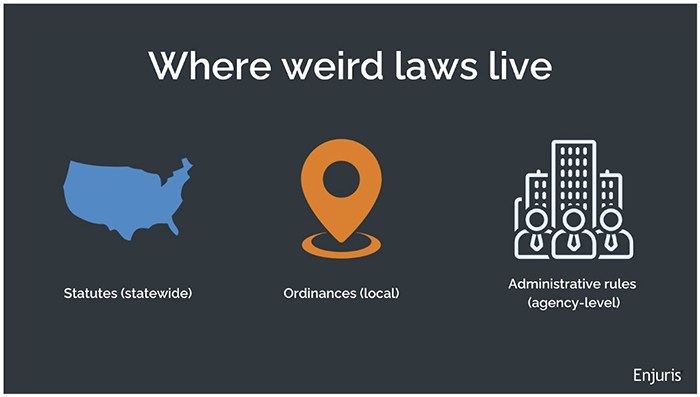
Here’s a quick glossary that will help you as you verify a law:
- Statute: A law passed by a state legislature.
- Ordinance: A local law (city, town, or county).
- Administrative rule: A binding regulation issued by a state agency under statutory authority.
- Repealed / reserved: “Repealed” means removed; “reserved” marks a placeholder where text used to be (or might appear later).
- Preemption: When a higher-level law (state or federal) overrides a conflicting local rule.
Frequently asked questions about odd laws
Are these bizarre laws legal if they sound unconstitutional?
Sometimes a law survives on the books because it hasn’t been challenged recently or because courts narrowed how it can be applied. A printed section isn’t the same as a court-tested rule.
Why do outdated laws stick around?
Repeal takes time and political attention. If a rule isn’t causing litigation or headaches, it can persist quietly through multiple code updates.
Can I get in trouble for breaking a “weird” law?
If it’s still in force, yes—at least in theory. Enforcement varies widely, and some penalties are minor (infractions) while others are misdemeanors or worse. When in doubt, follow the law or ask a local attorney.
What’s the difference between statewide and local rules?
A statewide statute applies everywhere in that state unless a higher law says otherwise. A local ordinance applies only within the city/county and may be more specific (or more restrictive) than state law if not preempted.
Where can I look up my city’s code?
Start at your city’s official website (often “City Code,” “Municipal Code,” or “Ordinances”). If they use a hosted library, you’ll see links to Municode, eCode360, Code Publishing, eLaws, or a similar provider.