
You’re a parent even before your baby is born… especially when it comes to the parts of parenting that involve worrying about the what-ifs and trying to create a safe home environment for your child. You might spend your pregnancy thinking about what you eat, attending doctor appointments, and setting up a nursery for when your little bundle arrives.
But setting up a baby-friendly home isn’t just about picking just the right shade of pastel for the nursery walls or installing child-safety locks on closets or drawers. It’s also important to consider safety when choosing big items like car seats, high chairs, strollers, and cribs.
Many parents research the safest and most user-friendly baby products, and rightfully so — they’re costly, you use them often, and sometimes your baby’s life can depend on them. You don’t want to skimp on safety.
So what happens when you’ve received and assembled a crib that costs several hundred dollars, only to learn that it’s subject to a recall or safety warning?
That’s what has happened to more than 11 million parents since 2005, when the U.S. Consumer Product Safety Commission (CPSC) recalled all cribs with drop-side detachments.
Drop-side cribs recalled
A drop-side crib has a movable side that was popular because it can be raised when the baby is alone in the crib and lowered when the caregiver wants to reach in and lift the child out.
However, while drop-side cribs might be convenient for shorter-standing caregivers and those who have a harder time bending over to lift a squirming or heavy baby, they can also be deadly. The drop-side can have a gap in which the baby could get caught, which injures their head and neck, and can even be fatal.
The gaps between the drop-side and other parts of the crib happen because of:
- Screws, tracking, pegs, or bolts that warp or break
- Wood that causes hardware to loosen
- Incorrect installation of drop-side
- Multiple assemblies and disassemblies of the equipment
- Worn drop-side track
The biggest concern is about cribs that are disassembled and reassembled because this process can weaken or strain the parts, which would increase the risk that it becomes unsafe. Unlike other types of equipment, cribs are likely to be disassembled and reassembled multiple times, often because people use them for subsequent children or pass them along to others to use.
Cribs are expensive, and most babies/toddlers only use them for 2 to 3 years, so naturally a parent wants to get as much use out of it as possible by using it for additional children. Many parents use swap sites like Craigslist or Facebook groups to purchase less expensive used cribs rather than buying a new one, but pre-owned cribs can come with problems.
Difference between a recall and a ban
A recall is issued by the CPSC when an item already on the market must not be used. If an item is recalled, there’s usually information that directs the consumer to return it or receive a refund.
If an item is banned, it means manufacturers and retailers may no longer sell it in the U.S.
When the spate of recalls occurred around 2010, drop-side cribs made by a variety of manufacturers were recalled. The remedies included replacement offers, parts that would modify a drop-side crib to become a stationary-side crib, and refunds. Owners of drop-side cribs could contact either the manufacturer or retailer to order replacement parts or a new crib, or to get instructions for a refund.
But what’s clear is that every crib, regardless of manufacturer or style, that had a drop-side, was recalled.
Beginning in June 2011, cribs sold in the U.S. were required to meet a new set of federal requirements. The CPSC recommended that parents not attempt to repair a damaged crib (unless provided with specific parts and instructions by a manufacturer), but rather to purchase a new crib if their crib no longer met the regulations.
Crib bumper class-action lawsuit
A crib bumper is the padding that is placed around the perimeter of a crib. They were designed so that a baby’s arms or legs couldn’t slip between crib slats, and also to provide a soft surface if a baby were to roll against the side of the crib while sleeping.
Although crib bumpers were once a “must-have” nursery accessory, appreciated for their usefulness as well as aesthetic value, it’s now well-established that they can be very dangerous. Crib bumpers can be anything from soft cotton to “breathable” mesh, but experts say even the mesh bumpers are hazardous and that no crib bumpers should be used.
It’s not just cribs!
Cribs aren’t the only nursery equipment that can cause injuries.
The CPSC reported that in 2016, there were 62,300 injuries to children under age 5 that required emergency department treatment that were the result of the use of nursery products. (source)
Seventy percent of the total number of injuries were attributed to high chairs, cribs and crib mattresses, strollers and infant carriers. The leading cause of injury was falling, and the most common injuries were to the head and face.
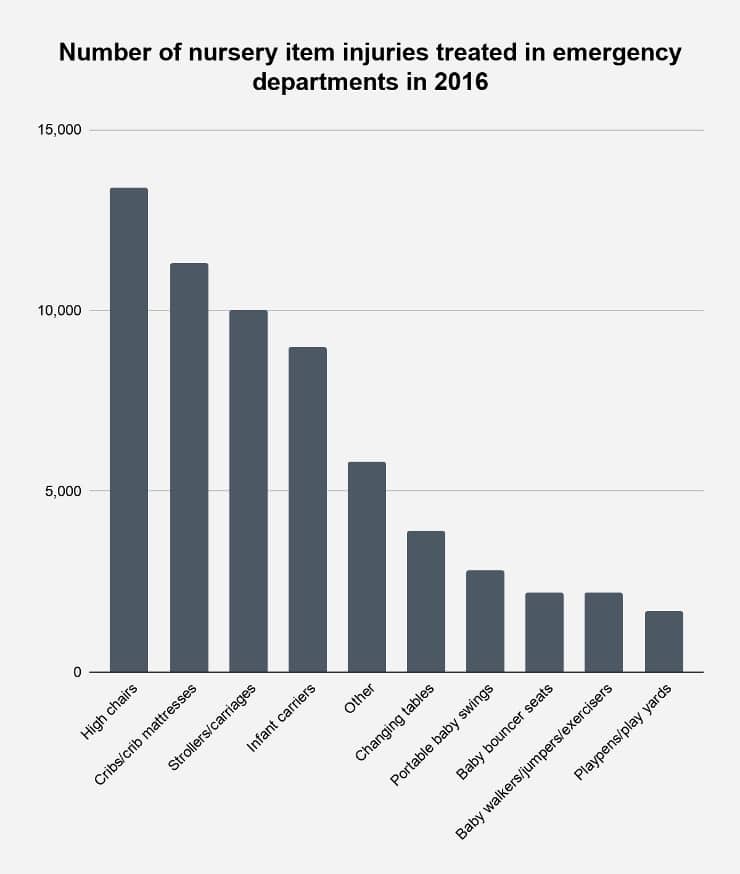
The “other” category includes pacifiers and teethers, diapers, rattles, night lights, potty chairs and training seats, baby scales, crib mobiles, harnesses, and safety pins.
Babies & soft bedding
Many deaths associated with cribs, playpens, and play yards are blamed on soft bedding like blankets or pillows, or a too-soft mattress. Young babies don’t have fully developed neck and upper body muscles to turn their heads if their nose and mouth are buried in fabric, like a pillow or blanket. They can suffocate if they’re not able to turn their head to get air.
Sometimes, this includes improvised covers on play yards or crib bumpers. Often, deaths are not directly caused by a failure of a product, but by additional items or uses of the product that are different from manufacturer recommendations.

The federal Consumer Product Safety Commission began to investigate Boppy Newborn Lounger and similar products when deaths began to be reported in December 2015. Between that time and June 2020, there were 8 reported infant deaths after the babies suffocated when placed in the loungers on their backs, sides, or stomachs. Find out more
Keeping your sleeping baby safe
These recommendations are based on guidance from the American Academy of Pediatrics (AAP):
-
A baby should be put to sleep on their back until they reach their first birthday. A baby sleeping on their back in a flat, firm sleep space is much less likely to die from Sudden Infant Death Syndrome (SIDS) than a baby placed on their stomach, side, or in an inclined sleeper.
Once your baby has learned to roll from back to front and front to back, you can let them roll freely because they’re able to turn their heads and get enough air on their own. But if they’re not yet rolling from front to back and they “accidentally” roll to their front, it’s best to return them to the back-sleeping position.
-
The sleep surface should be firm. We adults might like a soft sofa or bed mattress, but that’s not safe for babies. Any sleeping area for a baby should have a firm mattress that fits tightly into the crib, play yard, or bassinet, and a tight-fitting sheet that’s the correct size for the mattress.
You can tell that the surface is firm enough if there’s no indent when the baby is lying on it.
-
Your baby should have their own sleeping space, not in the bed with you. Most new parents are tempted to bring the baby into bed from time to time, even if it’s not intended to be a permanent arrangement. But it’s not safe. You can keep your baby in your bed for feeding, comforting, or cuddling, and then return them to their crib or bassinet.
Your bed likely has pillows or bedding that can suffocate your baby. In addition, new parents are often exhausted and when you sleep, you sleep hard. Even though you might think you’re aware of the baby in your bed, a parent is likely to roll onto a baby and cause an injury, either because of your weight or because of suffocation.
-
Do not share a bed. Experts in pediatrics don’t recommend co-sleeping or bed-sharing. This is even more dangerous in these circumstances:
- Your baby is younger than 4 months old.
- You are or any other person sharing the bed is a smoker.
- The baby’s birth mother smoked during pregnancy.
- The adults in the bed take any medicines or drugs that might make it harder to awaken, or if they drank any alcohol
- If there’s any soft bedding or pillows, or if the mattress surface is soft, like a couch or armchair, or if it’s an older mattress or waterbed
- You can (and should) room share if possible. Room sharing decreases the risk of SIDS, where bed-sharing increases the risk. The AAP says room sharing with the baby can decrease the risk of SIDS by as much as 50%. It’s recommended that you share a room with your baby for the first 6 months.
-
Remove all soft objects or loose bedding from the baby’s sleep space. This includes any objects that might increase the risk of strangulation, entrapment, or suffocation. Blankets, toys, bumpers, and stuffed animals can increase the risk. A sweet teddy bear in the corner of the crib might look cute, but it can be dangerous.
Remember… every baby has a first time rolling. You might think a pillow or stuffed animal far enough away and your baby isn’t mobile yet, but one day you’ll find your baby on the opposite side of the crib. You might not think they can roll or move, but they will — sometimes when you least expect it.
Babies shouldn’t use blankets for warmth. If you think the room is cold, dress your baby in warmer pajamas like a zip-up blanket sleeper, or look for a wearable blanket instead of a loose one.
- Never place your baby on a couch, sofa, or armchair unless there’s an awake adult supervising. This can be very dangerous because, in addition to suffocation risks, the baby can fall off and be injured.
- Try a pacifier for sleep soothing. Using a pacifier can reduce the likelihood of SIDS. As with any new practice or device, consult your baby’s doctor before making changes.
Products liability lawsuits for baby items
If your child was injured by a defective product, you might be considering legal action.
A product can be considered defective in 3 ways:
- Design defects. Even a perfectly made product can endanger the end-user if the defect was part of its design. A product is unreasonably dangerous if it does not perform as expected when used in its intended manner.
- Failure to warn. Also called “marketing defects,” these focus on actions in the supply chain. The product was properly designed, but it did not have the correct instructions or warnings. This lack of guidance made the product unreasonably dangerous to its intended consumers.
- Manufacturing defect. Even if the product was designed to be safe, the end result did not reflect that design. If that product then causes an injury to its intended user, the manufacturer can be held liable.
For example, a drop-side crib would be a design defect because this style of equipment is inherently unsafe. But if you have a stationary-side crib and one slat becomes loose, for instance, that might be a manufacturing defect.
If your child was injured by defective baby equipment, you should consult a personal injury attorney in your area to determine how to proceed, either with a lawsuit, to join a class action if there’s already one that’s applicable to your situation, or to file a complaint with the CPSC.