A comprehensive review of law school attendance and JD enrollment statistics by 2018 demographics like race and ethnicity
According to the most recent data collected by the American Bar Association (ABA) on law school admissions, minority enrollment increased in 2018.
While the percentages of law students who identify as Asian, Native American, or Native Hawaiian closely reflect the percentages found in the general population, Black Americans and Hispanics remain underrepresented in law schools across the country.
Here at Enjuris, we conduct our annual Women in Law School report to analyze gender enrollment in law schools. In that same vein, we decided to take a close look at race and ethnicity demographics in ABA-accredited law schools.
Minority representation in law schools
On average, the 2018 law school class was more racially diverse than the 2017 class. Every race and ethnicity that the ABA tracks through the ABA Annual Questionnaire increased by at least 6.1%. This includes Hispanics, Native Americans or Alaska Natives, Asians, Black Americans, Native Hawaiians or other Pacific Islanders, and Whites.
Tweet this
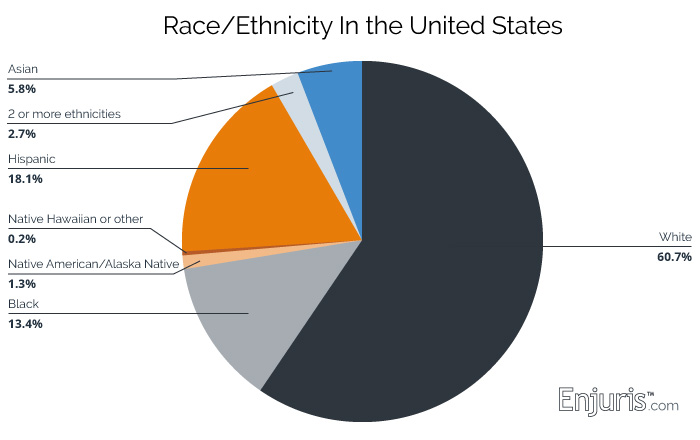
The racial makeup of law students in ABA-accredited law schools comes close to reflecting the racial makeup of the United States population as a whole. The first pie chart below shows the total percentage breakdown of races in the US according to the US Census Bureau.
This second pie chart shows the total percentage breakdown of races in all ABA-accredited law schools.
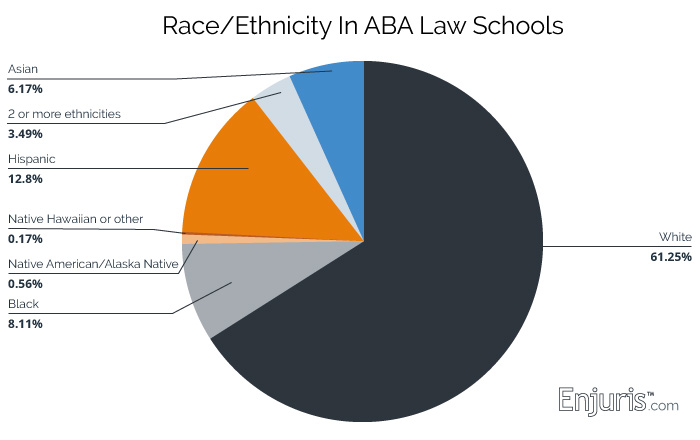
As you can see, the greatest disparities are with respect to the number of law students identifying as Hispanic or Black — groups that have historically been underrepresented in both law school classrooms and among practicing attorneys.
Minority law students by geographic location
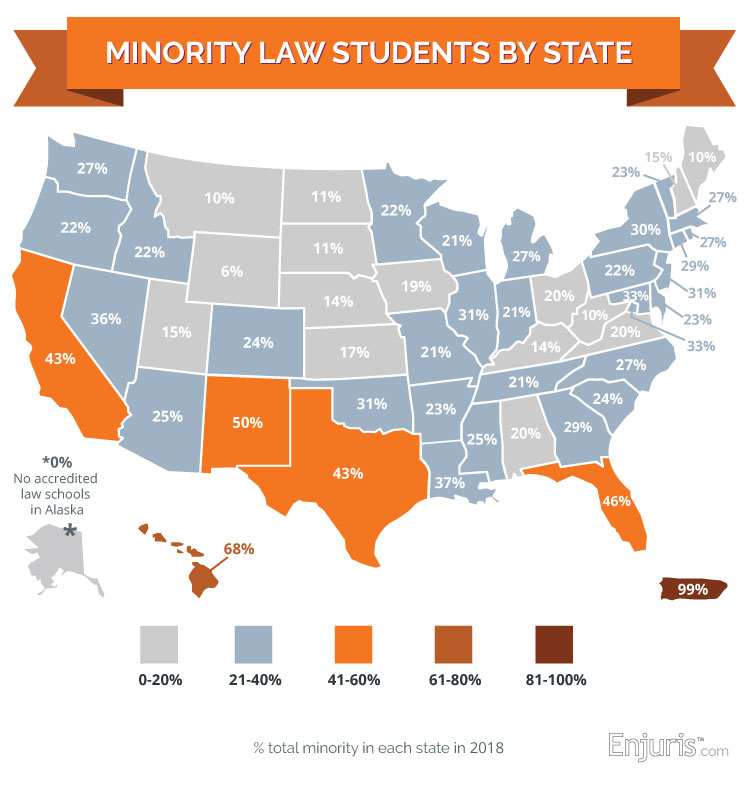
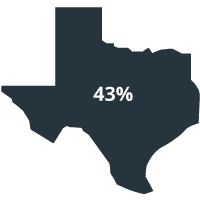
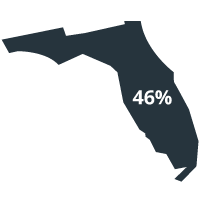
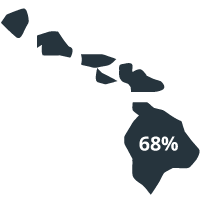
Some regions of the country seem to attract more minority law students than others. In general, New Mexico, Florida, California, and Texas have a high percentage of minority law students.
Hawaii and Puerto Rico also have a high percentage of minorities attending law school but those numbers are skewed due to the number of Native Hawaiians attending the University of Hawaii and the number of Puerto Ricans attending the 3 law schools in Puerto Rico.


Overall law school rankings based on minority enrollment
The ABA Council for Diversity in the Educational Pipeline and the Law School Admissions Council (LSAC) have made efforts to increase minority enrollment in colleges and law schools across the country.
In addition, many law schools have risen to the challenge by taking steps intended to increase minority enrollment. For example, some schools have made a point of hiring more minority professors and reserving admissions slots for applicants who have overcome adversity and show promise of representing underserved populations.
These efforts have paid off for a number of law schools. Below are the 10 law schools with the highest percentage of students identifying with each race recognized by the ABA.
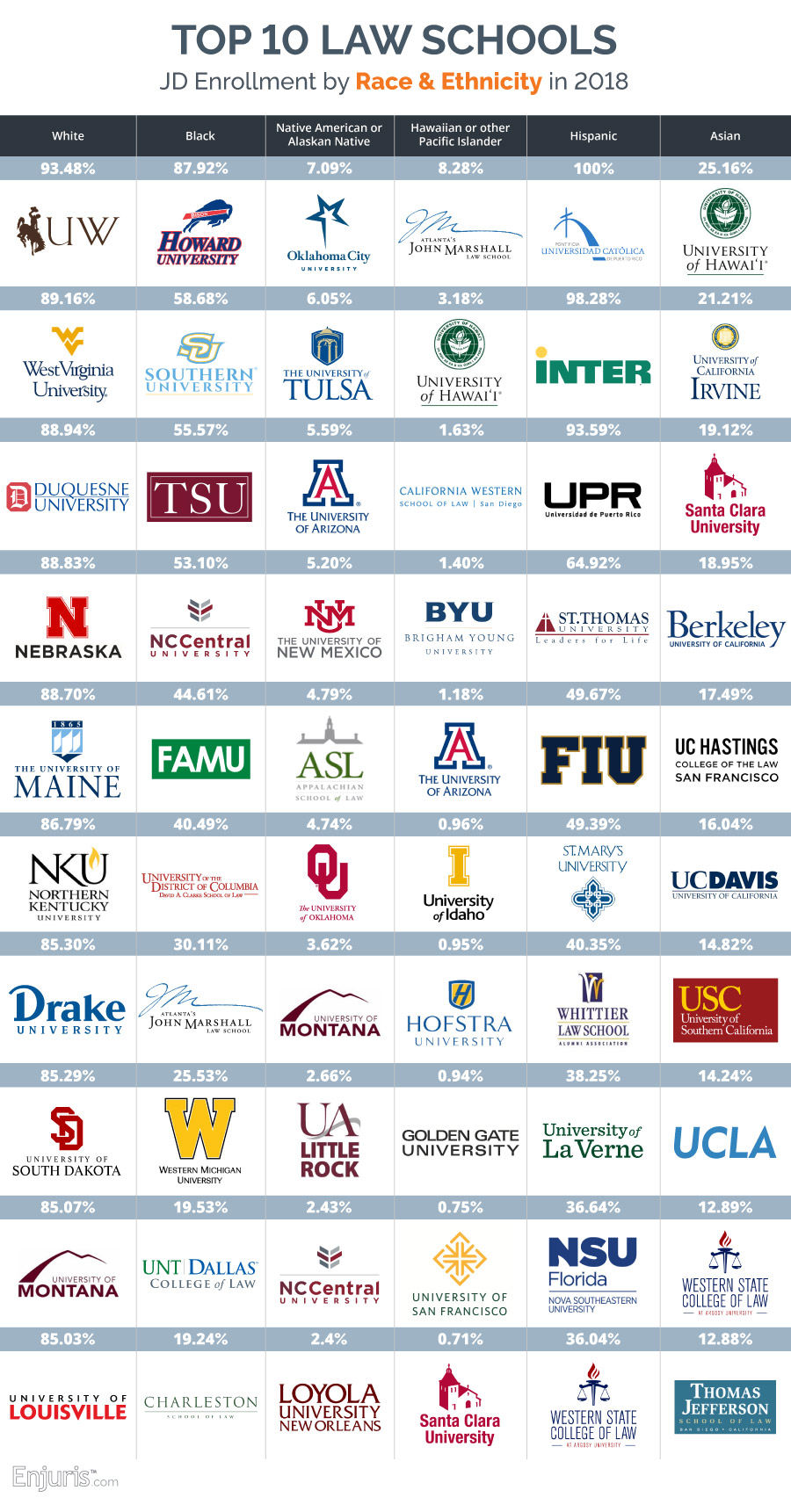
Other law schools have failed to attract minorities. Here’s a look at where minorities (and white candidates) are not going.
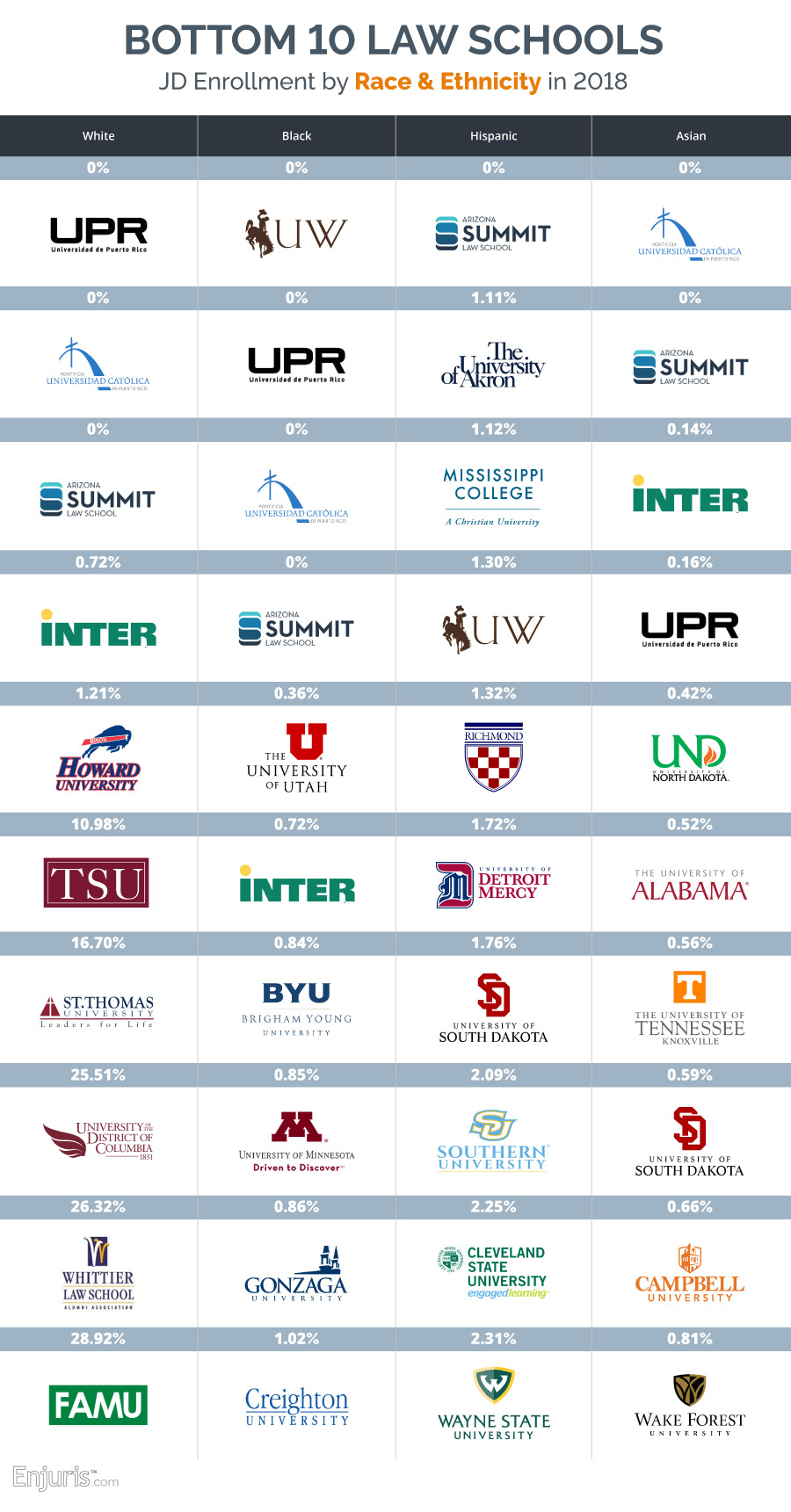
The chart above doesn’t include a list of schools with the lowest percentages of Native American or Alaskan Native law students because there were a total of 55 schools in the U.S. that reported enrolling 0% of students who identified themselves in this group.
The chart also excludes a list of the of school with the lowest percentages of Hawaiian or other Pacific Islander law students because there were a total of 125 schools in the U.S. that reported enrolling 0% of students who identified themselves in this group.
Conclusions
Collectively, the classrooms of ABA-accredited law schools generally reflect the racial makeup of the US. However, minorities tend to be concentrated among a handful of schools. For example, if we remove the 5 law schools with the highest percentage of Hispanics, the total percentage of Hispanics attending ABA-accredited law schools dips from 12.8% to 10.72%
What’s more, Hispanics and Black Americans remain underrepresented. The reasons for this are complex, but 3 factors stand out.
First, minority enrollment in law school is dependent on minority enrollment in college, as a person usually can’t attend law school without first graduating from college. In colleges, Black Americans are underrepresented, particularly in top colleges.
Additionally, among students who started 4-year public institutions, Black American students had the lowest completion rate (45.9%). Undergraduate enrollment and graduation rates for Hispanics, on the other hand, have exploded, but the explosion has been recent and the rates still lag behind whites. As a whole, the enrollment and graduation rates of Hispanic and Black American students in college lag behind whites.
Second, Black Americans and Hispanics tend to score lower on the Law School Admissions Test (LSAT). For example, the mean score for African Americans was 142 in 2013-2014 compared to 153 for whites. This creates not only academic barriers to law school, but also financial barriers, as law schools tend to award financial aid based on LSAT scores.
Third, even though minorities enroll in law school in decent numbers, there is a large disparity in the attrition rates between whites and nonwhites (particularly among African Americans). For example, in 2016, white students comprised 62% of first-year law students and 49% of first-year attrition. In contrast, minority students made up only 30% of first-year enrollment but accounted for 44% of attrition.
To gain even more insight into law school demographics in the United States, check our the Enjuris report on Women in Law School.
Data source: American Bar Association, ABA Required Disclosures (Standard 509 Reports). Any mistakes in data reported to the ABA are the responsibility of the reporting school. Enjuris assumes no responsibility for inaccuracies or for changes in such information that may occur after publication. The figures here are as reported on December 16, 2018. Schools may update their data at any time. Please see the ABA website for updated figures.
See our guide Choosing a personal injury attorney.