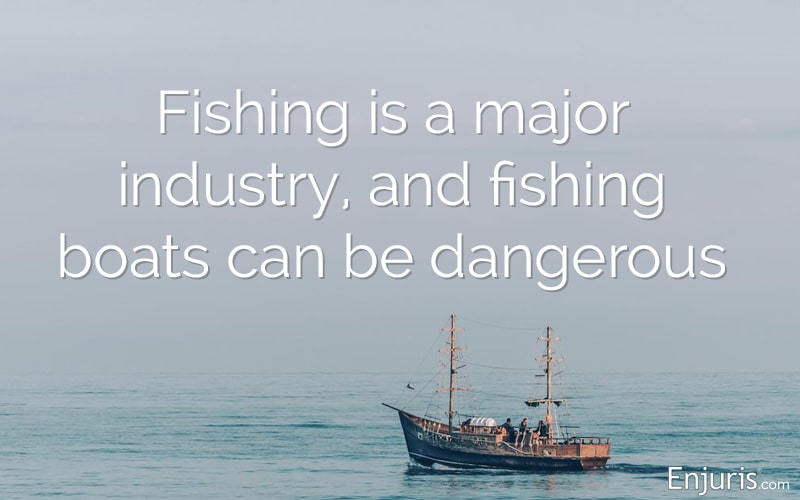
Fishing boat injuries can be subject to some laws that aren’t relevant for other types of accidents
Fishing is either a lucrative profession or a relaxing recreational activity.
Regardless of which category you fall into as you fish, you’ll want to know the risks associated with fishing boats and what you can do if you become injured.
When an individual is injured because of someone’s negligence, they can usually file a personal injury lawsuit.
However, fishing boat injuries work a little differently. First, if you’re a commercial fisher, you would likely be eligible for workers’ compensation rather than a personal injury lawsuit. Second, some fishing boat accidents would follow a slightly different process than a traditional injury because of jurisdictional issues and maritime law.
Seiner fishing boats
Many commercial fishing operations use seiner boats. This boat uses a dragnet (called a seine) to grab and haul fish from the water aboard the vessel.
A seiner boat has risks that other types of fishing boats might not because it includes heavy equipment for catching the greatest amount of fish in the most efficient time. A seine is designed with a weight at the bottom to hold the net in the water while the fish swim into it. Once the fish are trapped, the seine is gathered at the top and pulled onto the boat. The fisher uses a winch to operate the seine, which can cause an accidental injury or fatality if the equipment malfunctions or if the fisher or crew is not trained properly. These types of expeditions are also high risk for fatigue-related accidents because of the intense physical labor and strength involved.
Causes of fishing boat injuries
Certainly, a fisher aboard a seiner fishing boat can experience the same types of injuries that can happen during any type of boating accident—slip and fall, falling overboard, and similar.
Added risks of heavy deck machinery and equipment can make these types of fishing boats more dangerous than the typical. One risk for serious injury is becoming tangled in the seine (net) or winch line. On many of these types of boats, the machine controls are not within reach of the dangerous areas, which means a fisher could be unable to stop the equipment if they become tangled.
In a publicized New Zealand seine fishing boat accident in 2005, part of the net caught on a drum block in the water. This caused the fisher’s finger to become severed because they could not free it from the net.
If you’re not working aboard a seiner, other causes of typical fishing boat injuries include:
- Weather-related issues: Storms, wind, and rough waters increase the risk of accidents and injuries.
- Fire: You don’t have to be on dry land in order to experience fire conditions. Engines, fuel, and electrical equipment are at risk for sparks that could cause fires that spread quickly.
- Human error: People make mistakes. Misjudging a distance, overloading a boat, insufficient training, inexperience, or misunderstanding how to use equipment properly can all cause serious injuries.
- Equipment failure: Nets, lines and winches can break. These present serious risks to fishers aboard.
- Intoxication: Like any vehicle or vessel, it’s crucial that operators are not impaired by alcohol or other drugs. These substances affect reaction times and judgment and can cause situations that result in serious injuries.
Workers’ compensation vs. the Jones Act for a fishing boat injury
The basics of workers’ compensation
If you are injured at work—in any industry—workers’ compensation is the no-fault benefit program that permits you to receive compensation for your medical treatment, lost wages and related expenses.
There are two major benefits to the workers’ compensation program:
- It’s no-fault insurance, so you never need to prove that your employer (or anyone else) was at fault for the injury. You only need to prove that it happened at work or was caused by a condition in your workplace. You can still receive compensation if you were injured at work because of your own mistake (as long as it was not intentional).
- It spares both the claimant and the employer from enduring a lengthy and costly court process. However, it does prevent the worker from suing the employer for any other issues related to that particular injury.
In general, you can recover costs for medical treatment associated with the injury and a portion of your lost wages. There are also survivor benefits available to the family of a deceased worker.
Each state has its own set of workers’ compensation benefits and guidelines.
The Jones Act for injured maritime workers
The Jones Act has been a law since 1920. It was originally intended to protect merchant marines from foreign attacks and now provides injured sea workers the right to sue their employers. If an injured worker believes they were injured because of negligence while employed offshore, they may sue their employer under the Jones Act.
The caveat: “Seamen” are not entitled to workers’ compensation and the Jones Act is their only means for recovery. But not every worker who is aboard a vessel is a “seaman.” This term refers specifically to people who work on a vessel that operates in navigable waters, and the individual must spend at least 30% of their time onboard in order to qualify.
A “vessel” as defined by the Jones Act includes barges, dredges, drill ships, crew boats, supply boats and floaters. “Navigable waters” refers to waterways capable of being used for interstate or foreign commerce.
Who has jurisdiction over a fishing boat accident?
Jurisdiction refers to what court has the authority to determine the outcome of a legal claim.
Usually, an accident can be handled by the courts in the state where it occurred. When an accident happens at sea, there can be more questions about what court would be available.
What factors influence jurisdiction for a fishing boat accident?
- Location of the accident
- Type of accident
- Nationality of vessel and crew
- Applicable laws and regulations
If the accident is within U.S. territorial waters, then American maritime authority would have jurisdiction over legal proceedings. If it’s in international waters, it’s possible that international agreements or conventions would control the legal process.
If there’s a fishing boat accident that involves boats from more than one country or jurisdiction, you’ll need to consult with a maritime lawyer in order to determine where to file a claim.
Private fishing boat accidents
If you’re injured while on a private fishing expedition, you can likely file a lawsuit against the boat’s owner or the tour operator. The specific circumstances of the accident would determine who is the appropriate defendant.
Regardless of how the accident happened, these types of claims can be complex and can involve questions of law that are not present in a “typical” personal injury accident. Your best approach to receiving compensation—workers’ comp, Jones Act, or civil personal injury—is to contact a qualified, experienced lawyer for advice and guidance as to your legal options.
See our guide Choosing a personal injury attorney.