How do pedestrians recover damages in a no-fault insurance state?
According to the Minnesota Department of Transportation (MDOT), 3% of Minnesotans walk to work, and another 7% combine walking and biking to get to work.
Understanding that Minnesotans want and need safe places to walk, Minnesota Walks, a collaboration between MDOT and the Minnesota Department of Public Health (MDPH), was formed to create safe, desirable, and convenient places for Minnesotans to walk.
Unfortunately, as Minnesota tries to get more people to walk, pedestrian deaths are on the rise in the state.
Let’s take a look at pedestrian accidents in Minnesota, including the laws that impact pedestrians and how pedestrians can recover damages following a vehicle-pedestrian collision.
Are pedestrian accidents common in Minnesota?
How many vehicle-pedestrian crashes occur every year in Minnesota? Fifty? One hundred?
Keep going.
Pedestrian accidents in the North Star State have been on the rise in recent years, along with pedestrian fatalities. Most experts attribute the rise to the increase in large vehicles (such as trucks and SUVs) and the increase in distracted drivers.
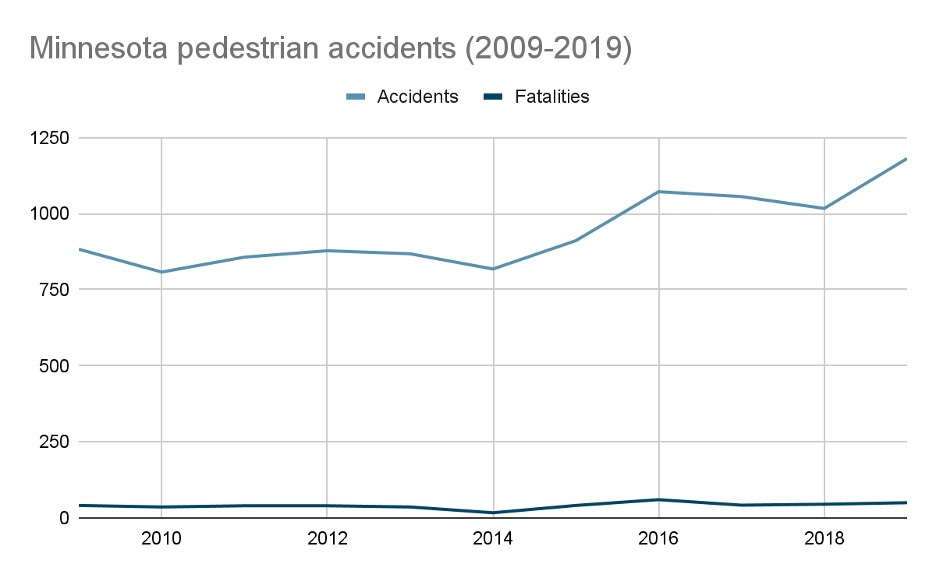
The most common contributing factors in vehicle-pedestrian crashes include failure to yield, distracted driving, and distracted pedestrians. Roughly 60% of pedestrians injured and killed were crossing the street at the time of impact.
What laws should pedestrians in Minnesota know about?
Minnesota legislatures have passed a number of laws that impact pedestrians. These laws, most of which can be found in Chapter 169 of the Minnesota Statutes, fall into 1 of 2 categories: pedestrian duties and driver duties.
Pedestrian duties
- Pedestrians must obey all pedestrian traffic control signals.
- Pedestrians crossing a road at any point other than within a marked crosswalk or at an intersection with no marked crosswalk must yield the right-of-way to vehicles.
- Between adjacent intersections at which traffic-control signals are in operation, pedestrians must not cross at any place except in a marked crosswalk.
- Pedestrians must walk whenever possible on the right half of the crosswalk.
- Pedestrians must walk on the left side of the road or its shoulder whenever possible. Where sidewalks are provided and are accessible, it’s unlawful for a pedestrian to walk on an adjacent road.
- Hitchhiking is strictly prohibited.
Driver duties with respect to pedestrians
- Motorists must stop for crossing pedestrians within a marked crosswalk or at an intersection with no marked crosswalk.
- Every motorist shall exercise due care to avoid colliding with a pedestrian.
How can a pedestrian recover damages after a pedestrian accident?
Pedestrians in Minnesota can use their auto insurance policies to recover damages after an accident with a motor vehicle regardless of who was at fault for the accident.
More specifically, a pedestrian can file a claim under the Personal Injury Protection (PIP) portion of their auto insurance policy. If the pedestrian doesn’t have an auto insurance policy, they may be able to file a claim under their family member’s policy.
If the pedestrian’s damages exceed the limits of their PIP coverage, they’ll need to make a claim against the driver’s liability insurance or file a personal injury lawsuit against the driver. To do so, the pedestrian will need to prove that the driver was “at fault” for the accident.
Drivers have a legal duty to exercise “reasonable care” when navigating Minnesota’s roads. In short, this means that drivers must behave as a reasonably prudent person would behave under the circumstances.
If a driver fails to exercise reasonable care and a pedestrian is injured as a result, the driver is “at fault” for the accident.
The legal theory that allows a pedestrian to sue a driver for their carelessness is called negligence. To prove negligence, a pedestrian must establish the following:
- Duty. The plaintiff must prove that the defendant owed them a duty of care. A duty of care arises when the law recognizes a relationship between the plaintiff and defendant requiring the defendant to exercise a certain standard of care to avoid harming the plaintiff. Drivers have a duty to exercise reasonable care to avoid harming others when operating a vehicle, including pedestrians.
- Breach. The plaintiff must prove that the defendant breached the duty of care. A breach occurs when the defendant fails to meet the standard of care required by, for example, running a red light and hitting a pedestrian at a crosswalk.
- Causation. The plaintiff must prove that their injury was caused by the defendant’s breach of the standard of care.
Although most pedestrian accidents are the result of vehicle-pedestrian collisions, other parties may be responsible for pedestrian accidents. For example:
- Bicyclists. Bicyclists also have a duty to obey all traffic laws and exercise reasonable care when navigating Minnesota’s roads. A bicyclist might be at fault for a pedestrian accident if they violate a traffic law or fail to exercise reasonable care by, for example, failing to stop at a crosswalk.
- Property owners. Under Minnesota’s premises liability laws, property owners typically have a duty to keep their properties in a safe condition. A property owner (often a local municipality) might be at fault for a pedestrian accident if they fail to keep their property in a safe condition by, for example, failing to place a cover over a manhole, and an accident results.
Minnesota’s modified comparative fault law
Minnesota is a modified comparative fault state, which means that a plaintiff’s damages are reduced by their percentage of fault. What’s more, if a plaintiff is more than 50% at fault for an accident, their recovery is completely barred.
Let’s take a look at an example:
Kirk is late for a job interview so he decides to run across 4th Street even though he’s not at a crosswalk or an intersection.
As Kirk is crossing the street, he’s struck by Lisa who never saw Kirk because she was texting while driving.
Kirk suffers several fractures and sues Lisa for $100,000. After a trial, the jury determines that Lisa is 60% at fault for the accident (for texting and driving) and Kirk is 40% at fault for the accident (for failing to cross at a crosswalk or an intersection).
As a consequence of Minnesota’s modified comparative fault law, Kirk can only recover $60,000 of the $100,000.
What types of damages can an injured pedestrian recover in Minnesota?
The good news is that if you’re injured in an accident in Minnesota, you don’t have to worry about any damage caps.
What’s the bad news?
Actually, there’s just more good news. In Minnesota you can recover 3 types of damages:
- Economic damages represent the monetary losses caused by your accident (e.g., medical expenses, lost wages, property damage).
- Non-economic damages represent the non-monetary losses caused by your accident (e.g., pain and suffering, loss of consortium).
- Punitive damages are intended to punish the defendant and are only available if the plaintiff can prove that the defendant showed a “deliberate disregard for the rights or safety of others” or that the defendant “deliberately acted with indifference to the high probability of injury.” These damages commonly come into play when a pedestrian is hit by a drunk driver.
7 steps to take after a pedestrian accident
Here are 7 steps that will improve your chances of recovering the damages you deserve after a pedestrian accident.
- Step 1. Get medical attention. When cars and pedestrians collide, the car always comes out on top. If you’re involved in a pedestrian crash, it’s important to get medical attention as soon as possible. Even if you believe the accident was minor, you could be suffering from serious internal damage. What’s more, insurance adjusters and jurors are typically skeptical when a plaintiff doesn’t seek immediate medical help after an accident.
- Step 2. Call the police. The police can conduct a brief investigation and draft a police report that may help support your legal claim. What’s more, the police can help limit the all-too-common “road rage” incidents that occur between drivers and pedestrians following a collision.
- Step 3: Collect contact information. Collect the contact information of anyone involved in the accident. If a driver was involved in the accident, they’re required by law to provide you with their contact information.
- Step 4: Gather evidence. Collect the contact information of any witnesses at the scene. Don’t forget to look for witnesses in nearby buildings with windows. It’s also a good idea to take photographs or videos of the accident scene, your injuries, and any property damage.
- Step 5: Notify your insurance company.
- Step 6: Avoid social media. Avoid posting any information about your accident on your social media platforms. Posting about an accident on social media can hurt your legal claim.
- Step 7: Consult an attorney. Finally, it’s a good idea to talk to an attorney as soon as possible. Most initial consultations are free.
See our guide Choosing a personal injury attorney.