
How to navigate the California courts for your personal injury claim
The California court system has a lot of moving parts, but it’s designed to provide a fair and navigable method for state residents to obtain the relief they need after an injury.
California has 58 counties and each has its own trial court, which is where the majority of legal cases begin.
Trial courts are available to hear:
- Civil cases
- Criminal cases
- Family court issues
- Probate
- Mental health proceedings
- Juvenile court
- Traffic cases
The trial court system (also called Superior Courts) employs 1,743 judges. An average of 5 million cases are filed each year in the Superior Courts.
While it’s interesting to read the statistics on how many cases work their way through the court system, you care about only one case… yours.
So let’s talk about what to expect if you’re in the process of filing a lawsuit, focusing on civil claims.
The process of a lawsuit in California State Courts
Trial (Superior) courts
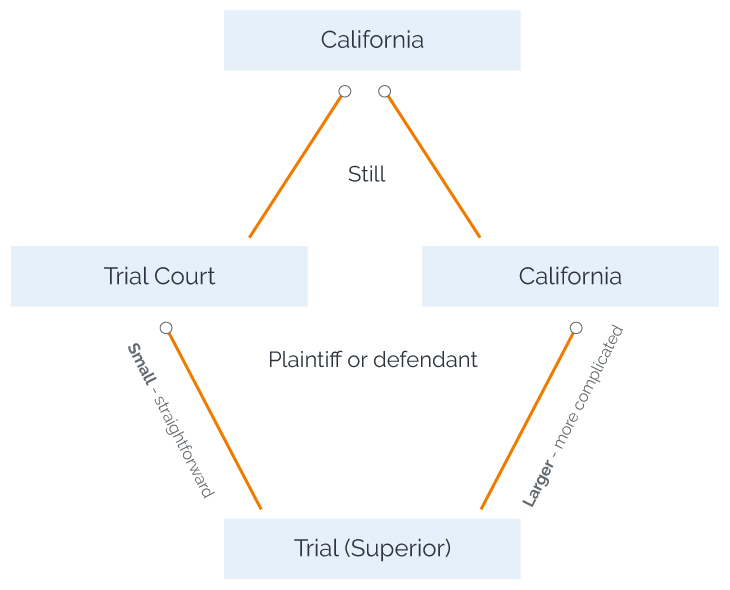
Every claim begins in the trial (Superior) court. When a case makes it to court, it will be decided by a judge or jury.
Most cases begin and end in the trial courts. Cases result in a verdict in favor of either the plaintiff or defendant, and in many situations that’s the natural conclusion to the legal process.
Occasionally, a party to the case will determine that the trial court judge or jury made the wrong decision. A smaller case can be reviewed by the trial court’s appellate division, which could result in a different verdict.
Courts of Appeal
For a more complicated case, a new lawsuit will be filed in the California Courts of Appeal.
When you appeal a decision, you’re essentially filing the lawsuit in reverse. If the trial court ruled in favor of the plaintiff, the defendant would then file a lawsuit against the plaintiff in the appeals court. A case can be appealed by either the plaintiff or the defendant.
You can’t escalate a case from the lower courts to appeals courts simply because you don’t like the verdict. There has to be a mistake of law that might’ve affected the outcome.
Before a case is tried in appellate court, the court will review the trial court record to determine if a legal mistake was made.
A case can go to an appellate court for:
- Prejudicial error. A mistake of law or procedure like incorrect jury instructions, errors by lawyers or jury, or mistakes of law made by the judge.
- Lack of substantial evidence. If the appellant believes that there wasn’t substantial enough evidence to support the court’s decision.
An appeal isn’t the same thing as a new trial. An appeals court won’t hear any new evidence. The case will be decided based on exactly the same evidence as was presented in the lower court.
It’s not easy to win a case on appeal.
Instead of making a case against the other party, you’re actually trying to win a case against the court system.
Your lawyer now needs to prove that the court made a legal mistake during the adjudication of your case. That’s a high standard to meet, and frivolous lawsuits (those that are without legal merit) aren’t viewed favorably.
Supreme Court
A case that has already been decided by the appeals court can escalate to the California Supreme Court if there are still disputed issues.
California Federal Courts
State and federal courts are completely separate.
The main difference between the two is the types of cases they hear:
| Federal courts | State courts |
|---|---|
| Constitutionality | Contracts |
| Federal (U.S.) laws | Torts (personal injury) |
| Cases that involve ambassadors or federal public ministers | Family law |
| Disputes between state governments | Criminal cases |
| Admiralty law | Probate (wills and estates) |
| Bankruptcy | Issues of state law or state constitution |
| Habeas corpus |
There are 3 levels of federal courts:
- U.S. District Courts
- U.S. Courts of Appeals
- U.S. Supreme Court
The district courts are the federal equivalent of the trial court, or the first level of litigation. There are 4 districts in California (Central, Eastern, Northern, Southern), and they feed into the 12 regions of federal districts for appeals.
California is part of the Ninth Circuit for the U.S. Courts of Appeals. The Ninth Circuit also includes:
- Alaska
- Arizona
- Hawaii
- Idaho
- Montana
- Nevada
- Oregon
- Washington State
The appeals process in the federal courts is similar to how it works in the state court system. If a party to a lawsuit has reason to believe that there was an error of law or other significant legal mistakes in the district court, they can file an appeal in the Ninth District Court of Appeals. The circuit court is usually the last stop for federal lawsuits.
The U.S. Supreme Court, with its Chief Justice and 8 associate justices, only handles cases about constitutionality or U.S. federal law.
How to file a personal injury lawsuit in California
All this information is interesting background about the legal system, but chances are that the personal injury lawsuit you file in California won’t involve all of these levels of courts and rules because only a small percentage of trial court cases go to appeal.
In order to file a personal injury claim, you must meet certain requirements:
- You’re a “natural person” (i.e. an actual, living person who has rights and responsibilities by law or a business or other entity with legal status) who has legal standing and capacity to sue the defendant.
- You know which court and county is the correct venue for your lawsuit.
- Your lawyer has drafted an initial complaint, which is what initiates a lawsuit. The complaint sets forth the basis for your claim and your demand.
- You or your lawyer has notified the defendant that a lawsuit has been filed against them.
What is ‘legal standing’?
Legal standing is the right to file a lawsuit. You can only file a lawsuit if you were actually injured by the defendant’s action or inaction.
You also must have “legal capacity,” meaning you are:
- At least 18 years old
- Mentally competent
If the injured person doesn’t have legal capacity, a representative can file a lawsuit on their behalf.
Where should you file your lawsuit?
A lawsuit must be filed in a county that has a link to the action that’s the cause of the lawsuit. It can be:
- Where the majority of witnesses are or where the injury/accident happened
- Where the defendant lives or has its principal place of business
- Where you live or your principal place of business
There might be more than 1 venue that would be appropriate for your case, and your lawyer can advise as to which would be best.
Hiring the right personal injury lawyer for your California lawsuit
California’s court system is complicated, and there are a lot of rules and exceptions beneath the surface. It’s a lot to unpack.
But you don’t have to do it alone.
Unless your lawsuit is eligible for small claims court (the demand is less than $10,000), a personal injury lawyer will be your best guide through the legal process.
Use the following free resources to find a California personal injury lawyer who is experienced at handling the court system, negotiating with other lawyers and judges, and bringing cases to the desired outcome:
- How to choose a personal injury lawyer: Questions to ask
- How to talk to a lawyer: Hiring an attorney after an accident
- Preparing to meet with a personal injury attorney
See our guide Choosing a personal injury attorney.